Is the Surge of Pakistani Migrants at European Borders a Result of Homegrown Despair?
Synopsis
Explore how the rise of Pakistani migrants at European borders is linked to despair at home and criminal networks abroad. This multifaceted crisis involves migration pressures, humanitarian issues, and smuggling operations that impact Europe significantly.
Key Takeaways
Migration from Pakistan is driven by despair and instability.
Smuggling networks exploit vulnerable populations.
Europe is facing a multifaceted crisis.
Human rights violations are at the core of this issue.
Religious minorities in Pakistan are particularly affected.
Dublin, Dec 17 (NationPress) The increase in Pakistani migrants at European frontiers is a direct result of a system that fosters despair at home and criminal profit abroad, according to a report released on Wednesday. It pointed out that Europe is grappling with a triple crisis — stemming from migration that is straining its borders and asylum systems; a humanitarian emergency fueled by rising persecution and violence in Pakistan; and a criminal crisis spurred by transnational smuggling networks.
"The surge in Pakistani migrants at Europe’s borders is not coincidental; it is the inevitable outcome of a system that creates despair at home and criminal profit abroad. In this context, Europe is not just a bystander but the final destination of a crisis that originates elsewhere, ultimately destabilizing the continent," stated Greek lawyer, journalist, and author, Dimitra Staikou, in her opinion piece for EU Reporter.
According to Frontex estimates, the report noted that Pakistanis account for 5–6 percent of all individuals attempting to enter the EU illegally. Although this figure may seem minor, it becomes significant when considered alongside high visa rejection rates, escalating persecution in Pakistan, and the operations of smuggling networks that have positioned Europe as their safest and most lucrative endpoint.
Based on total crossings along the primary migration routes, approximately 1,300–1,700 Pakistanis entered Europe in September 2025, 1,600–2,100 in October, and 900–1,300 in November. An estimated 3,800–5,100 Pakistanis entered the EU irregularly during the autumn months, solidifying Pakistan's status as one of the most persistent sources of migratory pressure.
"The scale and structure of this pressure become more apparent when investigating the smuggling networks exploiting Pakistan’s vulnerable populations. Investigations by The Telegraph into two of Pakistan’s most infamous traffickers — Usman Ali and Master Uzair — illuminate the extent and audacity of a criminal system that spans from Pakistan to North Africa and into Europe. Despite being internationally wanted, Usman Ali was discovered living freely in Italy, allegedly managing businesses and housing migrants.
"He is accused of orchestrating the deadly January 2025 shipwreck between Mauritania and Spain, where 80 individuals were tortured and most murdered for ransom, with only 22 surviving after 12 days of terror at sea. This situation highlights not only the power of these networks but also the significant gaps in Europe’s enforcement mechanisms," the EU Reporter opinion piece elaborated.
The case of Master Uzair, who was once the poorest individual in his village, illustrates how local legitimacy can be manipulated to construct sophisticated trafficking empires. Uzair is linked to the 2023 Adriana shipwreck, which claimed the lives of more than 600 people, half of whom were Pakistanis. His disappearance, despite international inquiries, demonstrates how entrenched and adaptable these networks have become, according to the report.
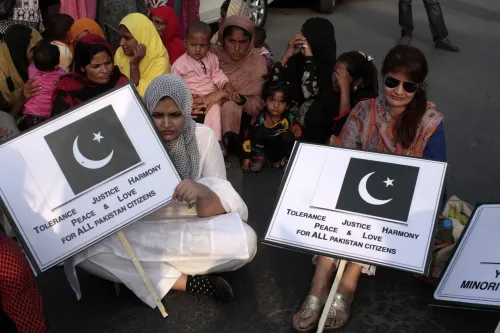
"However, despite the formidable nature of these networks, they are not the root of the crisis. At its core, irregular migration from Pakistan is driven by systemic human rights violations — including persecution, political instability, and the collapse of the rule of law. Pakistan’s Christian communities are enduring one of the darkest periods in recent history: attacks have increased by over 60 percent, more than 35 new blasphemy cases were filed in 2025, over 250 individuals remain imprisoned without due legal process, 26 churches and Christian neighborhoods have faced attacks, and there are documented incidents of torture, such as the arrest and abuse of a 49-year-old blind Christian detainee. Impunity exceeds 90 percent. Under such dire conditions, escape — even through criminal networks — becomes a matter of survival," Dimitra Staikou wrote.
"For the Hazara Shia community, the situation is even more dire. The year 2025 has been marked by bombings, targeted killings, and disappearances in Balochistan, where extremist organizations like Lashkar-e-Jhangvi and ISKP openly label Shiites as 'apostates.' Reports from UNHCR and Human Rights Watch document numerous disappearances, while families live in a climate of perpetual fear. Thousands of Hazaras are fleeing the country, relying on the same smuggling networks that transport migrants into Europe," she added.
Point of View
It’s essential to recognize the human rights violations driving this migration crisis. The interplay of economic despair, political instability, and an ineffective legal system in Pakistan necessitates a compassionate response from the international community.
NationPress
22 Sept 2026
Frequently Asked Questions
What factors are driving Pakistani migration to Europe?
The primary drivers include systemic human rights violations, political instability, and economic despair in Pakistan, compounded by the activities of transnational smuggling networks.
How significant is the role of smuggling networks in this crisis?
Smuggling networks play a crucial role by exploiting vulnerable populations in Pakistan, turning Europe into a lucrative endpoint for irregular migration.
What is the humanitarian situation for migrants from Pakistan?
Migrants face severe risks including persecution, violence, and exploitation, as well as harsh treatment during their journeys through smuggling networks.
How does the EU respond to this migration crisis?
The EU is currently grappling with the pressures on its borders and asylum systems, while also addressing humanitarian and criminal challenges linked to this migration.
What is the impact of the situation on Pakistan's communities?
Many communities, particularly religious minorities like Christians and Hazaras, face heightened risks of violence and persecution, leading to increased migration.