Why is BJP's ally Tipra Motha Party protesting in Agartala against remarks from Bangladesh leaders on Northeast India?
Synopsis
In a fervent demonstration, the Tipra Motha Party's youth wing protested against perceived anti-India comments from Bangladeshi leaders. The protest, led by Suraj Debbarma, highlights rising tensions and historical grievances between India and Bangladesh regarding the Northeast region.
Key Takeaways
The Tipra Motha Party protested against remarks from Bangladeshi leaders.
Suraj Debbarma emphasized India's historical contributions during the 1971 Liberation War.
The protest reflects rising tensions between India and Bangladesh over territorial claims.
The 'Seven Sisters' are crucial to India's northeastern identity.
Ongoing dialogue is essential for maintaining regional stability.
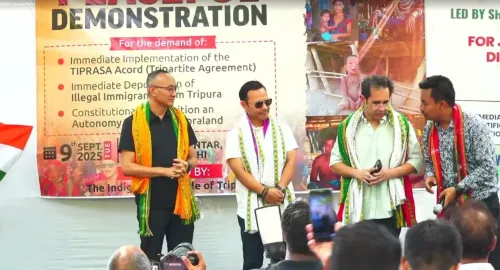
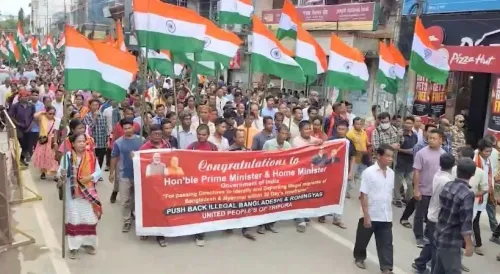
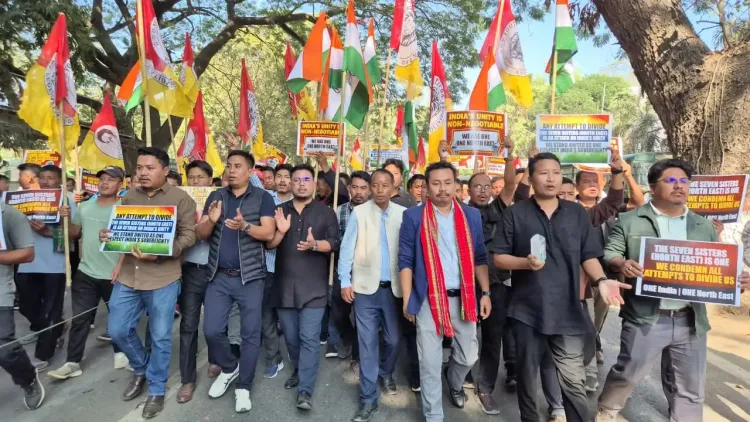
Agartala, Dec 19 (NationPress) The youth faction of the Tipra Motha Party (TMP), a partner in the BJP administration in Tripura, organized a significant protest outside the Bangladesh Assistant High Commission (AHC) in Agartala on Friday, denouncing recent statements made by officials from the neighboring nation who purportedly claimed ownership over India's Northeast region.
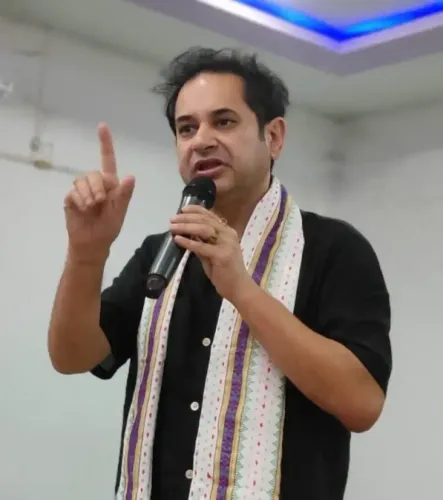
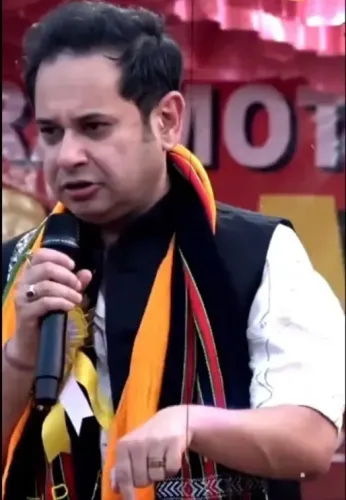
Numerous young individuals, including women, rallied under the leadership of Youth Tipra Federation (YTF) President Suraj Debbarma, assembling near the Bangladesh AHC, where they persisted in their demonstration for several hours starting from Friday morning.
The demonstrators shouted slogans condemning National Citizen Party (NCP) leader Hasnat Abdullah and Muhammad Yunus, the Chief Adviser of Bangladesh's interim government, accusing them of making anti-India remarks and fostering sentiments against India.
Speaking to the press, YTF President Debbarma noted that in recent days, protests had erupted in front of the Indian High Commission in Dhaka and various locations in Bangladesh, where participants were allegedly chanting slogans against India.
Earlier this week, NCP leader Hasnat Abdullah reportedly stated intentions to seize India's 'Seven Sisters' and the Siliguri Corridor, incorporating the region into their territory.
The Siliguri Corridor, commonly known as the 'Chicken's Neck', serves as a vital link connecting Northeast India with the rest of the nation through West Bengal.
The seven northeastern states—Arunachal Pradesh, Assam, Manipur, Meghalaya, Mizoram, Nagaland, and Tripura—are together termed the 'Seven Sisters'.
Debbarma stated that certain Bangladeshi leaders seem to have disregarded India's contributions and the sacrifices made by the Indian Army during the 1971 Liberation War, which led to the formation of Bangladesh as an independent nation.
He questioned, "Given India's extensive support during the 1971 conflict and subsequent years, why are Bangladeshi leaders now painting India as an adversary?"
He also cautioned that if Bangladeshi leaders persist in what he termed as futile claims regarding India's Northeast, TMP supporters might also bring historical matters into discourse, including claims on regions like Cox's Bazar, while noting that many minorities reside in the Chittagong Hill Tracts (CHT) of southeastern Bangladesh.
"It is well-known that TMP has been advocating for Greater Tipraland, and it is also widely recognized how Bangladesh has profited from India over the last fifty years," Debbarma remarked, adding that the party will not remain quiet if anti-India actions and false assertions about the Northeast persist.
Additionally, another senior TMP figure highlighted that the former Chakla Roshnabad was a zamindari of the historical princely state of Tripura, which once encompassed lands that are now part of Bangladesh's Noakhali and Sylhet districts.
In a related statement, NCP leader Hasnat Abdullah earlier this week allegedly threatened to isolate the Northeast's 'Seven Sisters' and provide refuge to separatist factions if India attempted to destabilize Bangladesh.
Point of View
It is vital to recognize the complexities surrounding the Tipra Motha Party's protest. The sentiments expressed reflect longstanding historical issues and highlight the need for diplomatic dialogue between India and Bangladesh. While the voices of the youth are crucial, a balanced approach is required to address grievances while fostering stronger ties in the region.
NationPress
30 Sept 2026
Frequently Asked Questions
What sparked the protest by the Tipra Motha Party?
The protest was ignited by remarks from Bangladeshi leaders who allegedly claimed ownership over India's Northeast region.
Who led the protest in Agartala?
The protest was led by Suraj Debbarma, President of the Youth Tipra Federation.
What are the 'Seven Sisters'?
The 'Seven Sisters' refer to the seven northeastern states of India: Arunachal Pradesh, Assam, Manipur, Meghalaya, Mizoram, Nagaland, and Tripura.
What historical context is relevant to this protest?
The protest is rooted in historical contributions made by India during the 1971 Liberation War, which led to the formation of Bangladesh.
What is the stance of the Tipra Motha Party regarding the claims made by Bangladeshi leaders?
The Tipra Motha Party opposes the claims and warns that their supporters might raise historical issues if these claims continue.