Trump Calls UK's New PM Andy Burnham, Pledges US Support
Synopsis
President Donald Trump publicly announced a warm first call with new UK Prime Minister Andy Burnham on 21 July 2026, pledging American support and signalling continuity in the US-UK 'special relationship' as the new British government settles in.
Key Takeaways
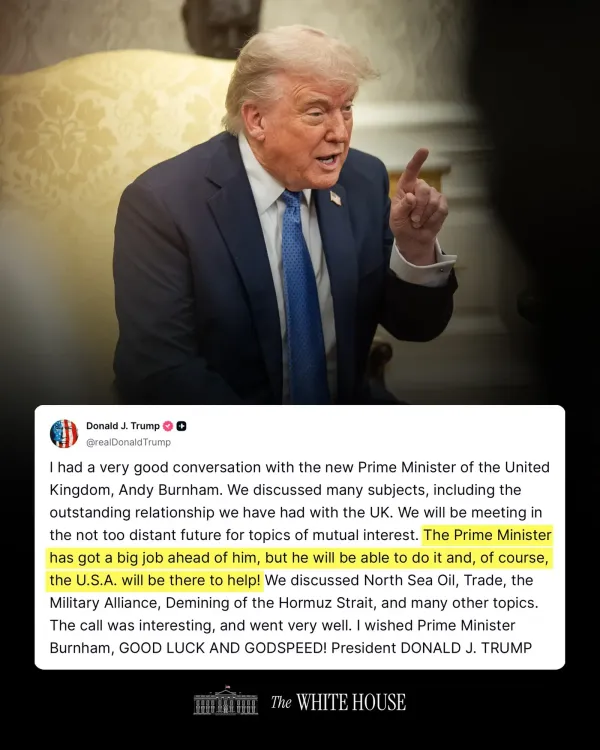
Trump spoke with new UK Prime Minister Andy Burnham and described the conversation as 'very good.' The White House posted Trump's remarks on 21 July 2026 , making it the first publicly confirmed contact between the two leaders.
Trump said the US 'will be there to help' Burnham's government, consistent with the longstanding US-UK 'special relationship.' The call follows a pattern of US Presidents reaching out to newly installed UK Prime Ministers to signal bilateral continuity.
Post-Brexit trade talks and NATO burden-sharing are expected to feature prominently on any future joint agenda.
An in-person meeting at the next G7 summit or a dedicated bilateral visit is now widely anticipated.
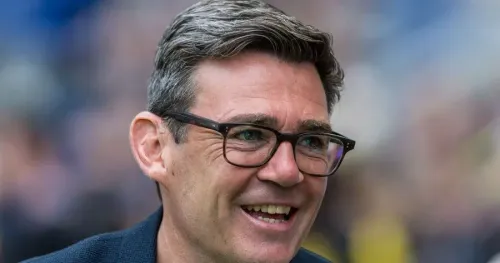
President Donald J. Trump on Tuesday, 21 July 2026 announced he had spoken with Andy Burnham, the new Prime Minister of the United Kingdom, describing the conversation as 'very good' and pledging full American support for the incoming leader. The White House shared the President's remarks on X, marking the first publicly confirmed contact between the two leaders.
Context
In his statement, President Trump said: 'I had a very good conversation with the new Prime Minister of the United Kingdom, Andy Burnham... The Prime Minister has got a big job ahead of him, but he will be able to do it and, of course, the U.S.A. will be there to help!' The remarks follow Andy Burnham's ascent to the office of Prime Minister, a significant shift in British political leadership.
It is customary for sitting US Presidents to reach out promptly to newly installed UK Prime Ministers, a practice that underscores the durability of the bilateral bond often referred to as the 'special relationship.' Trump followed this tradition during his first term as well, engaging directly with Theresa May and Boris Johnson shortly after each took office.
Policy Backdrop
The US-UK relationship rests on overlapping pillars: NATO defence commitments, the Five Eyes intelligence-sharing arrangement, and an evolving post-Brexit trade framework. Since the UK exited the European Union, successive British governments have prioritised securing a comprehensive bilateral trade deal with Washington, a goal that has remained elusive but consistently on the agenda.
During Trump's first term between 2017 and 2020, the two governments held multiple rounds of trade talks, with both sides expressing intent to finalise a deal. Those negotiations stalled but were never formally abandoned, leaving a ready-made agenda for any new UK administration to pick up.
Stakeholders and Impact
For Prime Minister Andy Burnham, an early and publicly warm exchange with President Trump carries immediate diplomatic value, signalling that Washington is prepared to engage constructively with the new government in London. The statement's tone — personal, encouraging, and unambiguous in its offer of support — is consistent with how Trump has historically framed bilateral endorsements.
Broader US allies within NATO will also read the statement as an indicator of Washington's continued commitment to the Atlantic alliance under the current administration. Markets and trade negotiators on both sides of the Atlantic are likely to watch for any follow-up signals on post-Brexit market access discussions.
What's Next
Diplomatic observers will now look for the scheduling of a formal in-person meeting, potentially on the sidelines of the next G7 summit or through a dedicated bilateral visit to either Washington DC or London. Trade talks on post-Brexit market access are the most substantive item likely to feature on any joint agenda.
The public nature of Trump's statement — posted directly by The White House — suggests an intent to set a cooperative tone early, though the specifics of any policy deliverables will depend on negotiations that are yet to begin in earnest.
Point of View
Designed to frame the new UK government as a partner rather than an unknown quantity. By posting the remarks directly on The White House's official channel, the administration is also speaking past London to reassure NATO allies and domestic audiences that the Atlantic alliance remains intact. The personal, almost paternal tone — 'he will be able to do it' — is a trademark Trump formulation that simultaneously elevates the new leader and positions Washington as the senior partner. The real test will come when the two governments sit down over trade terms and defence spending targets.
NationPress
20 Oct 2026
Frequently Asked Questions
Who is Andy Burnham and why is he UK Prime Minister?
Andy Burnham is the new Prime Minister of the United Kingdom. He previously served as Mayor of Greater Manchester before rising to lead the British government, though the precise circumstances of his becoming Prime Minister in 2026 are still emerging.
What did Trump say about Andy Burnham?
President Trump said he had a 'very good conversation' with Burnham, praised the Prime Minister's ability to handle a 'big job,' and pledged that 'the U.S.A. will be there to help.'
What is the US-UK special relationship?
The 'special relationship' refers to the exceptionally close political, diplomatic, intelligence, and military ties between the United States and the United Kingdom , underpinned by shared language, democratic values, NATO membership, and the Five Eyes intelligence alliance.
Will Trump and Andy Burnham meet in person?
No formal in-person meeting has been announced yet. Diplomatic observers expect the two leaders to meet on the sidelines of the next G7 summit or through a dedicated bilateral visit to Washington DC or London.
What is the status of the US-UK trade deal?
A comprehensive bilateral trade deal has been a long-standing goal for both countries since Brexit, but negotiations have not been finalised. The new Burnham government is expected to revive those talks, with post-Brexit market access as the central issue.