Trump Calls on U.S. AI Firms to Self-Fund Data Center Energy
Synopsis
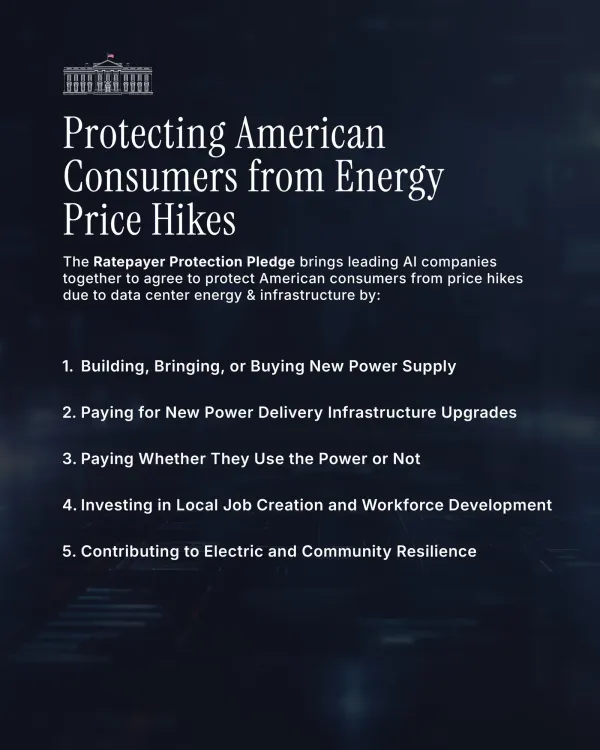
President Trump has directed leading U.S. AI companies to independently build, procure, or buy all energy needed for their data centres, while protecting American consumers from electricity price hikes driven by the AI industry's surging power demand.
Key Takeaways
Trump has called on leading U.S.
AI companies to self-fund all energy for data centre construction and operation.
The directive uses a three-part formulation: companies must 'build, bring, or buy' their required energy supply.
American consumers are explicitly to be protected from electricity price increases caused by AI industry power demand.
Major firms such as OpenAI , Google , Microsoft , and Amazon are among the companies most directly affected.
The policy continues a U.S. tradition of assigning infrastructure costs to the private sector rather than utilities or taxpayers.
Follow-on executive orders and Federal Energy Regulatory Commission activity will determine how the directive is enforced.
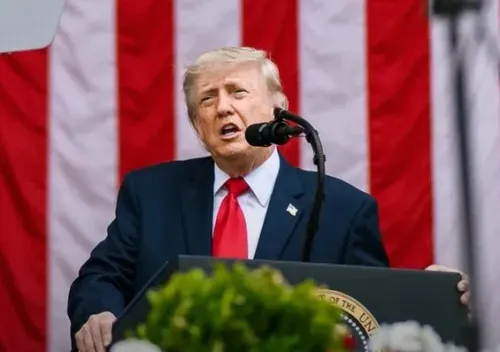
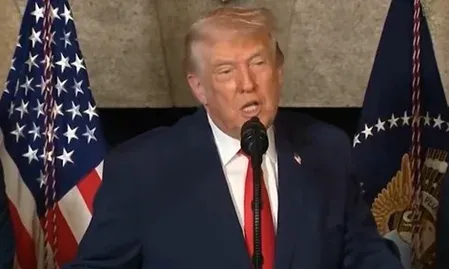
The White House announced on Saturday, July 11, 2026, that President Donald J. Trump is directing the leading U.S. artificial intelligence companies to independently build, procure, or purchase all energy required for constructing and operating their data centres, with an explicit mandate to shield American consumers from resulting electricity price increases.
Context
The White House statement says President Trump is calling on major AI developers to 'build, bring, or buy all of the energy needed for building and operating data centers' — a formulation that encompasses on-site generation, direct power purchase agreements, and wholesale energy acquisition. The directive is paired with a consumer-protection condition, signalling that the administration does not want the grid costs of AI expansion passed on to residential ratepayers.
The companies most directly implicated include firms such as OpenAI, Google, Microsoft, and Amazon, which operate or are constructing hyperscale data centres whose electricity appetite has grown sharply alongside the scale of frontier AI models.
Policy Backdrop
The announcement fits within a longer federal pattern of pairing technology-leadership ambitions with private-sector responsibility for supporting infrastructure. The National AI Initiative Act of 2020 established a federal framework for coordinating AI research and infrastructure investment, while the CHIPS and Science Act of 2022 authorised substantial support for domestic semiconductor and advanced computing facilities.
During his first term (2017–2021), President Trump pursued aggressive deregulation and domestic energy production under an 'America First' energy agenda. The current directive extends that philosophy by requiring AI companies — rather than utilities or taxpayers — to internalise the new energy loads they create.
Globally, the explosive growth of generative AI has pushed data-centre power demand projections far beyond earlier forecasts, forcing governments across Europe, Asia, and North America to confront grid capacity and cost-allocation questions. The United States is now formally taking a position: the industry must solve its own energy problem.
Stakeholders and Impact
U.S. AI companies will face the most immediate operational and financial implications. Self-supplying energy at data-centre scale typically requires long-term power purchase agreements, on-site generation assets such as gas turbines or small modular reactors, or direct acquisition of generation capacity — all capital-intensive options that could reshape corporate balance sheets.
American electricity consumers stand to benefit if the policy is enforced, since large industrial loads connecting to shared grids have historically contributed to transmission and distribution cost increases for all ratepayers. Electric utilities and grid operators will need to adapt interconnection and rate structures to accommodate the self-supply model the administration is promoting.
For India and other nations watching U.S. AI policy, the directive signals that Washington intends to keep AI infrastructure build-out domestic and privately financed, which could influence how global technology firms structure their international data-centre investments going forward.
What's Next
Analysts and industry observers will be watching for follow-on executive orders, filings before the Federal Energy Regulatory Commission, and any legislative provisions in upcoming energy or appropriations bills that formally codify self-supply requirements for large electricity loads. The administration's ability to enforce the consumer-protection component will depend heavily on how existing utility rate-setting authority at the state level interacts with any federal directive.
The coming weeks are likely to see responses from major AI firms, energy regulators, and congressional committees as the precise scope and enforcement mechanism of the president's call becomes clearer.
Point of View
The White House is effectively using market discipline as a regulatory tool — a hallmark of Republican energy philosophy. The consumer-protection rider adds political insulation, allowing the administration to champion both AI leadership and household affordability simultaneously. Whether the policy has teeth will depend entirely on the enforcement mechanisms that follow, and the absence of a formal executive order or legislative vehicle means the directive currently carries more signalling weight than binding authority.
NationPress
12 Jul 2026
Frequently Asked Questions
What did Trump say about AI companies and energy?
President Trump called on leading U.S. AI companies to build, bring, or buy all the energy needed for their data centres, ensuring that American consumers are not hit with higher electricity bills as a result.
Why do AI data centres need so much energy?
Training and running large AI models requires enormous amounts of computing power housed in data centres. As AI models have grown in scale, their electricity consumption has increased sharply, putting new pressure on national and regional power grids.
Which AI companies are affected by Trump's energy directive?
The White House statement targets leading U.S. AI companies broadly. Firms such as OpenAI , Google , Microsoft , and Amazon — which operate the largest data-centre footprints — are among those most directly implicated.
How does this protect American electricity consumers?
By requiring AI companies to self-supply their energy rather than draw from the shared grid without bearing the full cost, the policy aims to prevent the large new industrial loads from pushing up transmission and distribution charges for residential users.
Will there be a formal law or executive order on AI energy self-supply?
As of the White House announcement on July 11, 2026 , no formal executive order or legislation has been confirmed. Observers are watching for follow-on regulatory filings and congressional action that would give the directive binding legal force.