How Did Trump Defend Tariffs and Propose $2,000 Dividends?
Synopsis
In a recent press conference, President Trump defended his tariff policies, asserting they significantly reduced trade deficits and hinted at possible $2,000 dividend checks for Americans. His remarks emphasize the strength of the US economy and the importance of tariffs in national security and job creation. Discover the implications of his statements on international trade.
Key Takeaways
Tariffs have reportedly reduced US trade deficits.
Trump proposed potential $2,000 dividends for Americans.
He dismissed inflation concerns related to tariffs.
Manufacturing jobs are linked to tariff policies.
Legal challenges may impact Trump's tariff authority.
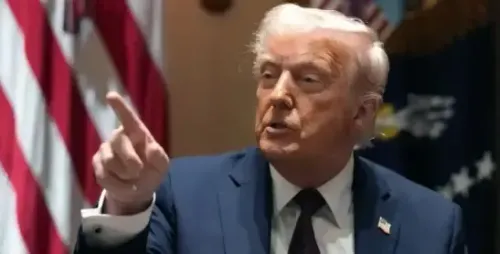
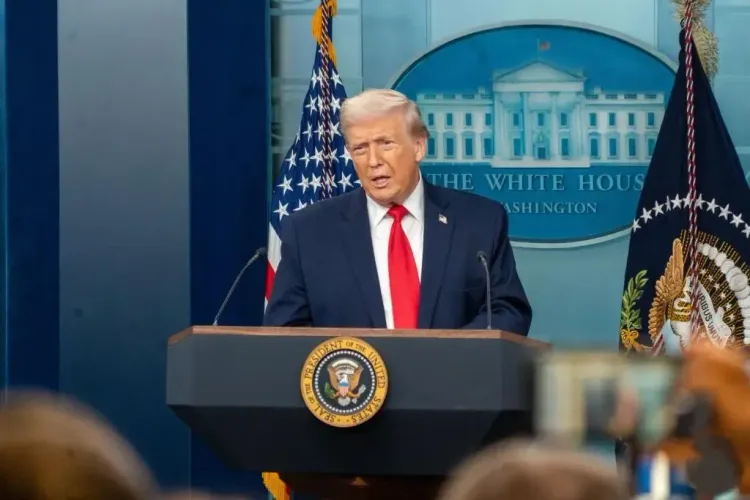
Washington, Jan 21 (NationPress) President Donald Trump on Tuesday defended his tariff strategy, arguing that it has played a crucial role in reducing the US trade deficits and could potentially finance direct payments to citizens.
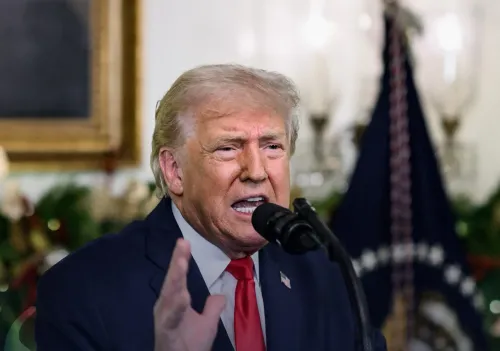
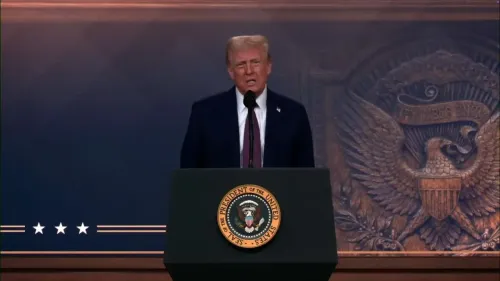
During a news conference at the White House, commemorating one year since his return to office, Trump stated that tariffs have been a significant factor in the robust performance of the US economy. “It’s due to tariffs and their effective implementation,” he declared.
Trump asserted that trade deficits have decreased significantly. “We have experienced a 62 percent reduction in our trade deficit,” he noted. He later mentioned that the deficit had been reduced by “77 percent in just one year.” He dismissed claims that tariffs lead to inflation. “Many warned that tariffs would trigger inflation,” he remarked. “Yet, we are experiencing very minimal inflation.”
The president indicated that tariffs have encouraged companies to establish manufacturing facilities in the United States. He said businesses are opting for domestic production to avoid import taxes. “Factories are being erected across the nation,” Trump stated. He also referenced what he termed “$18 trillion in commitments for new investments.”
Trump proposed the idea of returning funds to the public through tariff revenues. When asked about $2,000 rebate checks, he indicated that it is a possibility. “We could issue at least a $2,000 dividend,” he said. Trump expressed confidence that Congress might not be required for this initiative. “I don’t believe we would need to pursue the Congressional route,” he remarked.
He noted that any payments would likely be subject to income restrictions. Trump also stated that tariff revenues could assist in alleviating government debt. “We are receiving substantial revenue from tariffs,” he affirmed.
Trump acknowledged a legal challenge regarding his tariff authority currently before the US Supreme Court. He mentioned that a negative ruling could complicate matters. Nonetheless, he defended tariffs as essential for both security and revenue, stating, “Tariffs contribute significantly to our national security.”
The president also mentioned new global trade agreements, including one between the European Union and South American nations. He asserted that the US is no longer being “taken advantage of” in trade.
Trump reiterated the connection between tariffs and manufacturing jobs, cautioning that without them, foreign competitors would dominate critical sectors. “Without tariffs, we wouldn’t have any car dealerships,” he warned.
For India and other exporting nations, Trump's remarks indicate that US trade policy will continue to be stringent. Tariffs and trade pressures are expected to remain central to Washington’s economic strategy throughout the remainder of the Trump Administration.
Point of View
I observe that President Trump's remarks on tariffs and their potential benefits reflect a strong economic stance, yet they also provoke debate regarding their long-term impact on trade relations and domestic industries. While his administration emphasizes the advantages of tariffs, the future implications for international partners, including India, are crucial to monitor closely.
NationPress
30 Sept 2026
Frequently Asked Questions
What are the main points of Trump's tariff defense?
Trump argues that tariffs have reduced US trade deficits and could finance direct payments to Americans, asserting a strong economy.
Could Americans receive $2,000 dividends?
Trump suggested that using tariff revenues, the government might issue $2,000 dividends to the public.
How does Trump justify tariffs against inflation?
He contends that contrary to predictions, tariffs have not led to significant inflation in the economy.
What impact do tariffs have on US manufacturing?
Trump claims that tariffs incentivize companies to build factories in the US, fostering domestic job growth.
What challenges does Trump face regarding tariff authority?
A legal challenge to his tariff authority is currently before the US Supreme Court, which could complicate future policy.