Trump White House Hosts Columbus Day Celebration
Synopsis
President Trump hosted a Columbus Day celebration at the White House on October 9, 2026, reaffirming federal recognition of the holiday and signalling a sharp cultural contrast with cities and states that observe Indigenous Peoples Day instead.
Key Takeaways
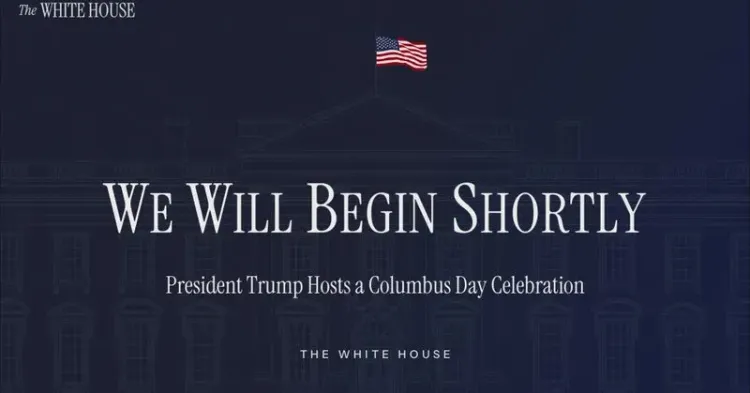
President Trump hosted a formal Columbus Day celebration at the White House on Friday, October 9, 2026 .
The event was broadcast live via an official White House stream, giving it broad public visibility.
Columbus Day, marking Christopher Columbus's 1492 arrival in the Americas, falls on the second Monday of October each year.
The celebration signals a continued break from the Biden-era dual proclamation that recognised both Columbus Day and Indigenous Peoples Day.
Italian-American communities, for whom the holiday carries deep historical significance, are a key constituency for the event's symbolism.
Dozens of U.S. cities and states have replaced Columbus Day with Indigenous Peoples Day, making a White House celebration an explicit cultural-political statement.
A federal holiday rooted in more than five centuries of contested memory got a moment of official pageantry on Friday, October 9, 2026, as President Donald Trump hosted a Columbus Day celebration at the White House — signalling, once again, the administration's deliberate embrace of the holiday that a growing number of U.S. states and cities have moved to replace or rename.
Columbus Day's Revival as a Political Statement
Columbus Day, observed on the second Monday of October, commemorates Christopher Columbus's arrival in the Americas on October 12, 1492. The Trump administration has consistently elevated the holiday as a point of cultural identity — a counterweight to the 'Indigenous Peoples Day' designation adopted by dozens of U.S. municipalities and states over the past decade.
By staging a formal White House celebration, the President sends a clear signal to Italian-American communities and conservative constituencies who view Columbus as a foundational symbol of Western civilisation's encounter with the New World — and who see efforts to downgrade the holiday as revisionism.
A Holiday in the Culture Wars
The tension around Columbus Day has sharpened considerably in recent years. Statues of Columbus have been removed in cities including Richmond, Virginia and Boston, Massachusetts, and several U.S. states — including South Dakota and New Mexico — officially observe Indigenous Peoples Day instead. The Biden administration in 2021 became the first to issue a presidential proclamation for Indigenous Peoples Day alongside Columbus Day, a dual recognition the Trump White House has not continued.
A presidential celebration at the White House, broadcast live and amplified on official channels, is thus as much a policy posture as a ceremonial gesture — drawing a sharp, visible line in one of American conservatism's most charged cultural debates.
Italian-American Community and the Day's Symbolic Weight
Columbus Day has long carried particular significance for Italian-Americans, whose advocacy in the late 19th century helped establish it as a national holiday — formally codified by President Franklin D. Roosevelt in 1937. For that community, the White House celebration is a moment of recognition, and the President's willingness to host it publicly is read as a deliberate political endorsement of their cultural heritage.
As the live broadcast rolled out from the White House, the event underscored that in Washington's current political climate, even a calendar date can carry the full weight of a governing philosophy.
Point of View
Publicly broadcast Columbus Day celebration is not merely ceremonial — it is a deliberate staking of cultural ground in one of America's sharpest ongoing identity debates. By restoring full federal enthusiasm for the holiday after years of competing proclamations, the White House is consolidating a coalition of Italian-American voters and cultural conservatives who see the holiday as under threat. The optics of a live White House broadcast amplify the message well beyond the Rose Garden, turning a calendar observance into a governing signal about whose history gets official celebration.
NationPress
9 Oct 2026
Frequently Asked Questions
What is Columbus Day and why is it controversial in the United States?
Columbus Day is a U.S. federal holiday observed on the second Monday of October, commemorating Christopher Columbus's arrival in the Americas on October 12, 1492. It is controversial because many Americans, particularly Indigenous communities, argue that Columbus's voyages led to the colonisation and displacement of Native peoples; dozens of cities and states now observe Indigenous Peoples Day on the same date instead.
Did Trump host a Columbus Day event at the White House in 2026?
Yes. On Friday, October 9, 2026, President Trump hosted a Columbus Day celebration at the White House, which was broadcast live on official channels.
What is the difference between Columbus Day and Indigenous Peoples Day?
Columbus Day is the long-standing federal holiday honouring Christopher Columbus, historically championed by Italian-American communities. Indigenous Peoples Day, adopted by many U.S. states and cities, recognises the history and cultures of Native American peoples and is observed as an alternative or alongside Columbus Day.
When did Columbus Day become a U.S. federal holiday?
Columbus Day was formally established as a federal holiday by President Franklin D. Roosevelt in 1937, following decades of advocacy by Italian-American communities.
Why does the Trump administration emphasise Columbus Day?
The Trump administration views Columbus Day as a symbol of Western civilisation and American heritage, and its promotion of the holiday serves as a cultural counterpoint to the growing movement to replace it with Indigenous Peoples Day — a stance that resonates with Italian-American voters and the conservative base.