White House Declares Columbus Day Is Back Under Trump
Synopsis
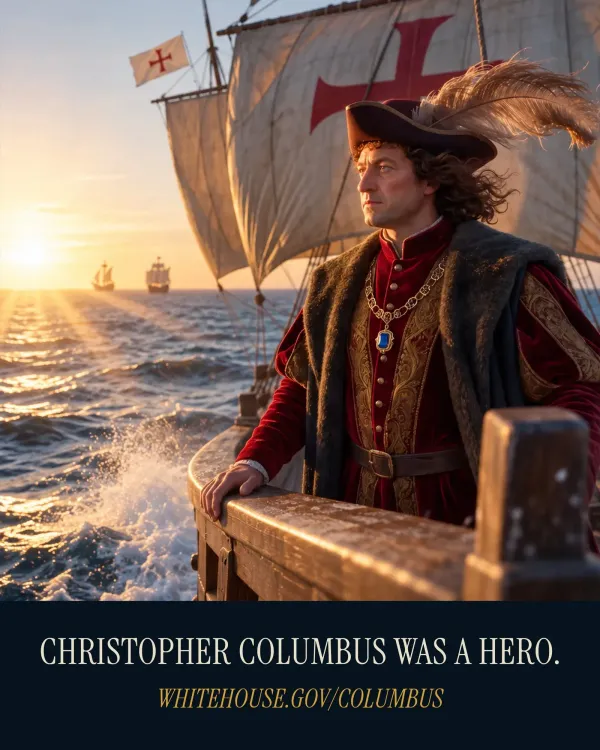
The White House marked Columbus Day on October 12, 2026 with a terse 'Sail On. Columbus Day is back' post, signalling the formal restoration of the contested federal holiday and a sharp departure from the Biden administration's dual recognition of Indigenous Peoples Day.
Key Takeaways
The White House posted 'Sail On.
Columbus Day is back' on October 12, 2026 , marking the federal holiday.
Columbus Day has been a U.S. federal holiday since 1937 , commemorating Columbus's arrival on October 12, 1492 .
The Biden administration in 2021 issued the first presidential proclamation recognising Indigenous Peoples Day alongside Columbus Day.
The current White House post implicitly rolls back that dual-recognition framing, reasserting Columbus Day's traditional identity.
The holiday sits at the intersection of Italian-American heritage politics and Indigenous rights advocacy — one of America's most persistent cultural flashpoints.
The two-word phrase 'Sail On' functions as both a historical allusion and a political signal that the administration considers the debate closed.
A two-word declaration — 'Sail On' — and a flag emoji. On Monday, October 12, 2026, the White House marked Columbus Day with a pointed post on X, signalling the federal holiday's formal restoration under the current administration after years of political contestation over its place in the American calendar.
Columbus Day vs. Indigenous Peoples Day: A Holiday at the Centre of America's Culture Wars
Few dates on the American calendar carry as much political freight as October 12. Columbus Day, a federal public holiday since 1937, commemorates Christopher Columbus's arrival in the Americas on October 12, 1492. For decades it was a mainstream celebration, particularly cherished by Italian-American communities who championed it as a marker of their heritage and contribution to American life.
The holiday became fiercely contested as a broader reckoning with colonial history accelerated. Critics argued that celebrating Columbus glossed over the violence, displacement, and forced labour that followed European contact with Indigenous peoples. Beginning in the 1990s, a growing number of U.S. cities and states began renaming the day Indigenous Peoples Day — a counter-observance that the Biden administration elevated in 2021 by issuing the first presidential proclamation recognising Indigenous Peoples Day alongside Columbus Day.
What the White House Post Actually Signals
The brevity of the post is itself the message. By declaring Columbus Day 'back,' the White House is drawing a clean, public contrast with that Biden-era framing — reasserting the federal holiday's traditional identity without qualification. The phrase 'Sail On' doubles as both a maritime nod to Columbus's voyage and a rhetorical instruction: the debate, from this administration's perspective, is settled.
For Italian-American advocacy groups and cultural conservatives who had lobbied for years to protect the holiday's name and character, the post lands as formal vindication. For Indigenous rights advocates, it signals a rollback of the symbolic recognition the previous administration had extended.
Why This Resonates Beyond the United States
The Columbus Day debate is a microcosm of a wider global argument — playing out from India to Ireland — about how nations publicly remember colonial histories. The U.S. administration's decision to plant its flag firmly on the traditional side of that argument is a cultural-policy signal that travels well beyond American shores, reinforcing an 'America First' identity politics that has become a defining feature of the current White House's domestic messaging.
A federal holiday restored, a culture-war line redrawn, and a voyage that changed the world invoked in just two words. The White House has made its position unmistakable — and the debate it reignites will outlast the day itself.
Point of View
The administration draws an explicit line against the Biden-era elevation of Indigenous Peoples Day and energises a base that views the holiday's traditional name as a matter of heritage and national identity. The choice of two words over a formal proclamation is itself strategic — it is a provocation dressed as a celebration. Globally, the signal feeds a broader pattern of Western conservative governments reasserting traditional national narratives against what they frame as revisionist history. For India-watchers, the episode is a reminder that how democracies manage contested historical memory is increasingly a front-line political battleground, not an academic footnote.
NationPress
12 Oct 2026
Frequently Asked Questions
Is Columbus Day a federal holiday in the United States?
Yes. Columbus Day has been a U.S. federal public holiday since 1937. It is observed on the second Monday of October each year, commemorating Christopher Columbus's arrival in the Americas on October 12, 1492.
What is the difference between Columbus Day and Indigenous Peoples Day?
Columbus Day is the traditional federal holiday celebrating Christopher Columbus's 1492 voyage. Indigenous Peoples Day is an alternative or complementary observance, adopted by many U.S. cities and states, that honours Native American peoples and histories. The Biden administration recognised both in 2021.
Why did the White House say Columbus Day is 'back'?
The phrase signals the current administration's stance that Columbus Day is being restored to its traditional, unqualified status as a federal holiday, in contrast to the Biden-era practice of recognising Indigenous Peoples Day alongside it.
Why is Columbus Day controversial in the United States?
Critics argue that celebrating Columbus overlooks the violence, displacement, and suffering inflicted on Indigenous peoples following European colonisation. Supporters, including many Italian-American groups, view it as a celebration of exploration, discovery, and Italian-American heritage.
When did the Biden administration start recognising Indigenous Peoples Day?
In 2021, the Biden administration issued the first-ever presidential proclamation recognising Indigenous Peoples Day on October 11, the day before Columbus Day, marking a significant symbolic shift in how the federal government framed the holiday period.