CM Himanta unveils world's biggest Semiconductor OSAT Facility in Assam

Synopsis
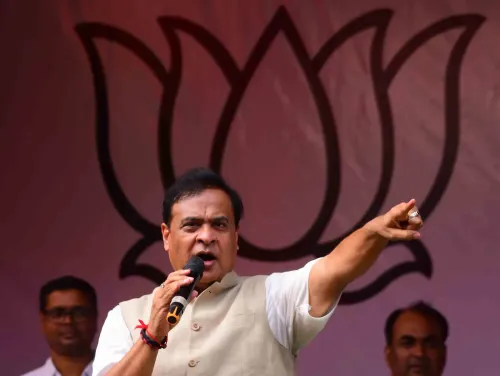
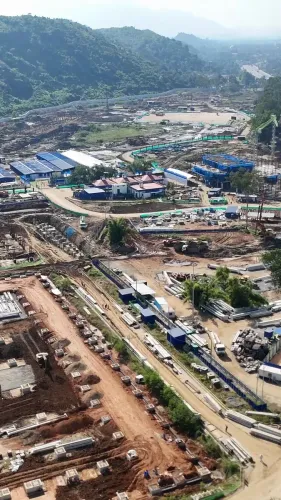
Assam CM Himanta Biswa Sarma has announced the world's largest Semiconductor OSAT facility in Assam is nearing operational readiness, positioning India as a major player in the global semiconductor packaging and testing ecosystem.
Key Takeaways
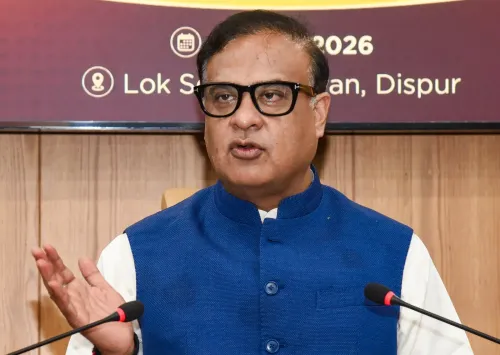
Assam CM Himanta Biswa Sarma announced on October 12, 2026 that the world's largest Semiconductor OSAT (Outsourced Semiconductor Assembly and Test) facility is located in Assam .
The facility is 'soon to be ready for operations,' indicating construction is in its final phase.
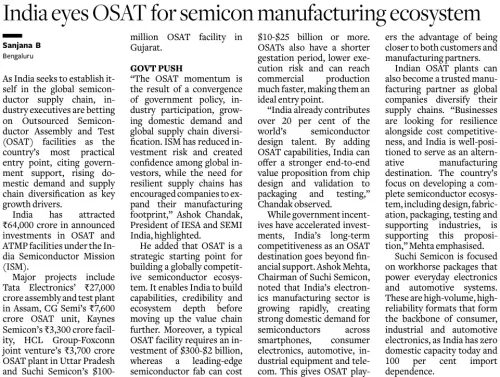
OSAT covers chip packaging and testing — the critical final stage before semiconductors reach device manufacturers worldwide.
The plant is expected to place India firmly in the global semiconductor supply chain, a gap exposed sharply during the global chip shortage of the early 2020s.
The facility's location in northeastern India adds strategic significance given the region's proximity to Southeast Asian manufacturing corridors.
The announcement represents a landmark industrial arrival for Assam, a state historically defined by tea, petroleum, and its border geography.
A landlocked northeastern state just staked its claim at the centre of the global chip economy. Assam Chief Minister Himanta Biswa Sarma on Monday, October 12, 2026, announced that the world's largest Semiconductor Outsourced Semiconductor Assembly and Test (OSAT) facility is located in Assam — and is nearly ready to begin operations.
What an OSAT facility means — and why 'world's biggest' matters
OSAT — Outsourced Semiconductor Assembly and Test — is the critical final stage of chip manufacturing: packaging raw silicon dies into finished semiconductors and rigorously testing them before they ship to device makers worldwide. It is the link between a fabricated wafer and a working chip inside your phone, your car, or your fighter jet. Controlling that link is serious geopolitical leverage.
For decades, OSAT capacity has been concentrated in Taiwan, South Korea, Malaysia, and China. India had virtually none at scale. A facility that claims the title of the world's single largest OSAT plant — sited not in a traditional industrial corridor but in northeastern India — represents a structural shift, not an incremental upgrade.
Assam's leap into the global semiconductor map
CM Sarma's post frames the announcement in explicitly global terms: 'place India firmly in the global semiconductor ecosystem.' That framing is deliberate. The semiconductor supply-chain crisis of the early 2020s exposed how dangerously concentrated chip production had become, and major economies from the United States to the European Union responded with aggressive domestic investment incentives. India launched its own India Semiconductor Mission to attract exactly this kind of investment — packaging and testing capacity that can anchor a broader domestic chip industry over time.
Assam, historically associated with tea, oil, and its strategic position bordering Bangladesh, Bhutan, Arunachal Pradesh, Nagaland, and Meghalaya, now adds semiconductor manufacturing to that identity. The facility's location in the northeast also carries quiet strategic weight: proximity to Southeast Asian supply chains and an emerging land-connectivity corridor through the region.
Operations 'soon' — what the timeline signals
The Chief Minister's choice of words — 'soon to be ready for operations' — signals that construction and fit-out are substantially complete and the facility is moving toward commissioning. That distinction matters: a fully operational OSAT plant at this scale would immediately generate thousands of high-skill technical jobs, anchor downstream component suppliers, and put Indian-packaged chips into global supply chains for the first time at volume.
For a state government that has aggressively courted industrial investment over recent years, this is the marquee arrival — the kind of anchor project that redefines a region's economic trajectory for a generation.
India's semiconductor ambitions have a flagship address now. It is in Assam.
Point of View
Who has staked significant political capital on transforming Assam's industrial profile, this facility is the most consequential proof point yet. If operations commence on schedule, it will pressure rival semiconductor nations and attract the downstream ecosystem — wafer suppliers, logistics players, talent pipelines — that defines whether a chip hub truly endures.
NationPress
12 Oct 2026
Frequently Asked Questions
What is an OSAT facility and why is it important for India?
OSAT stands for Outsourced Semiconductor Assembly and Test. It is the stage where fabricated silicon wafers are packaged into finished chips and tested before being shipped to device manufacturers. It is critically important for India because it represents an entry point into the global semiconductor supply chain that the country has historically lacked at any meaningful scale.
Where exactly in Assam is the semiconductor OSAT facility located?
Chief Minister Himanta Biswa Sarma's announcement confirms the facility is in Assam but does not specify the exact city or district in the post. Further operational details are expected closer to the facility's commissioning.
When will the Assam semiconductor OSAT facility start operations?
CM Himanta Biswa Sarma stated on October 12, 2026 that the facility is 'soon to be ready for operations,' indicating it is in its final pre-commissioning phase. An exact launch date has not been officially confirmed.
Is this the world's largest semiconductor OSAT facility?
CM Himanta Biswa Sarma described it as 'the world's biggest Semiconductor OSAT Facility.' Independent verification of that ranking was not available at the time of publication.
How does this facility relate to India's semiconductor mission?
India launched its India Semiconductor Mission to attract chip manufacturing and packaging investment and reduce reliance on foreign-dominated supply chains. An OSAT facility of this scale in Assam is precisely the kind of anchor investment the mission was designed to catalyse.