Trump Launches Ratepayer Protection Pledge to Shield Americans from AI Data Center Costs

Synopsis
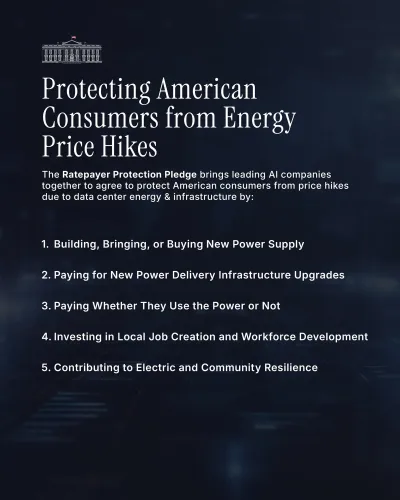
The White House announced that President Trump's Ratepayer Protection Pledge is designed to ensure that the U.S. push for AI supremacy does not result in higher utility costs for American households, as data center electricity demand surges nationwide.
Key Takeaways
The White House declared the U.S. is 'by far the leader in the global AI race' as of July 2026 .
President Trump introduced the Ratepayer Protection Pledge to prevent data center infrastructure costs from being passed on to American utility customers.
Data centers, which power AI systems, have been driving up electricity demand and raising concerns about higher consumer energy bills across several U.S. states.
The Trump administration's AI policy lineage dates to the 2019 American AI Initiative , which directed federal agencies to prioritise AI research and infrastructure.
State utility commissions and federal energy regulators are expected to be key arenas where the Pledge's practical enforcement is determined.
The policy has potential downstream relevance for Indian IT firms and global companies dependent on American data center infrastructure.
The White House announced on Thursday, July 24, 2026, that President Donald Trump is taking action to ensure that the rapid expansion of data center infrastructure underpinning the United States' artificial intelligence ambitions does not translate into higher utility bills for American households and communities.
Context
The White House stated that the U.S. is 'by far the leader in the global AI race' and introduced what it termed the Ratepayer Protection Pledge as the mechanism to decouple AI infrastructure growth from consumer energy costs. The post asserted that data center infrastructure price hikes 'DO NOT affect American consumers' — a direct signal that the administration views affordability as a non-negotiable condition of its technology expansion agenda.
Data centers are the physical backbone of AI systems, requiring enormous quantities of electricity to power servers and cooling systems. As AI investment has surged globally, utility grids in several U.S. states have faced pressure from power-hungry facilities, prompting concern among regulators and consumer advocates about cost pass-throughs to ordinary ratepayers.
Policy Backdrop
The Trump administration has consistently framed American technological supremacy as a national security and economic priority. As early as 2019, the administration issued an executive order establishing the American AI Initiative, directing federal agencies to prioritise AI research, infrastructure, and workforce development to maintain U.S. leadership over strategic competitors.
The Ratepayer Protection Pledge represents a newer layer in this policy architecture — one that attempts to address a domestic political vulnerability. Critics of rapid AI infrastructure buildout have pointed to rising electricity demand in states hosting major data center clusters, arguing that grid upgrades and new generation capacity ultimately burden residential and small-business customers through higher monthly bills.
By invoking the Pledge, the White House is signalling that federal policy will actively resist that cost-shifting dynamic, though the precise regulatory or legislative instruments remain to be detailed in subsequent filings or executive actions.
Stakeholders and Impact
American consumers and utility ratepayers are the stated beneficiaries of the Pledge. For households already navigating elevated living costs, any assurance that AI-driven infrastructure expansion will not inflate electricity bills carries direct pocketbook significance.
Data center operators — including major technology companies investing billions in AI compute capacity across the United States — may face heightened scrutiny over how they negotiate power agreements and whether their expansion plans trigger rate increases for neighbouring communities. State-level public utility commissions are likely to become a key arena where the Pledge's practical effect is tested.
From an Indian perspective, the announcement is notable because several Indian technology firms and global IT majors with large U.S. operations rely on American data center ecosystems. Any shift in U.S. energy policy affecting data center costs could have downstream implications for cloud pricing and outsourcing economics.
What's Next
Observers will watch for federal or state regulatory filings that give the Ratepayer Protection Pledge legal teeth — whether through Federal Energy Regulatory Commission guidance, state utility board directives, or legislation in Congress. The administration's ability to enforce such a pledge across a patchwork of state-regulated utility markets will be a critical test of its durability.
As global competition in AI intensifies — with significant investment activity in China, the European Union, and India — the White House appears determined to demonstrate that American AI leadership need not come at the expense of the very consumers whose tax dollars and energy grids underpin that ambition.
Point of View
The Trump administration is attempting to build a broader coalition of support for its technology agenda beyond the boardroom. The pledge also pre-empts Democratic and progressive criticism that deregulated AI infrastructure expansion externalises costs onto working households. Whether the Pledge carries enforceable mechanisms or remains aspirational will define its long-term policy significance.
NationPress
24 Jul 2026
Frequently Asked Questions
What is the Ratepayer Protection Pledge announced by the White House?
The Ratepayer Protection Pledge is an initiative announced by the Trump administration aimed at ensuring that the expansion of data center infrastructure to support artificial intelligence does not lead to higher electricity or utility bills for American consumers and communities.
Why are data centers causing concern over electricity costs in the US?
Data centers require vast amounts of electricity to run AI servers and cooling systems. As AI investment has surged, power demand from these facilities has placed pressure on utility grids in several U.S. states, raising fears that grid upgrade costs could be passed on to residential and small-business customers through higher monthly bills.
How does Trump's AI policy connect to energy affordability?
The Trump administration has consistently paired its push for U.S. AI leadership with measures intended to shield households from associated costs. The Ratepayer Protection Pledge is the latest example, building on the 2019 American AI Initiative that directed federal resources toward AI research and infrastructure.
Does this US AI data center policy affect India or Indian companies?
Indirectly, yes. Indian IT firms and global technology companies with large U.S. operations rely on American data center ecosystems. Any significant shift in U.S. energy or infrastructure policy affecting data center operating costs could influence cloud pricing and the economics of technology outsourcing for Indian businesses.
What happens next after the Ratepayer Protection Pledge announcement?
Analysts will watch for regulatory filings at the federal or state level that give the Pledge enforceable authority, including potential guidance from energy regulators or new legislation in Congress. State public utility commissions are expected to be a primary battleground for implementing the policy.