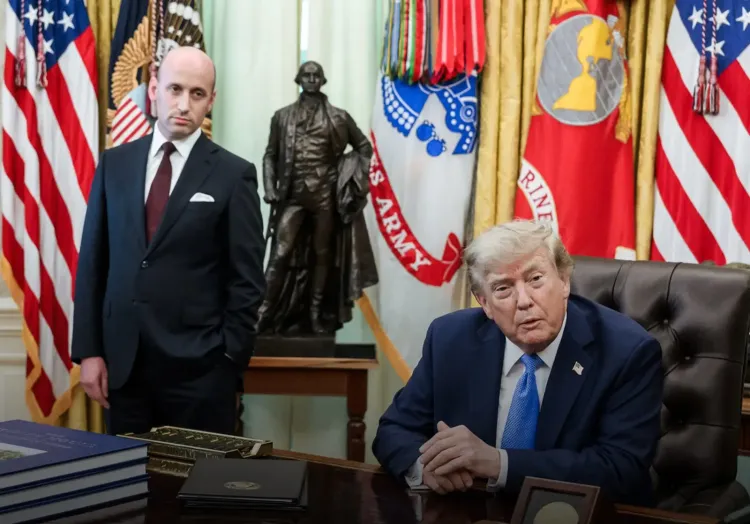
Trump names Stephen Miller White House chief of staff, replacing Susie Wiles
Synopsis
Donald Trump's elevation of Stephen Miller to White House chief of staff is more than a personnel reshuffle — it is a policy signal. Miller, the architect of the administration's toughest immigration measures, now controls the president's agenda and access, suggesting the second term's remaining years will be defined by an intensified domestic crackdown. Democrats have already promised oversight and subpoenas.
Key Takeaways
Donald Trump named Stephen Miller as White House chief of staff on 7 November 2026 , effective 9 November 2026 .
Miller becomes the 33rd chief of staff in US history, elevated from his role as deputy chief of staff overseeing domestic policy.
Susie Wiles , the first woman to serve as chief of staff, moves to the Trump Political Operation ; her new title was not specified.
Vice President JD Vance , Secretary of State Marco Rubio , and FBI Director Kash Patel all publicly endorsed the appointment.
Democratic Senator Alex Padilla pledged to use 'oversight, investigations, subpoenas, and leverage over federal funding' to challenge the administration.
US President Donald Trump on 7 November 2026 named Stephen Miller as the next White House chief of staff, elevating one of his most trusted advisers and a central architect of the administration's immigration agenda. Miller, who had been serving as deputy chief of staff overseeing domestic policy, will take over on Monday, 9 November 2026, replacing Susie Wiles, who becomes the first woman ever to have held the role.
What Trump Announced
Trump made the announcement on his Truth Social platform, confirming Miller's new role and praising Wiles's tenure. 'I am pleased to announce that Mr. Stephen Miller, the current Deputy Chief of Staff of the Trump Administration, and one of my most trusted advisors, will become the Chief of Staff starting Monday, November 9, 2026,' Trump wrote.
Wiles, Trump said, 'has done an outstanding job' and will move to the Trump Political Operation, though the president did not specify her new title or exact responsibilities. The White House separately confirmed Miller's appointment as the 33rd chief of staff in US history and released a wave of endorsements from Cabinet members, Republican lawmakers, and conservative allies.
Who Is Stephen Miller
Miller has been a fixture in Trump's inner circle across both administrations. As deputy chief of staff, he played a lead role in shaping domestic policy, particularly on immigration — overseeing measures that Democrats have linked to family separations, immigration enforcement raids, and arrest quotas. His promotion places him at the apex of the White House staff operation, giving him broader authority over the president's schedule, policy coordination, and access to senior advisers.
White House communications director Steven Cheung called Miller 'the biggest advocate for the Trump agenda,' adding: 'He will help the Administration deliver on monumental victories for the rest of this historic second term.'
Reactions From the Administration
Vice President JD Vance welcomed the appointment, calling Miller 'an amazing patriot' and thanking Wiles for her 'friendship and service.' Secretary of State Marco Rubio praised Wiles's leadership and said he looked forward to working with Miller to advance the president's agenda. FBI Director Kash Patel, who described Miller as a friend and colleague since the first Trump administration, said: 'I know his resolve and his commitment to this country, and I have no doubt he'll bring both to leading this team for President Trump.'
Democratic Opposition
The appointment drew immediate and sharp pushback from Democrats. Democratic Senator Alex Padilla of California said Trump was 'doubling down' on an aggressive immigration agenda. 'Trump is doubling down — so will we,' Padilla said. 'We will use every tool at our disposal — oversight, investigations, subpoenas, and our leverage over federal funding — to expose this Administration's abuse of power and hold those responsible accountable.'
Padilla accused Miller of being the driving force behind policies that have, according to him, spread fear in California neighbourhoods, schools, and workplaces. His statement outlined the tools Democrats intend to deploy but stopped short of announcing a specific investigation or subpoena.
What This Means Going Forward
Miller's elevation signals a consolidation of hardline domestic policy influence at the highest level of the White House. As chief of staff — a role that controls the president's information flow and shapes his daily agenda — Miller will be positioned to accelerate the immigration and domestic policy programme he helped build. Wiles's move to the political operation rather than an outright departure suggests the administration is positioning her ahead of the next electoral cycle. How Democrats translate their stated oversight tools into concrete action will be one of the defining political storylines of the months ahead.
Point of View
The courts, and the opposition exactly what the administration's remaining term will look like. The chief of staff role controls information flow to the president; placing the administration's most ideologically consistent figure there reduces the chance of internal friction on immigration or domestic policy. What mainstream coverage underweights is the structural consequence: Wiles was often described as a stabilising managerial force; Miller brings ideological intensity, not operational restraint. Democrats' promised oversight tools — subpoenas, funding leverage — are real but historically slow to produce results, meaning Miller is likely to have considerable runway before any check materialises.
NationPress
7 Nov 2026
Frequently Asked Questions
Why did Trump replace Susie Wiles with Stephen Miller as chief of staff?
Trump announced on Truth Social that Miller, already his deputy chief of staff, would become chief of staff from 9 November 2026, without detailing a specific reason for the change. Wiles was praised effusively and moved to Trump's political operation rather than being removed from the administration entirely.
Who is Stephen Miller and what is his role in Trump's administration?
Stephen Miller is a senior adviser who has served in both Trump administrations and is widely regarded as the chief architect of the administration's immigration and domestic policy agenda. As deputy chief of staff, he oversaw domestic policy before his elevation to the top staff role.
What will Susie Wiles do after leaving the chief of staff role?
Wiles will move to the Trump Political Operation, though Trump did not specify her new title or exact responsibilities in his announcement.
How have Democrats responded to Miller's appointment?
Democratic Senator Alex Padilla of California pledged to use 'oversight, investigations, subpoenas, and leverage over federal funding' to challenge the administration, accusing Miller of shaping policies involving family separations, immigration raids, and arrest quotas. His statement outlined intentions but did not announce a specific investigation.
What is the significance of the White House chief of staff role?
The chief of staff oversees White House staff, coordinates the president's policy work, schedule, and controls access to senior advisers — making it one of the most influential positions in any US administration. Miller is the 33rd person to hold the role.