Trump Pitches Single Government Portal to Replace Thousands of Sites
Synopsis
President Donald J. Trump has announced a plan to replace the sprawling network of tens of thousands of US federal government websites with a single unified portal, framing the move as ending the 'endless maze' citizens currently navigate to access government services.
Key Takeaways
President Trump announced a plan to consolidate tens of thousands of federal government websites into one unified citizen portal.
Trump described existing sites as an 'endless maze of terrible government websites,' promising 'one front door for every single question.' The 21st Century IDEA Act of 2018 previously mandated federal digital modernisation, but agency consolidation remained slow under successive administrations.
The GSA and OMB are the most likely institutional leads for any executive order or phased rollout.
Global precedents — including the UK's GOV.UK — show unified portals are achievable but depend heavily on agency migration discipline and timeline enforcement.
No specific launch date or executive order details have been confirmed; implementation timelines remain to be announced.
One door. That is the promise President Donald J. Trump is now putting at the centre of a sweeping federal digital overhaul — one that would collapse the sprawling, fragmented universe of tens of thousands of government websites into a single unified entry point for every American seeking a government service.
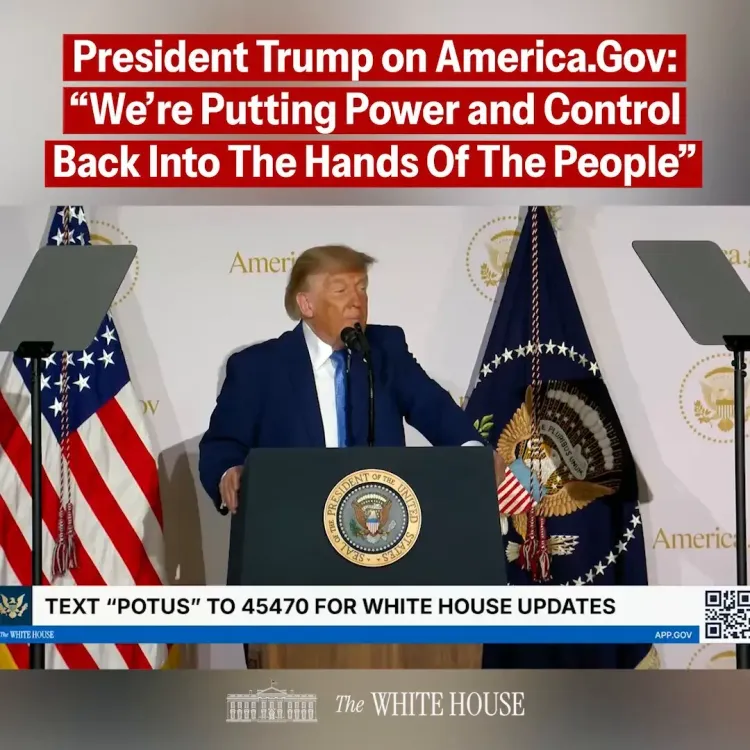
The White House shared the president's own framing on Tuesday, 29 September 2026, quoting Trump directly: 'Instead of forcing citizens to search through the endless maze of tens of thousands of terrible government websites... you'll now have one front door for every single question.' The language is blunt, the ambition is enormous, and the political bet is clear — that government inefficiency is a kitchen-table frustration, not just a bureaucratic footnote.
The Maze Americans Have Been Navigating for Decades
The problem Trump is describing is not new. The federal government has long operated a labyrinth of agency-specific websites — each with its own design, its own search logic, and its own dead ends. A veteran looking for benefits, a small business owner applying for a licence, a senior citizen tracking a Medicare query: each faced a different portal, often with no clear path between them.
Congress took a formal swing at this in 2018 with the 21st Century Integrated Digital Experience Act (IDEA Act), which required federal agencies to modernise their websites and improve digital services. Progress was incremental. The consolidation that the law envisioned moved slowly across successive administrations, with agencies guarding their digital turf and migration timelines slipping repeatedly.
A Single Front Door — What That Would Actually Mean
The concept of a unified federal portal is not without precedent globally. Several governments — notably the United Kingdom's GOV.UK — have demonstrated that consolidating thousands of agency pages under one domain dramatically improves citizen experience and reduces duplication costs. The question for the Trump administration is execution: which agency leads the rollout, what happens to existing agency URLs, and on what timeline do departments migrate.
The General Services Administration (GSA) and the Office of Management and Budget (OMB) are the institutional levers most likely to drive any such initiative. Whether the administration issues an executive order, OMB guidance, or a phased GSA-led rollout will determine how quickly — and how completely — the single-portal vision becomes operational reality.
Efficiency Politics and the Anti-Bureaucracy Playbook
Trump's framing — 'terrible government websites,' 'endless maze' — is deliberate. It slots neatly into the broader administrative efficiency drive that has defined his return to office, positioning government consolidation not as a technical IT project but as a direct service to ordinary citizens tired of bureaucratic friction. It is a message that polls well across party lines: few voters will argue in favour of confusing government websites.
The harder test comes in implementation. Federal IT modernisation projects have a long history of cost overruns, delayed timelines, and incomplete migrations. The ambition of 'one front door' will be judged not by the announcement, but by whether a citizen searching for a passport renewal or a tax form actually lands somewhere useful — fast.
The administration has set the expectation. The clock is now running.
Point of View
It could mark the most significant restructuring of federal digital infrastructure since the IDEA Act. If it stalls at the announcement stage, it joins a long list of promised government simplification drives that never fully landed.
NationPress
29 Sept 2026
Frequently Asked Questions
What is Trump's plan for government websites?
President Trump announced a plan to replace the current system of tens of thousands of separate federal agency websites with a single unified government portal, so citizens can find answers to any government question in one place.
How many US government websites exist currently?
The US federal government operates tens of thousands of websites across its agencies and departments, a fragmentation that has long been criticised for making it difficult for citizens to access services efficiently.
What is the 21st Century IDEA Act?
The 21st Century Integrated Digital Experience Act , passed in 2018 , required federal agencies to modernise their websites and improve digital services for citizens, though full consolidation remained incomplete across subsequent administrations.
Which US agency would run a unified government portal?
The General Services Administration (GSA) and the Office of Management and Budget (OMB) are the most likely agencies to lead the rollout and set agency migration timelines for any unified federal portal.
Has any country successfully consolidated all government websites into one portal?
Yes — the United Kingdom's GOV.UK is a widely cited example of a single government domain that consolidated thousands of agency pages, improving citizen experience and reducing duplication costs.