Is Trump Attempting to Disrupt the International Strategic Order?
Click to start listening
Synopsis
As President Trump marks the anniversary of his second term, he embarks on a controversial mission to reshape the international strategic framework. With NATO under threat and a nod to Russia, Trump's bold moves could redefine global alliances. This article explores the implications of his actions on NATO and the broader geopolitical landscape.
Key Takeaways
- Trump's ambition to alter international relations could reshape global alliances.
- The risk of NATO discord highlights internal challenges among member states.
- Public sentiment largely opposes the annexation of Greenland.
- Trump's tariffs could ignite economic tensions with Europe.
- The ongoing situation in Ukraine remains a critical concern amidst these developments.
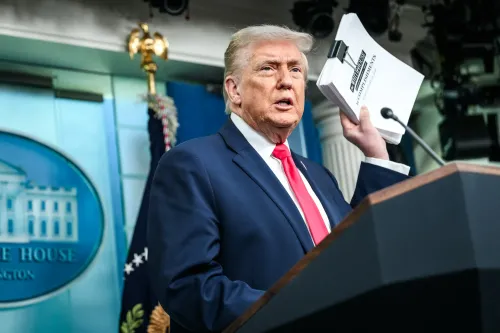
New York, Jan 20 (NationPress) On the anniversary of his inauguration for a second term, US President Donald Trump initiated a campaign to disrupt the existing international strategic framework, potentially straining the NATO alliance that has been essential to Western security for 76 years, while simultaneously extending a conciliatory hand to Russia.
In an early morning post on Truth Social, he proclaimed, "The United States of America is the most powerful Country anywhere on the Globe, by far," reaffirming his ambitious agenda as he pushed its boundaries, reiterating claims over Greenland and subtly suggesting a revival of interests in Canada.
France’s President Emmanuel Macron accused Trump of attempting to "weaken and subordinate" Europe, warning of a potential severe response from the European Union against the US, despite it sounding "crazy." He expressed regret, stating, "I do regret that, but this is a consequence of just unpredictability and useless aggressivity."
Macron referred to the notorious “Bazooka Option”, which could entail imposing substantial tariffs and various economic and political sanctions on nations that coercively influence EU members.
Such actions could jeopardize the Trans-Atlantic alliance, which is primarily anchored by NATO.
In a significant challenge to NATO, Trump invited Russia’s President Vladimir Putin to join his Peace Council.
As tensions within NATO escalated, Trump was scheduled to travel to Davos for the World Economic Forum, where he would confront some leaders regarding the ongoing dispute over Greenland.
"I agreed to a meeting of the various parties in Davos, Switzerland," he stated on TruthSocial, asserting, "Greenland is imperative for National and World Security. There can be no going back."
To emphasize his point, he shared an image of himself placing the US flag on Greenland.
In another image, he was seen in the Oval Office with a map highlighting Greenland, Venezuela, and a reminder of his previous threats regarding Canada, as part of an expanded US territory.
Domestic opposition to the annexation of Greenland is notably strong: a CBS News poll indicated that 86 percent of Americans are against a military takeover, and 70 percent are in disagreement with Trump's stance.
Trump threatened France with a 200 percent tariff on its wine and Champagne after reports surfaced that Macron was contemplating a boycott of the Peace Council due to Russia's expected participation.
This was in addition to the 10 percent tariffs he announced on France and seven other nations that opposed his Greenland acquisition plan, which could escalate to 25 percent by June.
Trump proposed the Peace Council as part of a plan to resolve the conflict in Gaza and has expanded its scope to address broader global issues, suggesting a $1 billion permanent membership as an alternative to the United Nations.
In a series of TruthSocial posts, he presented a friendly attitude towards Mark Rutte, NATO's secretary-general, who represents 30 European nations, along with the US and Canada.
Trump described their conversation as "good" and displayed a message from Rutte expressing commitment to finding a resolution regarding Greenland.
Earlier, Trump had humorously shared a screenshot of Macron proposing a G7 meeting in Paris after Davos, involving Denmark, Syria, Ukraine, and Russia on the sidelines.
In that communication, Macron also suggested, "Let us try to build great things," mentioning potential collaborations in Iran and Syria.
Additionally, Trump challenged Britain’s Prime Minister Keir Starmer over Diego Garcia, an island whose sovereignty Britain returned to Mauritius, yet signed a lease for US and British bases on it.
He also revealed to Norway’s Prime Minister Jonas Gahr Store that not receiving the Nobel Peace Prize led him to abandon hopes for peace.
In the backdrop of the Greenland dispute lies the ongoing situation in Ukraine.
Trump, who campaigned in 2024 on the promise to conclude the Ukraine War within 24 hours of taking office, finds himself at a standstill even a year later, alternating support between Kyiv and Moscow, including a summit with Putin.
Recently, Ukraine and Western European nations proposed a plan designed to address Russia's concerns, portraying it as a viable solution to the conflict, despite Moscow's hardline stance.
Trump may have had the opportunity to collaborate with Moscow to broker peace.
However, the Greenland controversy has cast doubt on potential agreements regarding Ukraine and empowered Russia amidst a disordered NATO.
Domestically, resistance to Greenland annexation persists, while pressing matters such as inflation and divisions on the management of illegal migrants dominate discussions in a year marked by pivotal mid-term elections that could influence Congressional control.
Trump’s unfavorable rating stands at 53.6 percent according to a RealClear Politics aggregation, revealing a 10.4 percent gap.
A possible strategy for Trump could involve framing the Greenland acquisition as a completed act during the year the US observes the 250th anniversary of its Independence, aiming to evoke a surge of patriotism.
Point of View
My perspective emphasizes the need for a balanced understanding of Trump's actions. While his approach may seem aggressive, it reflects a broader intent to redefine alliances and international norms. It is crucial for the nation to engage in constructive dialogue to navigate these complex dynamics effectively.
NationPress
21/01/2026
Frequently Asked Questions
What are Trump's current foreign policy objectives?
Trump aims to reshape international relations, emphasizing U.S. dominance and exploring potential alliances with nations like Russia.
How is NATO responding to Trump's actions?
NATO faces internal dilemmas as member countries assess their positions regarding Trump's proposals, particularly concerning Greenland.
What is the public opinion on Trump's Greenland plans?
Polls indicate significant domestic opposition, with a majority of Americans against military action for Greenland.
What are the implications of Trump's tariffs on France?
Trump's tariffs could escalate tensions and disrupt trade relations, prompting the EU to consider severe countermeasures.
How might this affect U.S. relations with Europe?
Trump's approach risks straining transatlantic ties, leading to potential consequences for security and economic cooperation.