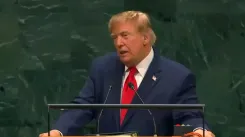
Trump announces two US military bases in Greenland at UN General Assembly
Synopsis
Speaking at the UN General Assembly on 22 September, Donald Trump revealed a formal agreement with Denmark granting the US permanent security control over Greenland — and announced construction of two major military bases on the island. The move dramatically reshapes Arctic geopolitics and closes the loop on Trump's long-running bid to secure American dominance over one of the world's most strategically sensitive territories.
Key Takeaways
President Donald Trump announced two major US military bases in Greenland at the UN General Assembly on 22 September 2026 .
A formal agreement with the Kingdom of Denmark grants Washington permanent control over security on Greenland.
US-designated adversaries will be barred from establishing military presence or making sensitive investments in Greenland without US written approval .
Trump linked the deal to NATO 's broader defence posture and praised Secretary-General Mark Rutte .
The agreement was expected to be signed later on 22 September .
The Arctic has become a flashpoint for strategic competition among the US , Russia , and China over shipping routes and critical minerals.
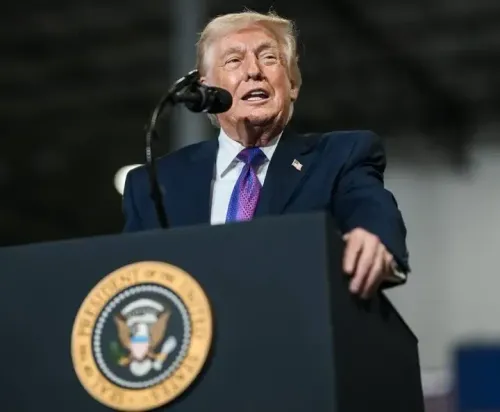
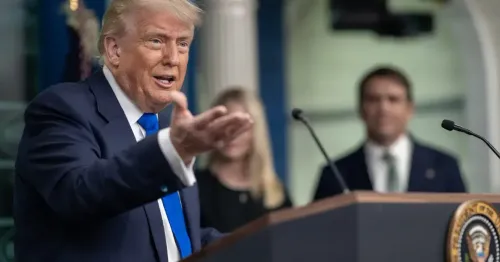
US President Donald Trump announced on Tuesday, 22 September 2026, that the United States would build two major military bases in Greenland under a landmark agreement with Denmark — one that he said grants Washington permanent control over security on the strategically vital Arctic island. The announcement came during Trump's address to the UN General Assembly in New York, marking one of the most consequential geopolitical moves in recent Arctic history.
What the Agreement Covers
Trump described the deal — struck with the Kingdom of Denmark and the government of Greenland — as unprecedented in scope. Under its terms, the United States would hold broad authority over security and, in his words, 'all other needs' on the territory. He confirmed the agreement was expected to be signed later the same day.
'This agreement, made with the Kingdom of Denmark, an incredible, beautiful country. And the Greenland people itself gives the United States permanent control over security and all other needs on that territory,' Trump said in his UN address.
Military Build-Up and Adversary Restrictions
Trump said Washington would 'immediately begin the process' of expanding its military footprint across Greenland, with construction of two very major military bases at what he termed 'appropriate locations.' He also announced that US-designated adversaries would be barred from establishing any military presence on the island and prohibited from making sensitive investments without prior written US approval.
'No US adversary will ever be permitted to establish a military presence in Greenland anymore or make sensitive investments there without our express written approval,' he said. Trump did not name the specific countries covered by this restriction, though Washington has repeatedly flagged growing strategic competition in the Arctic — particularly involving Russia and China.
Strategic and NATO Dimensions
Trump framed the agreement as a cornerstone of broader transatlantic security, arguing that an expanded American presence in Greenland would protect not only North America but also Europe. He linked the deal to NATO's evolving posture, praising NATO Secretary-General Mark Rutte and pointing to the alliance's move to raise defence spending targets.
Notably, this development comes amid sustained US pressure on NATO members to increase defence contributions — a signature demand of Trump's foreign policy since his first term. An enlarged American footprint in Greenland would extend Washington's strategic reach deeper into the North Atlantic and Arctic corridors.
Why the Arctic Matters Now
The Arctic has grown sharply in geopolitical importance over the past decade. Accelerating ice melt has opened new maritime routes, while the region holds significant reserves of critical minerals essential to defence and technology supply chains. The competition among the United States, Russia, and China for influence over these routes and resources has intensified, making Greenland — positioned between North America and Europe — a pivotal strategic asset.
This is not the first time Trump has pursued expanded US influence in Greenland; he floated the idea of purchasing the island during his first term, drawing a sharp rebuke from Copenhagen at the time. Tuesday's agreement marks a dramatic shift from that earlier rebuff to formal treaty-level cooperation.
What Comes Next
With the agreement set to be signed on 22 September, attention will now turn to the specific terms of the pact, the timeline for base construction, and the formal response from other Arctic powers. Greenland's own government — which has long sought greater autonomy — and Denmark's parliament will face scrutiny over the sovereignty implications of granting the US 'permanent control' language. Analysts are expected to closely parse what 'all other needs' means in practice beyond security.
Point of View
The precedent is worth watching: Washington is now formally codifying veto power over a third territory's external relationships, framed as defensive necessity. The Arctic mineral and shipping stakes — not just military geometry — are almost certainly part of what Washington sought to lock in.
NationPress
22 Sept 2026
Frequently Asked Questions
What did Trump announce about Greenland at the UN General Assembly?
Trump announced that the United States would build two major military bases in Greenland under a new agreement with Denmark that grants Washington permanent control over security on the Arctic island. The announcement was made during his address to the UN General Assembly on 22 September 2026.
What does the US-Denmark-Greenland agreement entail?
According to Trump, the agreement gives the United States permanent control over security and 'all other needs' on Greenland. It also bars US-designated adversaries from establishing a military presence on the island or making sensitive investments there without express US written approval.
Why is Greenland strategically important?
Greenland sits between North America and Europe in the Arctic, a region of growing strategic competition. Melting ice is opening new maritime shipping routes, and the area holds significant critical mineral reserves. The US, Russia, and China have all intensified efforts to secure influence in the Arctic.
How does this relate to Trump's earlier push to buy Greenland?
Trump first proposed purchasing Greenland during his first presidential term, a suggestion Denmark publicly and firmly rejected. The 22 September 2026 agreement represents a shift from that rebuff to formal treaty-level cooperation, giving the US far-reaching security authority without an outright purchase.
What are the NATO implications of the Greenland deal?
Trump explicitly linked the agreement to NATO's military strengthening and praised NATO Secretary-General Mark Rutte. An expanded US military presence in Greenland extends Washington's reach into the North Atlantic, potentially reinforcing NATO's northern flank against Russian and Chinese activity in the Arctic.