Trump pledges $5,000 'Trump dividend' if Republicans win Congress in November
Synopsis
Trump has put a price tag on a Republican Congress: $5,000 for every American adult. Branded the ‘Trump dividend’ and tied to tariff revenue, the pledge carries no eligibility rules, no cost estimate, and no legislative blueprint — but it reframes the November 3 midterms as a direct cash referendum on Republican rule.
Key Takeaways
President Trump promised a $5,000 per-adult payment, dubbed the ‘Trump dividend,’ conditional on Republicans winning both the House and Senate on November 3 .
Trump cited tariff revenue as the funding source but offered no cost estimate, eligibility rules, or legislative mechanism.
The pledge was made at a rally in North Carolina in support of Republican Senate candidate Michael Whatley , who faces Democrat Roy Cooper .
Trump also promised to permanently eliminate taxes on tips , overtime , and Social Security income, without specifying a legislative path.
Additional pledges included mandatory voter ID , proof of citizenship, an end to cashless bail, and interest rates at 1 per cent or less .
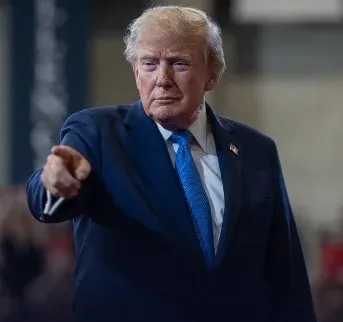
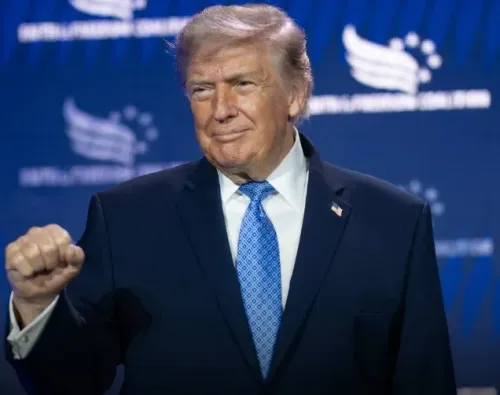
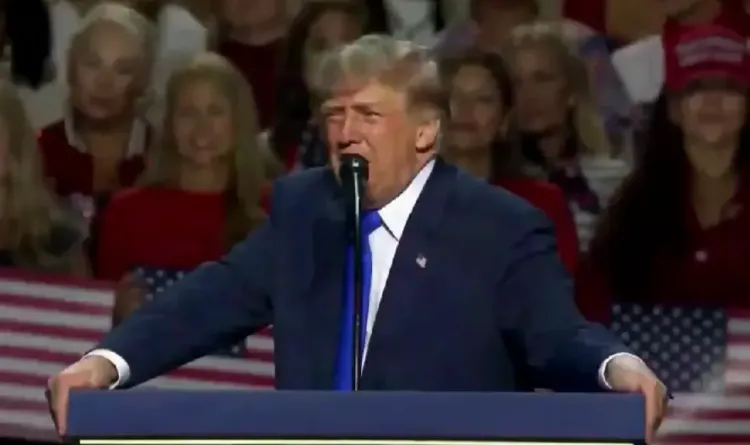
President Donald Trump on 17 September 2026 promised a $5,000 payment to every adult American if Republicans capture both chambers of Congress in the November 3 elections, framing the proposal as a “Trump dividend” funded by tariff revenue during a campaign rally in North Carolina. The announcement came as Trump stumped for Republican Senate candidate Michael Whatley, who is running against Democrat Roy Cooper.
The Dividend Pledge
Trump declared the payment would be universal — available to Democrats and Republicans alike — and tied it explicitly to a Republican sweep of the House and Senate. “And remember, if the Republicans win the House and Senate, I will issue what we will all call, from now on, the Trump dividend to every adult in America,” he said. “We’ll get $5,000, and you’ll get it.”
He did not outline eligibility criteria, a payment timetable, or any legislative mechanism for delivering the funds. No detailed revenue projections or estimate of the programme’s total cost were offered in his remarks. Trump attributed the financing to tariff income, stating: “Tariffs have made us rich.”
Electoral Stakes and Campaign Appeal
Trump framed the November congressional contests as a proxy vote on his presidency, urging supporters to “pretend I’m on the ballot just one more time.” He warned that a Democratic victory would jeopardise his administration’s tax cuts and border enforcement agenda — assertions made in a campaign context, without a Democratic rebuttal featured in the rally remarks.
Whatley, appearing onstage with Trump, kept his message focused on household finances and public safety. “I’m excited about running for Senate because I want every North Carolina family to make more money, to keep more money,” he said.
Broader Policy Promises
Beyond the dividend, Trump pledged to make permanent existing tax provisions he described as eliminating levies on tips, overtime pay, and Social Security income. “We’re gonna make it permanent. We’re gonna put it in law,” he said, without specifying the legislative path or fiscal impact.
He also proposed redirecting funds currently paid to large health insurers directly to individuals for private coverage, and called for mandatory voter identification, proof of citizenship, an end to cashless bail, and legislation barring future presidents from relaxing border enforcement — again, without providing financing or implementation details.
On monetary policy, Trump argued that US interest rates “should be 1 per cent or less,” citing what he called America’s unmatched creditworthiness amid tariff-driven inflows.
Context and Scrutiny
The $5,000 pledge arrives at a pivotal moment in the congressional campaign cycle. Critics and independent economists are likely to question the arithmetic: a universal adult payment at that level would cost an estimated several trillion dollars, a figure that tariff revenues — even at elevated rates — are not projected to cover, according to mainstream fiscal analysis. Notably, Trump offered no Congressional Budget Office score or Treasury estimate during the rally.
This is not the first time a direct-payment promise has featured prominently in a presidential campaign pitch; the precedent of COVID-era stimulus cheques has made cash transfers a politically potent rhetorical device. Whether Congress — even a Republican-controlled one — would legislate such a programme remains an open question.
With November 3 approaching, the North Carolina Senate race between Whatley and Cooper is shaping up as one of the marquee contests that will determine control of the upper chamber and, by Trump’s own framing, the fate of his second-term legislative agenda.
Point of View
No mechanism, and no timeline, designed to be shared rather than scrutinised. The fiscal math does not hold: a universal adult payment of $5,000 would cost well north of a trillion dollars, dwarfing any realistic tariff projection. What the pledge does do is collapse the distinction between congressional elections and a presidential personality vote, which is precisely Trump’s strategic intent. The deeper question mainstream coverage is underplaying is whether a Republican-controlled Congress — which includes deficit hawks — would actually pass such a programme, or whether voters are, once again, being offered a cheque that will never clear.
NationPress
17 Sept 2026
Frequently Asked Questions
What is the ‘Trump dividend’ that Trump promised?
The ‘Trump dividend’ is a pledge by President Donald Trump to pay every adult American $5,000 if Republicans win control of both the House and Senate in the November 3 elections. Trump said the payment would be funded by tariff revenue but provided no eligibility criteria, cost estimate, or legislative plan.
Is the $5,000 payment guaranteed, and when would it arrive?
No — the payment is explicitly conditional on a Republican sweep of both chambers of Congress in the November 3 elections. Trump offered no payment timetable or implementation details during his rally remarks.
How does Trump propose to fund the $5,000 payment?
Trump attributed the funding to tariff revenue, stating ‘Tariffs have made us rich.’ He provided no detailed revenue figures or independent fiscal estimate to support the claim that tariffs could cover the cost of a universal adult payment.
Who is Michael Whatley and why was Trump campaigning for him?
Michael Whatley is the Republican Senate candidate in North Carolina, running against Democrat Roy Cooper. Trump was in North Carolina to campaign on Whatley’s behalf and portrayed the Senate race as critical to his legislative agenda, saying ‘One vote could do it. You gotta get him in.’
What other policy promises did Trump make at the rally?
Beyond the $5,000 dividend, Trump pledged to permanently eliminate taxes on tips, overtime, and Social Security income; redirect insurer funds to individuals for private health coverage; mandate voter identification and citizenship proof; end cashless bail; and push US interest rates to 1 per cent or below. No financing or implementation details were provided for any of these commitments.