Escalating Tensions: Trump's Threats Against Iran Prompt Legal and Political Reactions
Synopsis
US President Donald Trump's recent threats to target Iranian civilian infrastructure have ignited backlash and legal concerns over international law violations. As tensions escalate around the Strait of Hormuz, reactions from lawmakers and legal experts highlight the serious implications of such rhetoric.
Key Takeaways
Trump’s threats against Iranian infrastructure escalates tensions.
Legal experts warn of potential violations of international law.
Lawmakers criticize the rhetoric from both political sides.
The Strait of Hormuz is vital for global oil shipments.
Iran remains defiant, rejecting US demands.
Washington, April 6 (NationPress) The recent threat issued by US President Donald Trump to target Iranian civilian infrastructure has sparked significant domestic criticism. Legal experts have raised alarms that such threats could breach international law, especially as tensions with Tehran heighten over the Strait of Hormuz.
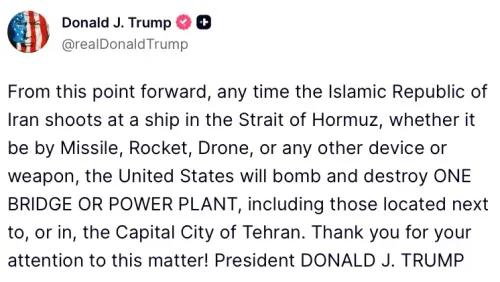
Trump warned that the United States might focus on Iran’s power plants and bridges if Tehran fails to reopen the Strait of Hormuz, per various media reports.
“Tuesday is going to be Power Plant Day and Bridge Day combined for Iran,” Trump expressed on Truth Social, as highlighted by Politico. “It will be unprecedented!!! Open the Strait, you reckless individuals, or you’ll find yourselves in a dire situation – JUST WATCH!”
These remarks signify a marked escalation in rhetoric amid rising tensions surrounding this crucial waterway, which serves as a vital passage for global oil shipments.
Trump also indicated a deadline for Iran to restore access to the strait. According to CNN, he “appeared to impose a new timeline for Iran to reopen the Strait of Hormuz,” threatening potential strikes should Tehran remain unresponsive.
The White House attempted to mitigate the repercussions. Press secretary Karoline Leavitt stated that the United States “will always operate within the boundaries of the law,” as reported by Politico.
Legal professionals have stressed that targeting civilian infrastructure raises critical issues under international humanitarian law.
As per The New York Times, facilities such as power plants and transport networks “form the backbone of civilian life in Iran” and their destruction “generally qualifies as a war crime under international law.”
International law forbids assaults on civilian sites unless they are utilized for military objectives and the anticipated military advantage surpasses the harm to civilians.
A legal authority told The Washington Post that “a threat to strike all bridges or power plants indiscriminately would effectively be a threat to commit war crimes.”
The remarks have attracted criticism from lawmakers across the political spectrum.
Senator Chris Murphy labeled Trump’s comments as “entirely, unequivocally unhinged,” according to The New York Times. Representative Don Bacon, a Republican, stated that Americans “do not wish for their president to resort to profanity and vulgarity,” adding that “self-control is a crucial aspect of leadership.”
House Minority Leader Hakeem Jeffries remarked that the administration has entangled the United States in a “reckless conflict of choice without any strategy,” as reported.
Some Republicans have stood by the administration. Representative Mike Lawler described the military operation as an “incredible endeavor,” according to The New York Times.
Tehran has dismissed US demands. A senior Iranian official claimed that the Strait of Hormuz “will remain obstructed until Iran receives compensation for war damages,” as noted by CNN.
Trump has amplified his rhetoric. In an interview with The Wall Street Journal, he stated that Iran could lose “every power plant and every other facility they possess in the entire country” if it does not comply.
“If they don’t take action by Tuesday evening, they will find no power plants and no bridges left standing,” Trump declared, according to the publication.
These statements have raised alarms among US allies. The Washington Post reported that the remarks have caused “whiplash for allies” as Washington also seeks diplomatic solutions.
Analysts suggest that the approach reflects a blend of pressure and negotiation but carries significant risks of escalation.
“The administration’s rhetoric and actions could have profound consequences,” The New York Times reported, cautioning that such statements may undermine international norms.
The Pentagon has not verified any intentions to target civilian infrastructure, with officials directing inquiries to US Central Command.
Trump has justified his strategy, asserting that pressure on Iran is essential, while also hinting that negotiations could still be on the table.
“We have this situation under control, genuinely under control,” Trump stated in comments referenced by Fox News.
The standoff revolves around the Strait of Hormuz, through which approximately a fifth of the world’s oil transits. Any disruption in this area has the potential to impact energy markets and global trade.
The ongoing tensions represent one of the most critical junctures in US-Iran relations in recent years, intertwining military pressure, economic risks, and intense rhetoric.
Historical conflicts indicate that threats against civilian infrastructure can attract international scrutiny and heighten the risk of broader escalation. Analysts believe the situation remains dynamic as both diplomatic and military pressures continue to intensify.
Point of View
It remains essential to navigate this complex landscape with caution while considering the implications for both US policy and global relations.
NationPress
7 Oct 2026
Frequently Asked Questions
What did Trump threaten regarding Iran?
Trump threatened to target Iranian civilian infrastructure, specifically power plants and bridges, if Iran does not reopen the Strait of Hormuz.
What are the legal concerns associated with Trump's threats?
Legal experts warn that targeting civilian infrastructure could violate international humanitarian law and may be considered a war crime.
How have lawmakers reacted to Trump's comments?
Lawmakers from both parties have criticized Trump's remarks, calling them reckless and unhinged.
What is the significance of the Strait of Hormuz?
The Strait of Hormuz is a critical waterway through which about a fifth of the world's oil passes, making any disruption potentially impactful on global trade.
What has been Iran's response to US pressure?
Iran has rejected US pressure, stating that the Strait of Hormuz will remain blocked until they receive compensation for war damages.