Why Are Trump’s Welfare Figures Missing India?
Synopsis
The absence of India in Trump's welfare recipient data highlights the unique economic status of Indian immigrants in the US. This article delves into the implications of this notable gap and the contributions of Indian immigrants to the American economy.
Key Takeaways
India is notably absent from welfare recipient data by Trump.
Indian immigrants are among the highest earners in the US.
They exhibit low dependence on public assistance.
Indian immigrants significantly contribute to the US economy.
They play vital roles in sectors like technology and healthcare .
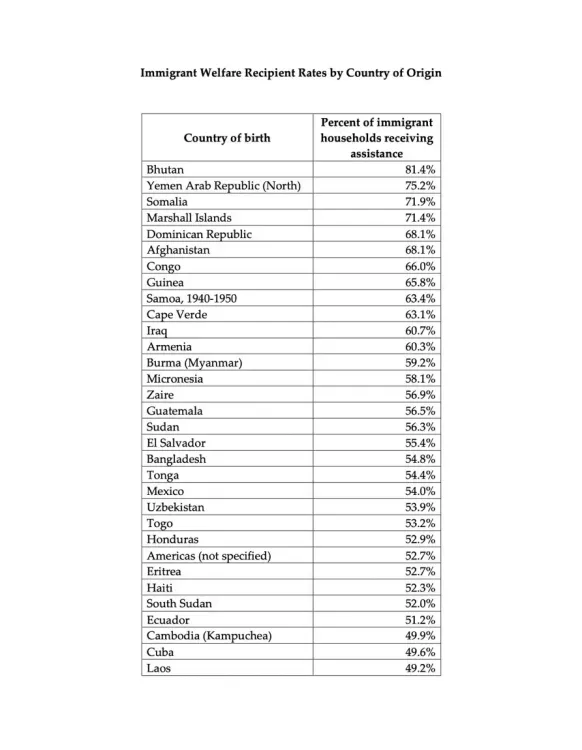
Washington, Jan 5 (NationPress) A compilation of data tables released by US President Donald Trump on Truth Social, which ranks immigrant welfare recipient rates by their countries of origin, has sparked interest in Washington. Notably, India is absent from this two-page list, revealing the unique economic profile of Indian immigrants in the larger context of US immigration.
The data is presented in two tables, collectively forming a comprehensive dataset that illustrates the percentage of immigrant households in the United States receiving government assistance. These rates vary, ranging from over 80 percent to just below 40 percent.
Leading the list is Bhutan at 81.4 percent, followed by Yemen (North) at 75.2 percent, Somalia at 71.9 percent, and the Marshall Islands at 71.4 percent. A number of other nations also display high welfare participation rates.
The Dominican Republic and Afghanistan each register at 68.1 percent. Congo is listed at 66 percent, Guinea at 65.8 percent, and Iraq at 60.7 percent. Various Central American, Caribbean, and African nations prominently appear within this group.
Guatemala shows at 56.5 percent, Sudan at 56.3 percent, and El Salvador at 55.4 percent. Honduras is listed at 52.9 percent, while Bangladesh stands at 54.8 percent.
The second page highlights countries with lower, yet still significant, welfare participation. Ivory Coast leads this segment at 49.1 percent, closely followed by Liberia at 48.9 percent and Algeria at 48.1 percent. Syria is noted at 48 percent.
Jordan and Libya are each cited at 47.8 percent. Ethiopia is at 47.6 percent, Rwanda at 47.1 percent, and Morocco at 46.6 percent. Pakistan is included at 40.2 percent, with Egypt at 39.3 percent.
Crucially, India is not included. This absence is particularly notable as immigration and welfare continue to be pressing political topics in the United States.
Research over the years consistently indicates that Indian immigrants in the US are among the highest earners across various ethnic groups. They exhibit high workforce participation and low reliance on public assistance.
Further studies, both industrial and academic, have illustrated that Indian immigrants significantly contribute to the US economy, especially in sectors like technology, healthcare, and engineering. They play a vital role in income tax revenues and have been instrumental in founding or co-founding a substantial number of startups in Silicon Valley.
Point of View
It is crucial to understand the implications of the absence of India from President Trump’s welfare recipient data. This gap not only highlights the unique economic status of Indian immigrants but also raises important questions about immigration policies and their impact on different communities within the United States. Our commitment remains to provide unbiased and comprehensive coverage on such critical issues.
NationPress
30 Sept 2026
Frequently Asked Questions
Why is India absent from Trump's welfare figures?
India's absence from the welfare figures shared by President Trump emphasizes the unique economic profile of Indian immigrants, who are known for their high earning potential and low reliance on public assistance.
What does the data reveal about Indian immigrants?
The data shows that Indian immigrants are among the highest earners across ethnic groups in the US, with significant contributions to sectors like technology and healthcare.