Typhoon Noul: Over 3.4 lakh evacuated in Guangdong as storm nears coast

Synopsis
Over 3,40,000 people have been evacuated from Guangdong as Typhoon Noul — the 12th of the year — zeroes in on the coast between Shenzhen and Huilai. With Level III alerts active, 5,109 vessels redirected, and flood warnings spanning seven provinces including the Pearl and Yangtze river basins, China is bracing for one of its most coordinated typhoon responses of 2025.
Key Takeaways
More than 3,40,000 people were evacuated across Guangdong Province by 4 pm on 25 July ahead of Typhoon Noul .
The storm is expected to make landfall between Shenzhen and Huilai , with intensity ranging from typhoon to severe typhoon level .
19 cities and 135 county-level regions in Guangdong activated emergency responses; 12 cities imposed full or partial shutdowns.
5,109 vessels were guided to safety, with another 418 redirected across provincial boundaries.
China's Ministry of Water Resources issued a Level-IV flood alert across 7 provinces , covering the Pearl, Yangtze and Huaihe river basins.
Geological disaster alerts were activated in Jiangxi and Hunan , with existing alerts maintained in Guangdong and Fujian .
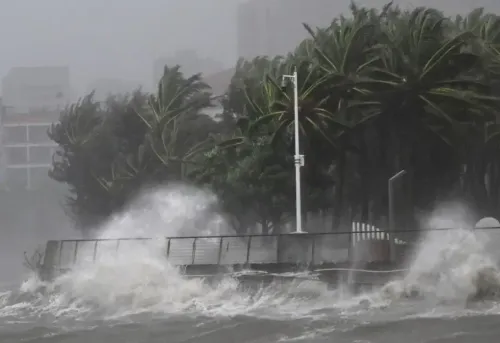
More than 3,40,000 people were evacuated across south China's Guangdong Province by 4 pm on Saturday, 25 July, as Typhoon Noul — the 12th typhoon of the year — closed in on the coastline, according to provincial flood, drought and typhoon control authorities. The storm is expected to make landfall along the stretch between Shenzhen and Huilai in Guangdong between Saturday evening and Sunday morning.
Storm Track and Expected Intensity
Authorities warned that Typhoon Noul could strike with an intensity ranging from typhoon to severe typhoon level at landfall. The window for impact — Saturday evening through Sunday morning — has put coastal districts on high alert. China's State Flood Control and Drought Relief Headquarters raised its emergency response for flood and typhoon control in Guangdong to Level III on Saturday, reflecting the storm's escalating threat.
Scale of Emergency Response
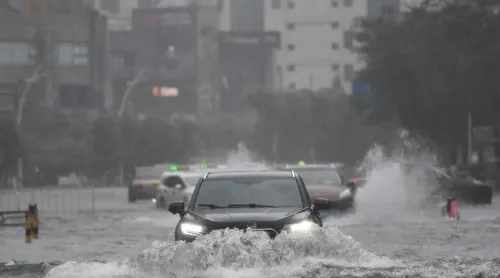
A total of 19 cities and 135 county-level regions in Guangdong had activated emergency responses for strong winds or flooding by 4 pm Saturday. Among them, Shanwei and Huizhou, along with 10 county-level regions, launched the highest-level response. An additional 12 cities introduced full or partial shutdown measures to limit public exposure to the storm.
Maritime authorities guided 5,109 vessels in Guangdong's coastal waters to safe anchorages. A further 418 vessels were directed across jurisdictional boundaries to shelter in western Guangdong, Hainan Province, and waters off northern Fujian Province.
Wider Flood Threat Across Seven Provinces
The storm's reach extends well beyond Guangdong. China's Ministry of Water Resources activated a Level-IV flood-control emergency response across seven provincial-level regions on Saturday — Fujian, Jiangxi, Henan, Hubei, Hunan, Guangdong and Guangxi — covering large swathes of eastern, central and southern China. China operates a four-tier emergency response system, with Level I being the most severe.
Major rivers at heightened flood risk include the Pearl, Yangtze and Huaihe. The ministry urged local water conservancy authorities to monitor weather changes closely, issue timely warnings, and make targeted use of flood-control infrastructure.
Geological Disaster Alerts Issued
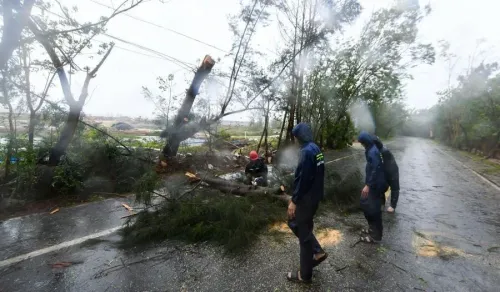
Separately, the Ministry of Emergency Management activated a Level-IV emergency response for geological disasters in Jiangxi and Hunan on Saturday, while maintaining a Level-IV response of the same type in Guangdong and Fujian. The overlapping alerts signal that landslides and ground instability pose an additional risk alongside flooding as the typhoon makes landfall.
With landfall imminent, authorities are expected to escalate response levels further if the storm intensifies or shifts track toward more densely populated coastal zones.
Point of View
40,000 evacuated, over 5,500 vessels repositioned, and seven provinces on flood alert simultaneously — reflects a command-and-control disaster response architecture that few countries can replicate at this speed. Yet the real test will be post-landfall: China's southern coastline has seen repeated typhoon damage in recent years, and the convergence of storm surge, river flooding, and geological risk in a single weather event raises the stakes considerably. The activation of geological disaster alerts in Jiangxi and Hunan — inland provinces — is a reminder that typhoon damage in China rarely stops at the coast. Whether infrastructure investments in flood barriers and early warning systems have kept pace with climate-driven storm intensification is the question that will be answered in the next 48 hours.
NationPress
25 Oct 2026
Frequently Asked Questions
What is Typhoon Noul and where is it expected to make landfall?
Typhoon Noul is the 12th typhoon of the year to affect China, expected to make landfall along the Guangdong coast between Shenzhen and Huilai between Saturday evening and Sunday morning on 25-26 July 2025. Authorities warn its intensity could range from typhoon to severe typhoon level at the time of landfall.
How many people have been evacuated in Guangdong ahead of Typhoon Noul?
More than 3,40,000 people had been evacuated across Guangdong Province by 4 pm on Saturday, 25 July, according to provincial flood, drought and typhoon control authorities. A total of 19 cities and 135 county-level regions activated emergency responses.
Which other Chinese provinces are on flood alert due to Typhoon Noul?
China's Ministry of Water Resources activated a Level-IV flood-control emergency response across seven provincial-level regions: Fujian, Jiangxi, Henan, Hubei, Hunan, Guangdong and Guangxi. Major rivers at risk include the Pearl, Yangtze and Huaihe.
What emergency response level has China activated for Typhoon Noul?
China's State Flood Control and Drought Relief Headquarters raised the emergency response for Guangdong to Level III on Saturday. Separately, a Level-IV flood-control response was activated in seven provinces by the Ministry of Water Resources, and Level-IV geological disaster alerts were issued for Jiangxi and Hunan.
How many vessels were redirected ahead of Typhoon Noul?
Maritime authorities guided 5,109 vessels in Guangdong's coastal waters to safe areas, while an additional 418 vessels were directed across jurisdictional boundaries to shelter in western Guangdong, Hainan Province, and waters off northern Fujian Province.