UN Biodiversity COP 17 opens in Yerevan: 90% nations set targets, action lags
Synopsis
The world's governments have gathered in Yerevan for UN Biodiversity COP 17 — the halfway checkpoint before 2030. A new global report shows 90% of nations have set targets, but fewer than half are on track. With four years left, conference leaders say Yerevan must be a turning point, not another round of pledges.
Key Takeaways
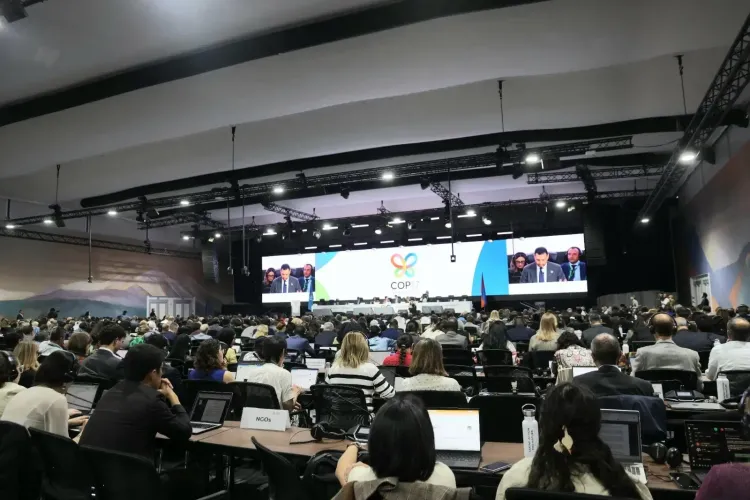
The 2026 UN Biodiversity Conference (COP 17) opened in Yerevan, Armenia on 19 October 2026 , running until 30 October .
A new report, State of Biodiversity Action , shows nearly 90% of parties have set national targets, but fewer than half are on track.
The conference marks the halfway point between the 2022 adoption of the Kunming-Montreal Global Biodiversity Framework and the 2030 deadline.
Three formal meetings are running in parallel: COP 17 , CP-MOP 12 (Cartagena Protocol), and NP-MOP 6 (Nagoya Protocol).
CBD Executive Secretary Astrid Schomaker warned the world is 'not moving fast enough' and called Yerevan a potential 'turning point.'
Representatives of governments, indigenous peoples, local communities, and stakeholders convened in Yerevan, Armenia on Monday, 19 October 2026 for the 2026 UN Biodiversity Conference, marking the halfway point between the landmark Kunming-Montreal Global Biodiversity Framework (KMGBF) adoption in 2022 and the critical 2030 targets deadline. The conference, running until 30 October, opens against a sobering new global progress report that shows commitment on paper but insufficient delivery on the ground.
What the New Global Report Reveals
The freshly released State of Biodiversity Action report offers a mixed picture of global effort. According to the report, nearly 90 per cent of parties to the Framework have set national biodiversity targets, and more than 70 per cent have submitted national progress reports. Action is reportedly underway across all 23 targets of the KMGBF.
However, implementation remains critically insufficient: fewer than half of national targets assessed by parties themselves are considered on track. The report underscores an urgent need to accelerate delivery with only four years remaining before the 2030 deadline.
Structure and Key Priorities of COP 17
The 2026 UN Biodiversity Conference formally comprises three parallel processes: the 17th meeting of the Conference of the Parties (COP 17) to the Convention on Biological Diversity (CBD), as well as meetings of the Parties to the Cartagena Protocol on Biosafety (CP-MOP 12) and the Nagoya Protocol on Access and Benefit Sharing (NP-MOP 6).
At COP 17, parties will undertake the first-ever global review of collective progress under the KMGBF, alongside decisions on protecting biodiversity, addressing the drivers of biodiversity loss, and mobilising finance and capacity-building. Strengthening the role of indigenous peoples and local communities in biodiversity governance is also a stated priority.
CP-MOP 12 will focus on updating risk assessment and management guidance under the Cartagena Protocol, while NP-MOP 6 will advance implementation of the Nagoya Protocol, particularly on benefit-sharing monitoring and institutional effectiveness.
What Leaders Said
Hambardzum Matevosyan, COP 17 President and Minister of Environment of the Republic of Armenia, called on parties to renew their collective commitment. 'Four years ago, we agreed an ambitious global agreement for nature. In Yerevan, halfway between the adoption of the Kunming-Montreal Global Biodiversity Framework and 2030, we must renew our collective commitment and focus on its delivery,' he said.
Matevosyan added: 'We welcome the world to Armenia for the 2026 UN Biodiversity Conference. As COP 17 President, I am confident that through inclusive and constructive cooperation, parties can work together, find common ground and deliver for nature for people around the world.'
Astrid Schomaker, Executive Secretary of the Convention on Biological Diversity, struck an urgent tone. 'Yerevan is about accelerating action to protect nature,' she said, adding: 'Protecting biodiversity is not separate from protecting our economies. Our food, water, health and livelihoods all depend on healthy ecosystems. In 2022, the world agreed on a plan to halt and reverse biodiversity loss. Four years on, we know where we are, where the gaps are and that we are not moving fast enough. Yerevan must mark a turning point in our journey to 2030, putting us on a faster path to meeting the biodiversity targets and achieving our vision of living in harmony with nature.'
Beyond the Negotiations: Society-Wide Engagement
The conference extends beyond formal government negotiations, bringing together actors from science, finance, business, cities, youth, and indigenous communities through high-level gatherings and side initiatives. These exchanges are intended to strengthen cross-sector partnerships and mobilise what organisers call 'whole-of-society action' needed to deliver on global biodiversity commitments.
This is the first full-scale biodiversity COP since the KMGBF was adopted in Montreal in December 2022, and Yerevan's outcomes will shape the trajectory of global biodiversity governance through 2030 and beyond.
Point of View
But the real number to watch is the one buried in the report: fewer than half those targets are on track. That gap — between pledging and doing — has been the defining failure of multilateral environmental agreements for decades, from Aichi to Paris to now Kunming-Montreal. Yerevan's first-ever global progress review under the KMGBF will test whether the Framework's design — 23 interconnected targets, finance mobilisation mechanisms, indigenous community participation — can translate diplomatic ambition into verifiable on-ground outcomes. The next four years will determine whether 2022's Montreal moment becomes a genuine inflection point or another footnote in the long history of environmental commitments that outlasted the political will behind them.
NationPress
19 Oct 2026
Frequently Asked Questions
What is the 2026 UN Biodiversity Conference in Yerevan?
It is the 17th meeting of the Conference of the Parties (COP 17) to the Convention on Biological Diversity, held in Yerevan, Armenia, from 19 to 30 October 2026. The conference also includes parallel meetings under the Cartagena Protocol on Biosafety (CP-MOP 12) and the Nagoya Protocol on Access and Benefit Sharing (NP-MOP 6).
What does the new State of Biodiversity Action report say?
The report finds that nearly 90% of parties have set national biodiversity targets and more than 70% have submitted national reports, but fewer than half of those targets are assessed as on track. It concludes that implementation remains insufficient given the four years left before the 2030 deadline.
What is the Kunming-Montreal Global Biodiversity Framework?
The Kunming-Montreal Global Biodiversity Framework (KMGBF) is a global agreement adopted in December 2022 in Montreal, Canada, to halt and reverse biodiversity loss by 2030. It sets out 23 interconnected targets covering protected areas, ecosystem restoration, finance mobilisation, and benefit-sharing from genetic resources.
Why does COP 17 in Yerevan matter?
Yerevan marks the halfway point between the KMGBF's 2022 adoption and the 2030 deadline, making it the first opportunity for a full global review of collective progress. Leaders have described it as a potential turning point to accelerate action before it is too late to meet the framework's targets.
Who is attending the 2026 UN Biodiversity Conference?
The conference brings together government representatives, indigenous peoples and local communities, scientists, financial institutions, businesses, cities, and youth groups from around the world. Beyond formal negotiations, high-level side events aim to mobilise whole-of-society action on biodiversity.