Should the Economic Growth of Developing Nations Lead to UNSC Reform?
Click to start listening
Synopsis
As developing nations witness faster economic growth, UN Chief Antonio Guterres advocates for urgent reform of the UNSC and financial institutions. This transformative shift reflects a world that demands new governance aligned with contemporary realities. Discover the implications of this changing landscape and its impact on global cooperation.
Key Takeaways
- Reform of the Security Council is crucial to align with global economic changes.
- Developing nations are growing at a faster rate than developed countries.
- India's economic growth positions it as a key player in UNSC reforms.
- The UN is working to enhance its financial and operational efficiency.
- International cooperation is under threat due to current power dynamics.
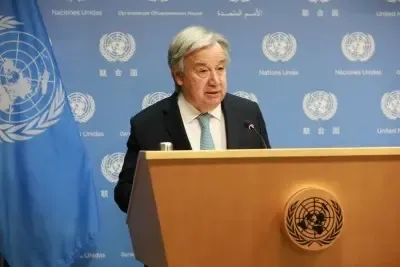
United Nations, Jan 15 (NationPress) - The acceleration of economic growth in developing nations compared to their developed counterparts underscores the urgent need for reform in the Security Council and global financial institutions, stated Secretary-General Antonio Guterres on Thursday.
“Each day, the proportion of global GDP represented by developed economies diminishes incrementally. Meanwhile, emerging economies are expanding in size, strength, and influence. Additionally, trade between Southern nations is increasingly outpacing that of Northern nations,” he remarked.
“Our institutions must mirror this evolving landscape,” he emphasized, pointing out that the strategies that were effective in 1945, when the UN and key global financial bodies were established, are inadequate for addressing the challenges of 2026.
He stressed the necessity of reforming the Security Council alongside the need to modernize the governance structures of international financial entities.
According to the latest UN report on the global economy, developing countries experienced a growth rate of 4.2% last year, while developed nations saw only a 2.9% increase.
India, which is vying for a permanent seat on a revamped Council, emerged as the fastest-growing major economy, boasting a growth rate of 7.4% last year.
This speech marked the final annual address to the General Assembly by Guterres, who concludes his second term this year. While he highlighted numerous global crises threatening international collaboration, he also noted some encouraging signs.
“Let’s acknowledge that amidst this upheaval, we have carved out a space for the United Nations where it was not guaranteed,” he stated.
Although Guterres refrained from naming the US or Russia, both permanent members of the Security Council accused of breaching international law and the UN Charter while wielding veto powers, he remarked, “Some individuals are attempting to place international cooperation on deathwatch” with their actions “undermining the foundations of global collaboration and testing the resilience of multilateralism itself.”
“I assure you: we will not surrender,” he declared.
In a subtle reference to the US, he discussed the financial difficulties facing the UN due to Washington’s failure to meet its financial obligations as mandated by the General Assembly.
“The current scenario is completely unsustainable,” he said.
“Either all nations, without exception, fulfill their financial responsibilities under the Charter – which no longer appears to be occurring. Or Member States must revamp our financial regulations to avert a budget crisis,” he added.
However, he also noted that the UN is optimizing its structure to enhance efficiency and realize savings.
Point of View
The statements made by UN Chief Antonio Guterres reveal a critical juncture in international relations. The economic rise of developing countries signifies a shift in global power dynamics, necessitating a reevaluation of the UNSC's structure. As nations navigate these changes, the call for reform represents a fundamental step toward ensuring that international institutions reflect contemporary realities and promote equitable cooperation.
NationPress
15/01/2026
Frequently Asked Questions
Why does the UN Secretary-General advocate for UNSC reform?
The UN Secretary-General suggests reforming the UNSC to reflect the shifting economic landscape, where developing nations are growing faster than their developed counterparts. This reform is essential for ensuring that global governance is representative and effective.
What growth rates did the UN report reveal?
The UN report indicated that developing countries experienced a 4.2% growth rate last year, surpassing the 2.9% growth rate of developed nations.
What role does India play in this reform discussion?
India is positioning itself as a candidate for a permanent seat on a reformed UNSC, reflecting its status as one of the fastest-growing major economies.