UN Security Council Set for Urgent Meeting: Guterres Decries Military Escalation
Synopsis
As tensions rise in the Middle East, UN Secretary-General Antonio Guterres condemns military actions and calls for peace. With the UN Security Council convening urgently, the situation remains precarious, as international leaders urge a return to diplomatic negotiations.
Key Takeaways
UN Security Council meeting convened due to military escalation.
Antonio Guterres condemns U.S.-Israel actions and calls for peace.
Iran retaliates against military strikes with missile attacks.
Involvement of international leaders highlights global concern.
Emphasis on negotiations to prevent further conflict.
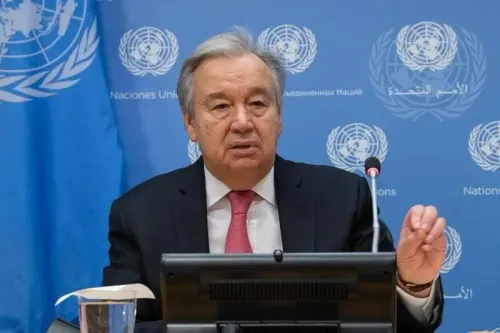
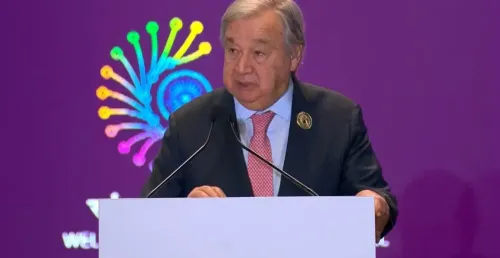
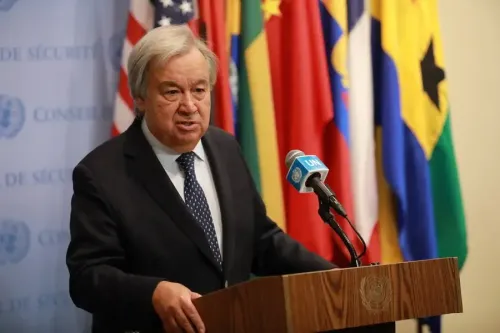
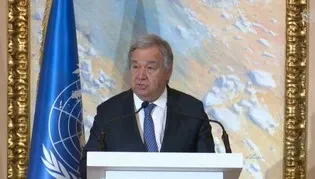
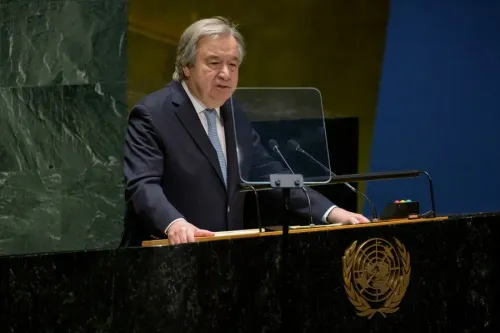
United Nations, Feb 28 (NationPress) As the UN Security Council gears up for an emergency session on Saturday, Secretary-General Antonio Guterres has denounced the escalating military actions in the Middle East.
He pointed out that the U.S.-Israel military operations against Iran and Tehran's counteractions across the region threaten to destabilize global peace and security.
France's President Emmanuel Macron, emphasizing the serious implications of the U.S.-Israel assault on Iran, urged the Council to convene urgently.
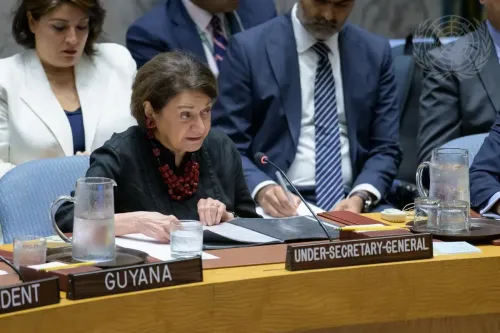
Iran's Foreign Minister Abbas Araghchi called for the Council's intervention, asserting that the actions of the U.S. and Israel breach international law.
Two officials from UN agencies voiced their apprehensions regarding the situation in the Middle East.
UN Human Rights High Commissioner Volker Turk stated, "I express my deep concern over the military strikes on Iran this morning by Israel and the United States, followed by Iran's retaliatory actions."
World Health Organisation Director-General Tedros Adhanom Ghebreyesus also shared his distress about the unfolding crisis, extending his sympathy to the civilians caught in the crossfire.
Both officials joined Secretary-General Guterres in demanding an immediate cessation of hostilities.
Guterres emphasized, "I urge an urgent halt to hostilities and a return to dialogue. Ignoring this call could lead to a broader regional conflict with severe repercussions for civilians and stability. All parties must immediately seek to negotiate."
The U.S.-Israel offensive came after negotiations involving the U.S. and Iran, facilitated by Oman, which appeared to stall.
U.S. President Donald Trump expressed dissatisfaction with the negotiations on Friday, highlighting a critical sticking point regarding Iran's uranium enrichment.
Oman's Foreign Minister Badr bin Hamad Al Busaidi, who was involved in the talks, lamented the attack on Saturday, stating, "Active and serious negotiations have yet again been undermined," and urged the U.S. to avoid further involvement.
Trump openly advocated for regime change in Iran following military operations targeting key Iranian leadership.
In response, Iran executed missile strikes on Israel and various targets in the United Arab Emirates, Qatar, Bahrain, Kuwait, Saudi Arabia, and targeted U.S. forces in the waters of the region.
In his letter to the UN Security Council, Araghchi asserted, "All military bases belonging to hostile forces in the region will be viewed as legitimate targets under Iran's right to self-defense."
Guterres reiterated that, "All Member States must adhere to their responsibilities under international law, including the UN Charter," which prohibits the use of force against the territorial integrity or political independence of any state.
Point of View
It's crucial to approach this escalating conflict with an emphasis on global stability. The actions of major powers like the U.S. and Israel, along with Iran's responses, highlight the fragility of peace in the region. A focus on dialogue and adherence to international law is essential for resolving these tensions.
NationPress
20 Sept 2026
Frequently Asked Questions
What triggered the emergency UN Security Council meeting?
The meeting was called in response to escalating military actions by the U.S. and Israel against Iran, which have raised significant concerns over regional stability and international peace.
What is Secretary-General Guterres' stance on the military actions?
Guterres condemned the military escalation, urging an immediate cessation of hostilities and a return to negotiations to prevent further conflict.
How has Iran responded to the U.S.-Israel attacks?
Iran retaliated with missile strikes on Israel and various targets across the region, asserting its right to self-defense.
What role did Oman play in the negotiations?
Oman was involved as a mediator in the negotiations between the U.S. and Iran, which reportedly did not yield any progress.
What are the implications of the military actions for civilians?
The ongoing conflict poses severe risks to civilians caught in the crossfire, as emphasized by international leaders urging for an end to hostilities.