White House Says US Gas Prices Drop Below $4 Per Gallon
Synopsis
The White House declared on 18 June 2026 that rising domestic oil output has pushed the US national average gasoline price below $4 per gallon — a politically significant threshold last breached when prices topped $5 in 2022 amid global supply shocks.
Key Takeaways
The White House announced on 18 June 2026 that US gasoline prices have fallen below $4 per gallon nationally.
The administration attributed the decline to increased domestic oil production — 'oil is flowing,' the post stated.
The $5-per-gallon peak in 2022 , triggered by supply disruptions after Russia's invasion of Ukraine, set the high-water mark against which this drop is being measured.
The United States became a net energy exporter in 2019 following the shale-oil boom, giving federal leasing and production policy direct influence over pump prices.
Monthly EIA data releases and any new federal leasing or export policy announcements will determine whether sub-$4 prices hold.
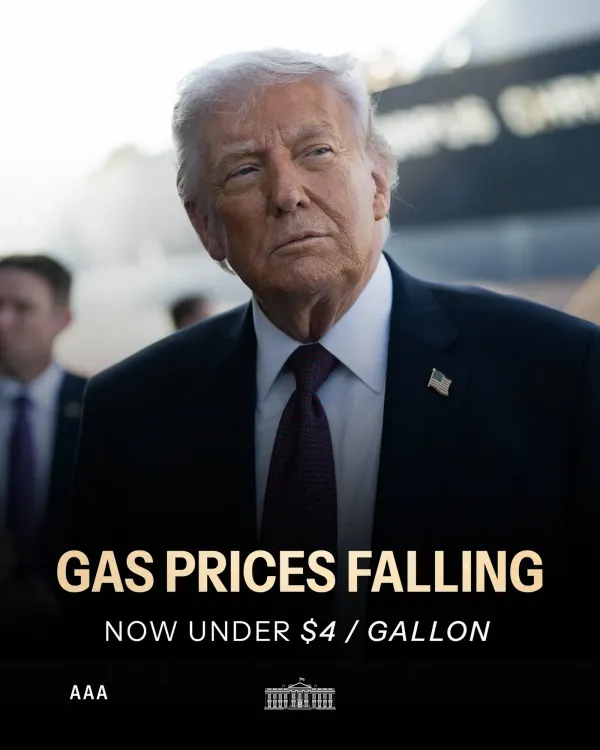
The White House, the official communications account of the Executive Office of the President of the United States, announced on Thursday, 18 June 2026 that domestic oil production is rising and that the national average gasoline price has fallen below $4 per gallon.
Context
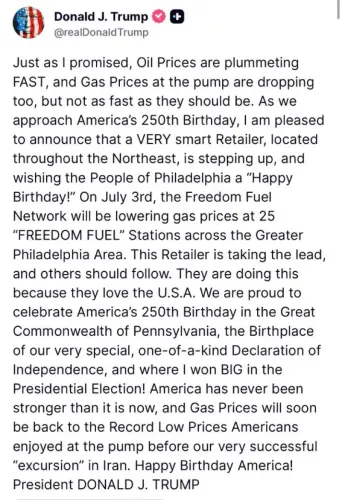
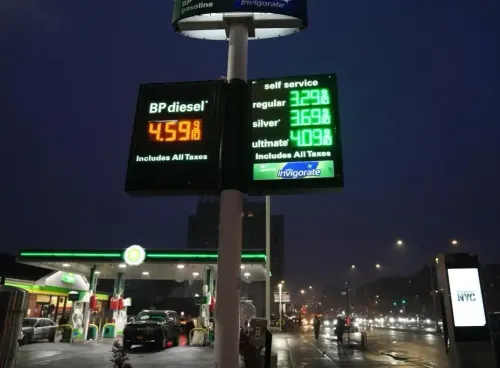
The post states plainly: 'Oil is flowing and gas prices have begun tumbling down, now BELOW $4 per gallon nationally.' The announcement frames the price decline as a direct consequence of increased domestic oil output, positioning it as a supply-side policy win for the current administration.
The $4-per-gallon threshold carries significant political weight in the United States. When the national average breached $5 per gallon in 2022 — driven by supply shocks following Russia's invasion of Ukraine — it became a flashpoint in domestic energy debates. Falling back below $4 is widely seen as a meaningful benchmark for American households.
Policy Backdrop
The United States became a net energy exporter for the first time in decades in 2019, a milestone driven by the domestic shale-oil boom that dramatically expanded production capacity. Since then, federal leasing policy, drilling permits, and the management of the Strategic Petroleum Reserve (SPR) — the federal crude stockpile created in the 1970s to cushion supply disruptions — have been central levers in efforts to influence pump prices.
US energy policy has historically oscillated between expanding fossil-fuel output to lower prices and bolster energy security on one hand, and advancing decarbonisation measures on the other. Administrations across the political spectrum have routinely highlighted falling pump prices as evidence of successful supply-side management, making announcements of this kind a recurring feature of executive communications.
Stakeholders and Impact
American drivers are the most immediate beneficiaries of lower gasoline prices. With the United States being one of the world's largest vehicle markets and car-dependent economies, pump prices feed directly into household budgets, consumer sentiment, and broader inflation readings.
Oil and gas producers face a more complex calculus: while higher output drives the volume gains that can satisfy policy goals, sustained low prices can compress margins and reduce incentives for further capital investment in new wells. Global factors — including OPEC production decisions, geopolitical developments in oil-producing regions, and macroeconomic demand signals — continue to interact with domestic supply trends to set the final price at the pump.
What's Next
Analysts and policymakers will watch monthly data releases from the US Energy Information Administration (EIA) to track whether the sub-$4 level is sustained or proves temporary. Any new federal leasing rounds, export policy shifts, or changes in global crude benchmarks could quickly alter the trajectory.
For India, which imports a substantial share of its crude from global markets, sustained lower US production costs and a softer global oil price environment could offer downstream relief on import bills and domestic fuel retail prices — a dynamic Indian policymakers and energy economists will monitor closely.
Point of View
And a decline below a round-number threshold is a ready-made headline. The framing — 'oil is flowing' — signals a deliberate emphasis on supply-side expansion rather than demand management or strategic reserve releases, suggesting the administration wants credit for production-led relief. For global markets, sustained higher US output adds downward pressure on crude benchmarks, a dynamic that ripples through import-dependent economies including India. Whether the price holds will depend as much on OPEC decisions and geopolitical risk as on any domestic policy lever.
NationPress
18 Sept 2026
Frequently Asked Questions
What did the White House say about US gas prices in June 2026?
The White House announced on 18 June 2026 that the national average gasoline price in the United States has fallen below $4 per gallon, crediting rising domestic oil production for the decline.
Why is $4 per gallon significant for US gasoline prices?
The $4-per-gallon mark is a widely watched benchmark because the national average exceeded $5 per gallon in 2022 following supply disruptions caused by Russia's invasion of Ukraine, making any sustained drop below $4 a notable relief for American consumers.
How does US oil production affect gasoline prices?
Higher domestic output increases the supply of crude available for refining, which tends to put downward pressure on both crude oil benchmarks and the retail gasoline prices derived from them.
What is the Strategic Petroleum Reserve and how does it affect fuel prices?
The Strategic Petroleum Reserve is a federal crude oil stockpile created in the 1970s to address supply disruptions. Releasing reserves adds supply to the market and can help push prices lower during periods of shortage or price spikes.
Does a fall in US gas prices affect India?
Yes, sustained lower US production costs can soften global crude oil benchmarks, which in turn reduces India's crude import bill and can ease pressure on domestic fuel retail prices.