US, Japan, South Korea deepen AI, semiconductor and security ties at UN
Synopsis
On the sidelines of the UN General Assembly, the US, Japan and South Korea announced a sweeping trilateral pact covering AI, semiconductors, quantum tech, small modular reactors and a new economic security consultation body — while hardening their collective line on North Korea's nuclear programme and opposing any unilateral change to the Taiwan Strait's status quo.
Key Takeaways
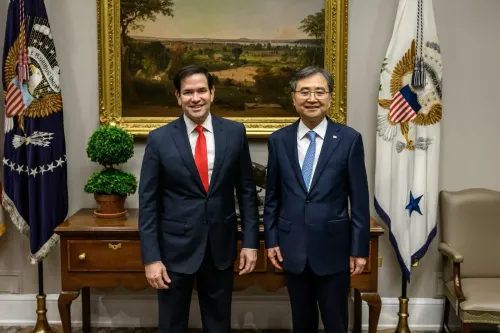
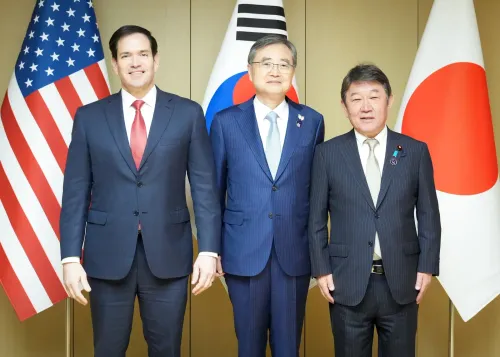
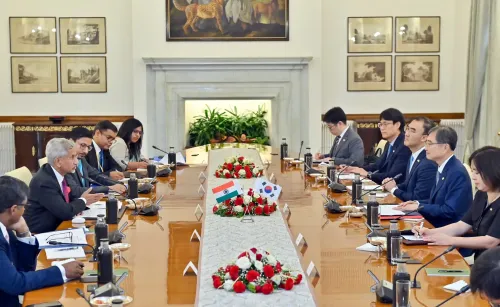
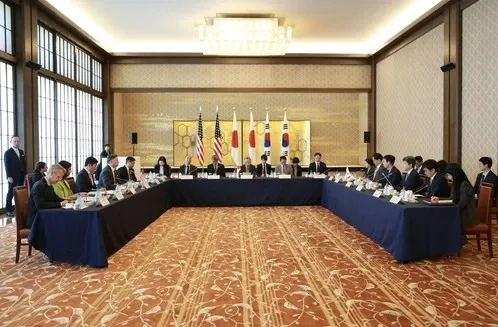
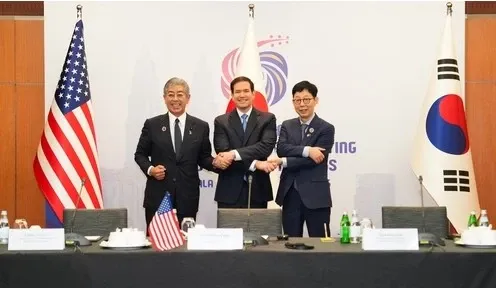
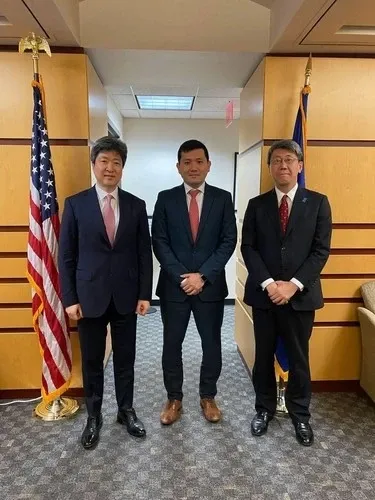
US Secretary of State Marco Rubio , Japanese Foreign Minister Motegi Toshimitsu and South Korean Foreign Minister Cho Hyun met on 21 September 2026 in New York during the UN General Assembly high-level week.
The three nations agreed to prioritise artificial intelligence , semiconductors , quantum technology , digital infrastructure and biotechnology as trilateral technology cooperation areas.
A new economic security consultation mechanism and a strengthened supply-chain early-warning system were announced.
The governments committed to implementing a July memorandum on deploying small modular nuclear reactors (SMRs) in partner countries under strict safety and non-proliferation standards.
The ministers reaffirmed US extended nuclear deterrence for Japan and South Korea, backed peace across the Taiwan Strait and opposed unilateral status-quo changes in the Indo-Pacific .
Cooperation with the UNODC was announced to disrupt Southeast Asian scam centres accused of fraud using trafficked workers.
US Secretary of State Marco Rubio, Japanese Foreign Minister Motegi Toshimitsu and South Korean Foreign Minister Cho Hyun convened on the sidelines of the UN General Assembly's high-level week in New York on 21 September 2026, agreeing to intensify trilateral cooperation across artificial intelligence, semiconductors, quantum technology and critical supply chains while reinforcing the three nations' joint security posture in the Indo-Pacific. A joint statement from the US State Department confirmed the breadth of commitments, spanning economic security, emerging technology, energy resilience and North Korea's nuclear threat.
North Korea Denuclearisation and Sanctions Pressure
The three foreign ministers reaffirmed their shared commitment to the complete denuclearisation of North Korea and called on Pyongyang to return to dialogue. They pledged to strengthen coordination against North Korea's nuclear and ballistic missile programmes, cyber operations and revenue-generation activities that allegedly violate UN Security Council resolutions.
The ministers welcomed the work of the Multilateral Sanctions Monitoring Team in documenting alleged violations and sanctions evasion. They also cited a multi-country alert regarding North Korean IT workers reportedly deployed abroad under false identities to funnel earnings back to sanctioned programmes — a practice Western governments have repeatedly flagged at the UN.
The path to dialogue with Pyongyang was described as remaining open. The statement also renewed calls for resolution of cases involving abductees, detainees, unrepatriated prisoners of war and families separated by the division of the Korean Peninsula.
Economic Security and Supply-Chain Resilience
Economic security formed a major pillar of the trilateral talks. The ministers collectively opposed economic coercion, market-distorting practices and arbitrary export restrictions that disrupt international supply chains — language widely read as directed at China, though Beijing was not named in the statement.
The three governments agreed to strengthen a trilateral early-warning system designed to flag emerging supply-chain disruptions before they escalate. They also announced a new economic security consultation mechanism to coordinate responses across the three capitals.
Energy Resilience and Small Modular Reactors
The officials underscored the need to build regional energy resilience through expanded oil stockpiles and tighter cooperation between energy-producing and energy-consuming nations. They welcomed Japan's 'POWERR Asia' initiative and South Korea's push to broaden regional energy-security cooperation.
Notably, the three governments confirmed they would implement a July memorandum to accelerate deployment of small modular nuclear reactors (SMRs) in partner countries, stipulating that all such projects must adhere to high standards of nuclear safety, security and non-proliferation.
Emerging Technology: AI, Quantum and Semiconductors
On the technology front, the ministers committed to strengthening advanced-technology systems and making supply chains more resilient. Priority areas identified included artificial intelligence, quantum technology, digital infrastructure and biotechnology. They backed greater semiconductor cooperation and called for closer links between their respective national laboratories — a step that goes beyond existing bilateral frameworks.
Security Posture, Taiwan Strait and Indo-Pacific Stability
The ministers reaffirmed US extended nuclear deterrence commitments to both Japan and South Korea. They stressed the importance of maintaining peace and stability across the Taiwan Strait and explicitly opposed any unilateral attempt to change the regional status quo.
The statement supported freedom of navigation, overflight and lawful commerce in the Indo-Pacific in accordance with international law. The three countries also announced cooperation with the UN Office on Drugs and Crime (UNODC) to disrupt organised criminal networks — particularly scam centres in Southeast Asia accused of large-scale financial fraud using trafficked workers. Consultations on international disaster relief and maritime security cooperation were also launched.
With the agreement in place, the next test will be whether the new economic security consultation mechanism and the SMR deployment roadmap translate into concrete deliverables before the next scheduled trilateral review.
Point of View
Suggesting the three governments are building an integrated economic-security architecture, not just issuing diplomatic communiqués. The explicit opposition to 'market-distorting practices' and 'economic coercion' without naming China is a studied ambiguity that allows each capital to frame the message domestically. The SMR deployment commitment is the most under-reported detail: it signals a coordinated push to export a specific energy technology as a geopolitical instrument in the Indo-Pacific. For India, watching from the sidelines, this trilateral deepening — especially on semiconductors and AI — raises questions about whether the Quad framework is keeping pace with the ambition of the US-Japan-South Korea axis.
NationPress
22 Sept 2026
Frequently Asked Questions
What did the US, Japan and South Korea agree at the UN General Assembly 2026?
The three countries agreed on 21 September 2026 to deepen cooperation on artificial intelligence, semiconductors, quantum technology and critical supply chains. They also launched a new economic security consultation mechanism and committed to deploying small modular nuclear reactors in partner countries.
What was agreed regarding North Korea at the trilateral meeting?
The three foreign ministers reaffirmed their commitment to the complete denuclearisation of North Korea and urged Pyongyang to return to dialogue. They also pledged to strengthen coordination against North Korea's nuclear, missile and cyber programmes and welcomed the work of the Multilateral Sanctions Monitoring Team.
What is the new economic security consultation mechanism announced by the three countries?
It is a newly announced body to coordinate economic security responses among the US, Japan and South Korea. It complements an existing trilateral supply-chain early-warning system, which the three governments also agreed to strengthen to flag disruptions before they escalate.
What is the small modular reactor agreement between US, Japan and South Korea?
The three governments agreed to implement a July memorandum aimed at accelerating the deployment of small modular nuclear reactors (SMRs) in other countries. All projects under the agreement must meet high standards of nuclear safety, security and non-proliferation.
Why did the three nations stress Taiwan Strait stability and Indo-Pacific freedom of navigation?
The ministers stressed peace and stability across the Taiwan Strait and opposed any unilateral change to the regional status quo, in line with longstanding US policy and shared concerns about Chinese assertiveness. They also backed freedom of navigation and overflight in the Indo-Pacific in accordance with international law.