Is India Still a 'Key Partner' for the US After Missing Pax Silica?
Click to start listening
Synopsis
The US emphasizes India's importance as a strategic partner in supply chain security, despite its absence at the Pax Silica Summit. This initiative aims to fortify global semiconductor supply chains amidst rising competition in critical technologies. The ongoing collaboration between Washington and New Delhi reflects a shared commitment to economic security.
Key Takeaways
- The US emphasizes India's strategic role in supply chain security.
- Pax Silica initiative aims to secure semiconductor supply chains.
- Trade discussions between the US and India are ongoing and distinct from supply chain talks.
- Future collaboration opportunities are anticipated, including high-level summits.
- The initiative is part of a broader US economic security strategy.
Washington, Dec 18 (NationPress) The United States has emphasized that India continues to be a “highly strategic potential partner” in areas such as supply chain security and advanced technologies, despite New Delhi's absence from the first Pax Silica Summit, a US-led initiative aimed at securing the global silicon and semiconductor supply chain.
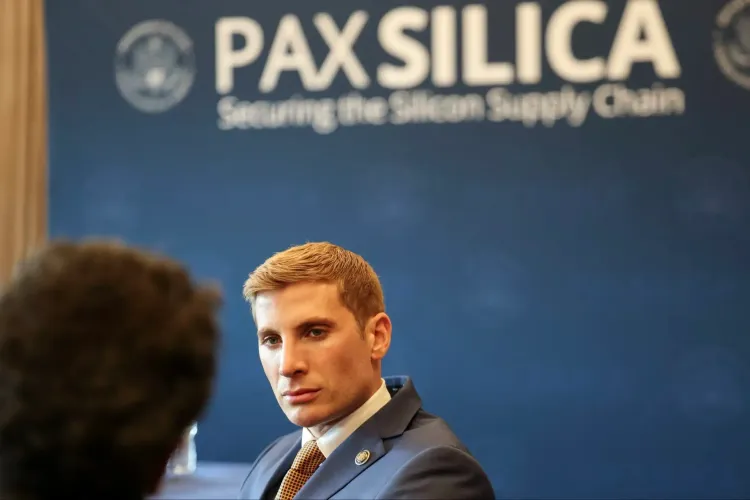
According to Under Secretary of State for Economic Affairs Jacob Helberg, the speculation regarding India's non-participation being linked to political tensions with Washington is misplaced and incorrect. He addressed reporters during a news conference at the Foreign Press Centre, clarifying that trade discussions between the US and India are a separate and parallel track to the supply chain security dialogues.
“There has been much speculation about India’s absence from the Pax Silica Summit,” Helberg said. “I want to clarify that our discussions regarding trade arrangements are distinct from our conversations on supply chain security. We do not conflate these two issues.”
He remarked, “We regard India as a highly strategic potential partner in efforts related to supply chain security, and we are eager to engage with them.”
The Pax Silica initiative, which was launched last week, unites an initial group of countries closely associated with semiconductor manufacturing and advanced technology supply chains, including Singapore, Israel, Japan, South Korea, Australia, and the United Kingdom.
This framework aims to minimize single points of failure in global supply chains that support various industries, from smartphones and automobiles to artificial intelligence.
Helberg noted that the initiative is part of a broader US economic security strategy that focuses on four pillars: rebalancing trade, stabilizing conflict zones, reindustrializing the United States, and securing supply chains.
“We have initiated a flagship project called Pax Silica that seeks to safeguard the silicon supply chain, which is essential for cutting-edge technologies, from automotive to smartphones and artificial intelligence,” he explained.
On the subject of India, Helberg highlighted that engagement with New Delhi remains ongoing and dynamic. “I am in almost daily communication with our contacts in Delhi,” he said, adding that Washington is actively exploring methods to deepen this collaboration swiftly.
He also mentioned an upcoming opportunity for high-level engagement, stating that he would participate in the India AI Impact Summit in February. “This will give us a chance to meet face-to-face and hopefully establish some tangible milestones,” he remarked.
Helberg expressed Washington's intention to significantly enhance bilateral cooperation with India on matters of economic security, suggesting that Indian involvement in future Pax Silica-related initiatives remains a viable possibility.
Earlier in the briefing, Helberg clarified that the initial group of Pax Silica nations was intentionally limited to those forming the “nucleus of semiconductor manufacturing,” such as Singapore, South Korea, Japan, Taiwan, and the Netherlands, before expanding further down the supply chain to critical minerals.
He stated that the initiative focuses on the supply side, differentiating it from previous efforts like the Mineral Security Partnership. “This is a supply-side strategy that enables us to establish communication channels with the companies responsible for managing and operating the global supply chain,” Helberg noted.
He characterized the Pax Silica Summit and declaration as “historic,” indicating it marks the first instance where countries have collectively organized around compute, silica, and minerals as shared strategic assets. “We believe that the declaration signifies a new foreign policy consensus that economic security equates to national security,” he asserted.
The Pax Silica initiative emerges amid escalating global competition in semiconductors and AI technologies, sectors deemed crucial for both economic growth and national security.
India, which has introduced incentive programs to foster a domestic semiconductor ecosystem and has established itself as a trusted technology partner, is increasingly featured in US strategic considerations.
In recent years, Washington and New Delhi have expanded their cooperation through platforms like the Initiative on Critical and Emerging Technology (iCET), reflecting a mutual interest in resilient supply chains and advanced manufacturing.
Point of View
It is clear that the US's ongoing engagement with India reflects a recognition of India's growing role in global supply chains and technology. The emphasis on collaboration in areas of economic security illustrates a strategic alignment that benefits both nations. As the landscape of technology and trade evolves, sustaining these partnerships will be crucial for resilience and innovation.
NationPress
20/12/2025
Frequently Asked Questions
Why was India not part of the Pax Silica Summit?
India's absence from the Pax Silica Summit has been attributed to speculation, but US officials clarified that it is unrelated to political tensions and that trade discussions are ongoing.
What is the Pax Silica initiative?
Pax Silica is a US-led initiative focused on securing the global silicon and semiconductor supply chain, bringing together nations involved in semiconductor manufacturing.
How does the US view India's role in supply chain security?
The US considers India a highly strategic potential partner in efforts related to supply chain security and is keen to deepen collaboration in this area.
What are the goals of the Pax Silica initiative?
The initiative aims to reduce vulnerabilities in global supply chains that are critical for industries such as smartphones, automobiles, and AI technologies.
What future engagements are planned between the US and India?
High-level engagements, including participation in the India AI Impact Summit in February, are planned to enhance bilateral collaboration on economic security.