Does the US Senate Resolution Challenge China’s WWII Claims?
Click to start listening

Synopsis
The US Senate's recent resolution challenges China's narrative of WWII, asserting the vital contributions of the Republic of China and the United States, while emphasizing the importance of historical accuracy. This move could reshape Indo-Pacific dynamics amid rising tensions with China.
Key Takeaways
- The US Senate has condemned China's revisionist history regarding WWII.
- Japan's role in the Quad is crucial for stability in the Indo-Pacific.
- The resolution emphasizes the contributions of the Republic of China and US forces in defeating Imperial Japan.
- It calls for accurate historical education about WWII allies.
- The resolution highlights the growing tensions between the US and China.
Washington, Dec 5 (NationPress) In a decisive action impacting India and its Indo-Pacific allies, the US Senate has put forward a resolution denouncing what it deems the Chinese Communist Party's “stolen valour” efforts to alter the narrative of World War II and minimize the contributions of Allied forces during that period.
This resolution also highlights Japan's pivotal role in the Quad alliance—comprising India and other nations—as essential for maintaining stability against China's growing dominance in the region.
Senate Resolution 523, introduced by Senator Dan Sullivan and sent to the Senate Foreign Relations Committee, addresses what lawmakers define as Beijing's “exercise in orchestrated propaganda” during its ceremony on September 3, 2025, commemorating the 80th anniversary of the conclusion of the war in Asia.
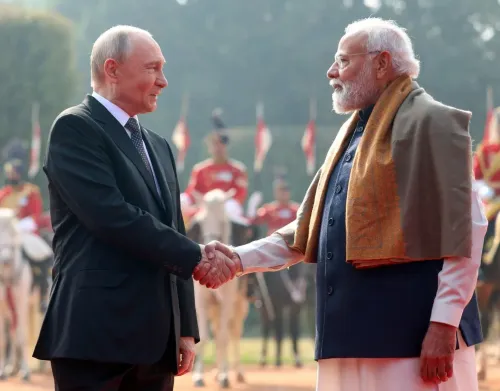
The resolution points out that this event was attended by leaders from Russia, North Korea, Belarus, Iran, Cuba, and other authoritarian regimes that the People's Republic of China seeks to align with in its vision for a future world order.
The text asserts that Beijing's assertion that the Communist Party's forces were primarily responsible for defeating Imperial Japan “is a historical revisionist claim that amounts to 'stolen valour' at the expense of the Republic of China, which was a wartime ally of the United States, and the US Armed Forces.”
Instead, senators stress that “the burden of the war effort against the then-Empire of Japan in China was primarily shouldered by the Republic of China and the armed forces led by Chinese Nationalists.”
Prior to the US formally joining the war, American aviators formed the American Volunteer Group—known as the “Flying Tigers”—to aid the Nationalist government. Following 1941, Lieutenant General Joseph Stilwell, the Allied commander in the China-Burma-India Theatre, collaborated closely with General Sun Li-jen, who is referenced in the resolution as “a graduate of Virginia Military Institute.”
Quoting a 1939 report by Chou En-lai (Zhou Enlai) addressed to Joseph Stalin, the resolution mentions that out of approximately one million Chinese combat casualties against Japan during that time, “only three percent were Communist forces,” thereby emphasizing the predominant role of Nationalist troops. Additionally, senators highlight the Soviet Union's late involvement in the Pacific conflict on August 9, 1945—just “six days before the effective end of hostilities”—and its efforts to capture land and resources “to benefit the Chinese Communist Party.”
The resolution chronicles the events leading to Japan's surrender, from the signing of the Instrument of Surrender aboard the USS Missouri on September 2, 1945—where the Republic of China was represented by General Hsu Yung-ch'ang and the US by Fleet Admiral Chester W. Nimitz—to the formal presentation of the surrender document in Nanking on September 9, 1945.
After the war, Japan underwent significant changes, including the adoption of its 1947 constitution and the security agreements with the United States in 1951 and 1960, promoting “robust cooperation” in maintaining peace in Asia.
The resolution also emphasizes that Japan participates in “the Quad and other multilateral discussions that stress the importance of safeguarding freedom of navigation and peace in the Indo-Pacific,” positioning India as a critical player in this strategic framework.
Furthermore, the resolution calls upon the US government to combat CCP propaganda, urging the Secretary of State to confront historical inaccuracies at the United Nations and encouraging American educators “to ensure that the history involving the United States’ allies during World War II is taught with factual precision.”
It also acknowledges the achievements of both China and the United States, praises the “heroism and altruism” of the Flying Tigers, and supports Taiwan's initiatives to enhance diplomatic relations under the TAIPEI Act.
The demand to address China's wartime narrative arises amid escalating US-China tensions, which encompass issues from technological restrictions to military maneuvers throughout the Indo-Pacific. In response to concerns regarding Beijing's assertiveness, India, the United States, Japan, and Australia have intensified Quad discussions in recent years.
Point of View
I believe the US Senate's resolution symbolizes a critical stance against historical revisionism that can have far-reaching implications for international relations. The emphasis on accurate historical representation is vital for fostering trust among allies in the Indo-Pacific region.
NationPress
06/12/2025
Frequently Asked Questions
What is the main purpose of the US Senate's resolution?
The resolution aims to condemn the Chinese Communist Party's attempts to distort World War II history and to affirm the contributions of the Republic of China and the United States.
How does this resolution affect Indo-Pacific relations?
This resolution reinforces the strategic importance of alliances like the Quad, which includes India, Japan, the US, and Australia, in countering China's influence in the region.
What historical claims does the resolution challenge?
The resolution challenges the claim that the Communist Party forces were primarily responsible for defeating Imperial Japan, asserting that the Republic of China and Nationalist forces played a dominant role.
What actions does the resolution call upon the US government to take?
It urges the US government to counter CCP propaganda and ensure that historical truths about World War II allies are accurately taught in schools.
What are the implications of this resolution for US-China relations?
The resolution is likely to exacerbate existing tensions between the US and China, particularly regarding historical narratives and military actions in the Indo-Pacific.