Are More Than 20 US States Challenging Trump's $100K H-1B Fee That Could Impact Schools and Hospitals?
Synopsis
In a significant legal battle, over 20 states are contesting the Trump administration's controversial $100,000 fee on H-1B visas, warning of its potential disruption to schools and hospitals. The outcome could reshape access to essential services and skilled professionals in the US.
Key Takeaways
Over 20 US states are contesting a $100,000 fee on H-1B visas.
The fee could significantly impact schools and hospitals across the nation.
Indian professionals are a major group affected by this policy.
The legal challenge highlights concerns over labor shortages in critical sectors.
The outcome could reshape immigration policy related to skilled labor.
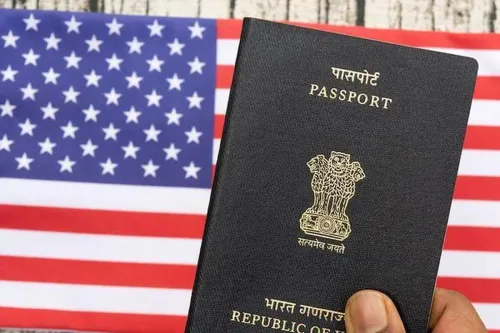
Washington, Dec 24 (NationPress) Over 20 US states have taken action to prevent the Trump administration’s new $100,000 fee on H-1B visas, expressing concerns that this policy would disrupt schools and hospitals across the nation, and hinder a vital source of skilled foreign professionals.
The legal opposition is particularly crucial for Indian workers, who make up a significant portion of H-1B visa recipients and are essential in various sectors such as healthcare, education, research, and technology. States argue that public institutions cannot absorb the burden of this exorbitant fee.
A multistate amicus brief supporting the plaintiffs in Global Nurse Force, et al. v. Trump has urged the US District Court for the Northern District of California to issue a preliminary injunction against the policy, contending that the fee is unlawful and detrimental to public interest, as it would exacerbate labor shortages, weaken the economy, and disrupt essential public services.
California Attorney General Rob Bonta stated, “The Trump Administration’s $100,000 visa fee imposes unnecessary and unlawful financial burdens on public employers and will leave essential positions in critical sectors unfilled.” He emphasized his office’s commitment to challenging this fee in court and supporting related challenges to protect universities, schools, and hospitals that thrive by attracting skilled talent globally.
This unprecedented fee was introduced on September 19, 2025, affecting new H-1B petitions submitted after September 21. Through a series of documents from the Department of Homeland Security, the policy allows the DHS secretary to decide which petitions may incur the fee or be exempt, raising concerns regarding selective enforcement.
H-1B visas enable US employers to recruit highly skilled foreign nationals for specialty occupations that require at least a bachelor’s degree, encompassing roles such as physicians, researchers, nurses, and educators. While most private-sector H-1B visas are capped at 65,000 annually, with an additional 20,000 for advanced degree holders, many government and nonprofit research institutions are exempt to meet public service needs.
The states argue that the $100,000 fee would effectively exclude public employers from the program.
The nation is grappling with a widespread teacher shortage, with 74% of school districts reporting challenges in filling open positions for the 2024–2025 school year, particularly in special education, physical sciences, bilingual education, and foreign languages.
Educators constitute the third-largest occupational group among H-1B holders, with nearly 30,000 working under these visas, and close to 1,000 colleges and universities depending on H-1B personnel to support teaching and research initiatives.
As K–12 schools, colleges, and universities are typically government or nonprofit entities, the brief asserts they cannot absorb an additional $100,000 per hire. States warn that this would lead to larger class sizes, limited course offerings, and program cuts, ultimately degrading education quality and adversely affecting students.
Hospitals and healthcare systems would encounter similar challenges. The brief highlights that hospitals depend on H-1B visas to recruit physicians, surgeons, and nurses, especially in low-income and working-class communities. Approximately 11.4 million Californians—around one-quarter of the state’s population—reside in areas facing primary care shortages. Historically, nearly 23,000 H-1B physicians have served in underserved communities.
The United States anticipates a shortfall of 86,000 physicians by 2036, prompted by an aging population and increasing care demand. States caution that the $100,000 fee would render it financially unfeasible for numerous hospitals to recruit new H-1B healthcare workers, resulting in inadequate staffing. The brief warns this could lead to increased wait times, errors, higher mortality rates, and even hospital closures.
“At a time when many hospitals are already experiencing cuts in health insurance subsidies and reduced Medicaid payments, a $100,000 fee for H-1B healthcare workers is simply not feasible,” the states contend.
Beyond staffing issues, the brief emphasizes the broader economic implications of the program, noting that H-1B workers and their families contribute approximately $86 billion annually to the US economy and pay substantial amounts in federal, state, and local taxes.
In submitting the amicus brief, Bonta was joined by attorneys general from states including Arizona, Colorado, Connecticut, Delaware, the District of Columbia, Hawai‘i, Illinois, Maine, Maryland, Massachusetts, Michigan, Minnesota, Nevada, New Jersey, New Mexico, New York, North Carolina, Oregon, Rhode Island, Vermont, Washington, and Wisconsin.
This legal challenge arises amid a broader initiative by the Trump administration to restrict legal immigration pathways. For Indian professionals, who constitute a significant proportion of new H-1B applicants, the case's outcome could influence access to US public-sector positions in healthcare, education, and research for years ahead.
Point of View
000 H-1B fee highlights the critical intersection of immigration policy and public service needs. As states rally to protect essential sectors like education and healthcare, the outcome of this case could set a precedent for how the US manages skilled labor and public resources in the future.
NationPress
7 Oct 2026
Frequently Asked Questions
What is the $100,000 H-1B fee?
The $100,000 H-1B fee is a new charge imposed by the Trump administration on employers seeking to hire foreign skilled workers through the H-1B visa program, aimed at funding various initiatives.
Which states are involved in the legal challenge?
Over 20 states, including California, New York, and Colorado, are participating in the legal challenge against this fee.
How could this fee impact education and healthcare?
The fee could deter public employers from hiring essential personnel, leading to larger class sizes, reduced course offerings in schools, and staffing shortages in hospitals.
What is the significance of H-1B visa holders?
H-1B visa holders, particularly professionals from India, play a vital role in sectors such as healthcare, education, and technology, often filling critical shortages.
What are the broader economic implications?
H-1B workers contribute approximately $86 billion annually to the US economy, and the fee may hinder their ability to work, affecting overall economic growth.