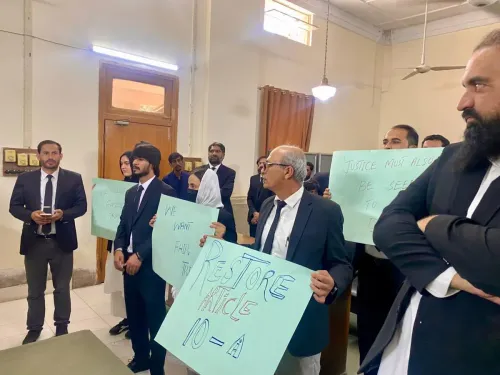
Is Pakistan's Whistleblower Protection Framework Sufficient?
Synopsis
Pakistan's whistleblower protection system is deemed grossly inadequate, reflecting a failure in political accountability. A recent report highlights the urgent need for reform to foster a culture of transparency and accountability, crucial for attracting investment and talent.
Key Takeaways
Pakistan's whistleblower protection system is deemed inadequate.
Ranked 135th in the 2024 Corruption Perceptions Index.
The existing law lacks effective enforcement and operational capacity.
Alignment with the UNCAC is crucial for improvement.
Transparency and accountability are essential for attracting investment .
Islamabad, Feb 11 (NationPress) The situation in Pakistan is quite revealing, as it demonstrates a whistleblower protection system that is not only inadequate but also largely symbolic. This highlights persistent issues related to political accountability, compliance with contracts, and regulatory autonomy, according to a recent report.
As per the 2024 Corruption Perceptions Index, Pakistan finds itself at the 135th position out of 180 countries, categorizing it among the most corruption-prone nations globally.
An opinion piece featured in The News International emphasized the necessity of transparency and accountability in any civilized society. These concepts are not mere political rhetoric but fundamental elements that build trust between the government and its citizens. Therefore, fostering a culture of whistleblowing is crucial to maintaining transparency and accountability; without these, corruption flourishes, leading to a culture that rewards silence while punishing those who speak out.
"Pakistan's whistleblower protection framework is fundamentally flawed. Although the Whistleblower Protection and Vigilance Commission Act 2019 is in place, it lacks the necessary enforcement and operational capacity. Without assured anonymity, a robust enforcement mechanism, and protection from retaliation, progress remains elusive. This situation can be improved by synchronizing existing whistleblower laws with the United Nations Convention against Corruption (UNCAC)," stated Sakib Berjees, a political economist and public policy analyst, in The News International.
While anti-corruption legislation does exist in Pakistan, the government shows a lack of resolve to enforce it.
"Pakistan stands at a critical juncture where years of inadequate accountability have weakened institutions, diminished public trust, and led to both talent and capital flight. Professionals are not leaving because they have abandoned Pakistan; they are departing because the nation has dismissed merit. Whistleblower protection is not a panacea for our national issues, but it is the foundation upon which all substantial reforms depend," Berjees wrote.
"Countries that commit to establishing accountability attract investment, skilled professionals, and gain legitimacy. Those who reject these principles and remain in denial may experience temporary success, but ultimately, they will confront dire consequences. By protecting our whistleblowers, we safeguard our future; conversely, punishing them will surely disqualify us from modernization," he further articulated in The News International.
Point of View
We remain committed to advocating for the principles of transparency and accountability in Pakistan. The need for a robust whistleblower protection framework is crucial for rebuilding trust between the state and its citizens. We must address these shortcomings to foster an environment that encourages truth-telling and combats corruption effectively.
NationPress
9 Oct 2026
Frequently Asked Questions
What is the current state of whistleblower protection in Pakistan?
The whistleblower protection framework in Pakistan is deemed inadequate and largely symbolic, failing to provide necessary enforcement and operational power.
How does Pakistan rank in terms of corruption globally?
According to the 2024 Corruption Perceptions Index, Pakistan ranks 135th out of 180 countries, categorizing it among the most corruption-vulnerable nations.
What reforms are suggested for improving whistleblower protections?
It is suggested that Pakistan align its whistleblower protection laws with the United Nations Convention against Corruption to enhance enforcement and protection mechanisms.
Why is whistleblower protection important for Pakistan?
Whistleblower protection is vital for fostering a culture of transparency and accountability, which can help attract investment and restore public trust.
What are the potential consequences of failing to protect whistleblowers?
Failing to protect whistleblowers may lead to increased corruption, diminished public trust, and further talent and capital flight from the country.