White House Revives Columbus Day With Defiant Proclamation
Synopsis
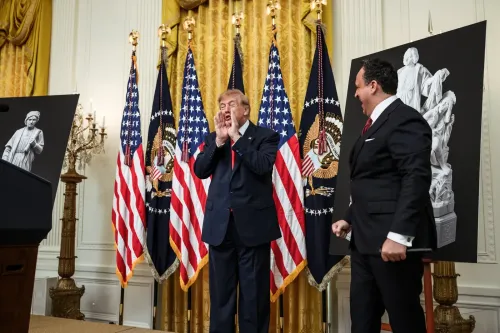
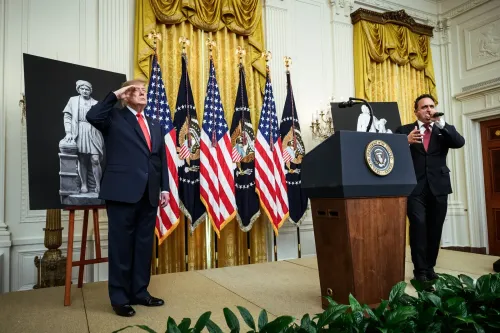
The White House posted a bold Columbus Day greeting on October 12, 2026, declaring 'America is back' — framing the federal holiday's revival as a deliberate cultural and political statement amid years of debate over replacing it with Indigenous Peoples' Day.
Key Takeaways
The White House marked Columbus Day on October 12, 2026 with an official post declaring 'America is back, and so is Columbus Day.' The statement signals a conscious embrace of the federal holiday after years of political pressure to replace it with Indigenous Peoples' Day .
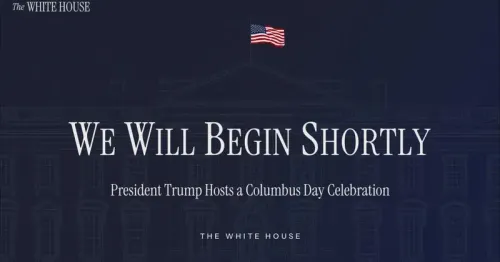
The post included a video and was shared from the official account of the Executive Office of the President of the United States .
The 'America is back' framing positions the holiday as a broader cultural reclamation, not just a calendar observance.
The debate over Columbus Day vs Indigenous Peoples' Day has divided American cities, states, and administrations for over a decade.
With a four-word declaration — 'America is back' — The White House marked Columbus Day on Monday, October 12, 2026, framing the federal holiday's renewed emphasis as a statement of cultural restoration after years of political debate over its place in the American calendar.
The official account of the Executive Office of the President posted a video greeting alongside the message 'America is back, and so is Columbus Day. HAPPY COLUMBUS DAY TO ALL!' — language that signals a deliberate departure from the trend of many cities and states that had replaced the October federal holiday with Indigenous Peoples' Day.
A Holiday at the Centre of America's Culture Wars
For much of the past decade, Columbus Day has sat at the intersection of American identity politics. The holiday, observed on the second Monday of October, commemorates the 1492 arrival of Genoese explorer Christopher Columbus in the Americas under Spanish commission. Supporters see it as a celebration of Italian-American heritage and Western civilisation; critics argue it erases the suffering of indigenous populations who experienced colonisation, displacement, and violence in the centuries that followed. Several Democratic-governed cities — including Los Angeles and Washington, DC — had formally adopted Indigenous Peoples' Day as an alternative, while the federal government under previous administrations had navigated the tension with careful, often muted, Columbus Day statements. The current White House's framing — 'America is back' — inverts that caution entirely.The 'America Is Back' Signal
The phrase carries deliberate rhetorical weight. It positions the celebration of Columbus Day not merely as a calendar formality but as a cultural and political reclamation — a pushback against what the administration's broader messaging has described as the erasure of American founding narratives. The pairing of Columbus Day with the 'America is back' tagline echoes themes of national pride and civilisational confidence that have defined executive-branch communications in this period. For Indian observers, the moment is a window into an American political culture sharply divided over history, memory, and who gets to define national identity — debates that resonate, in different registers, across democracies worldwide. The question the White House has now planted in the public square is sharper than any calendar dispute: whose story is the American story? The administration has given its answer, loudly, on the federal record.Point of View
It signals that the executive branch intends to contest — not concede — battles over historical memory and national identity. Internationally, it reaffirms that the United States under this administration sees cultural confidence as inseparable from geopolitical posture.
NationPress
13 Oct 2026
Frequently Asked Questions
What is Columbus Day and why is it controversial in the US?
Columbus Day is a US federal holiday observed on the second Monday of October, commemorating Christopher Columbus's 1492 arrival in the Americas. It is controversial because many argue it celebrates colonisation and the suffering of indigenous peoples, leading numerous cities and states to replace it with Indigenous Peoples' Day .
Did the White House reinstate Columbus Day in 2026?
The White House posted a celebratory Columbus Day message on October 12, 2026 , declaring 'America is back, and so is Columbus Day,' signalling a strong official embrace of the federal holiday after years of muted or contested observances.
What does 'America is back' mean in the White House Columbus Day post?
'America is back' is a rhetorical phrase used by the White House to frame the Columbus Day celebration as a cultural and political reclamation — a pushback against the trend of replacing the holiday with Indigenous Peoples' Day .
Which US cities celebrate Indigenous Peoples' Day instead of Columbus Day?
Several US cities, including Los Angeles and Washington, DC , have formally adopted Indigenous Peoples' Day as an alternative to Columbus Day, reflecting a broader movement to recognise the impact of colonisation on Native American communities.
Is Columbus Day still a federal holiday in the United States?
Yes, Columbus Day remains a US federal holiday , observed on the second Monday of October. Whether it is celebrated, replaced, or observed alongside Indigenous Peoples' Day varies by state and city.