White House Declares American Manufacturing Is Back
Synopsis
The White House declared on August 20, 2026 that American manufacturing is back, invoking the 'Made in America' slogan tied to a decades-long bipartisan push for domestic jobs, supply-chain security, and competition with China. Monthly BLS data will be the real test.
Key Takeaways
The White House posted on August 20, 2026 declaring American manufacturing has staged a comeback.
The post highlighted three pillars: Made in America output , American jobs , and American innovation . 'Buy American' provisions have statutory roots going back to the 2009 American Recovery and Reinvestment Act .
The 'Made in America' message has been used by presidents of both parties since the 2008 financial crisis , often tied to trade policy and competition with China .
Monthly Bureau of Labor Statistics manufacturing employment figures will be the key data point to watch against this claim.
Follow-on executive actions on procurement rules or tariffs could give the declaration its concrete policy weight.
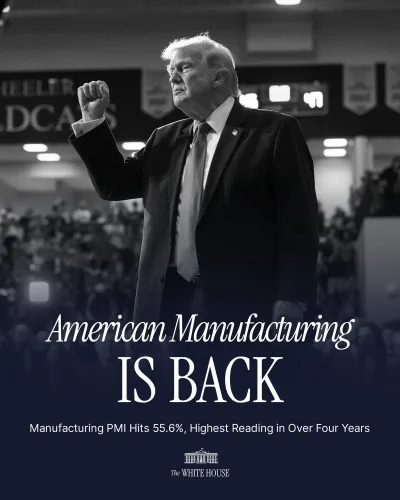
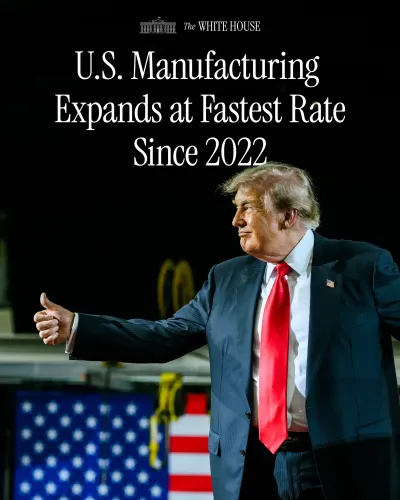
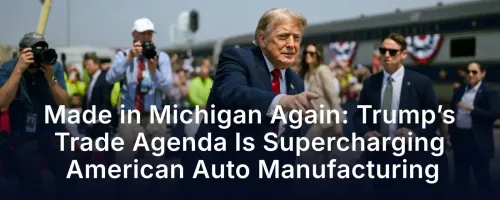
The flags are out and the message is unambiguous. The White House posted a tricolour-heavy declaration on Thursday, August 20, 2026, announcing that American manufacturing has staged a comeback — invoking the twin pillars of jobs and homegrown innovation in three sharp lines.
The 'Made in America' Playbook and Its Long Roots
The phrase 'Made in America' carries decades of political weight in Washington DC. Since the 2008 financial crisis, presidents of both parties have reached for factory-floor imagery to signal economic revival — and the rhetoric has almost always arrived packaged with trade policy, procurement rules, and supply-chain security arguments.
The statutory backbone dates at least to the 2009 American Recovery and Reinvestment Act, which embedded 'Buy American' provisions into federal spending. That lineage has been extended, tightened, and rebranded through successive administrations, each adding its own executive orders and tariff architecture to push domestic production.
Why Jobs and Innovation Are Named Together
The White House post singles out three pillars: manufacturing output, American jobs, and American innovation. That trio is deliberate. Manufacturing employment is a politically sensitive metric — one the Bureau of Labor Statistics tracks monthly — and pairing it with 'innovation' signals that the argument is no longer purely about blue-collar factory floors but also about semiconductor fabs, electric-vehicle plants, and advanced materials.
The competition-with-China dimension sits just beneath the surface of any 'reshoring' message: supply-chain vulnerabilities exposed during the pandemic years accelerated bipartisan consensus that domestic production capacity is a national-security issue, not merely an economic one.
What the Numbers Will Have to Prove
Declarations are easy; data is harder. The next monthly manufacturing employment release from the Bureau of Labor Statistics will be the immediate stress-test for the White House's claim. Analysts and lawmakers on both sides will scrutinise whether factory payrolls, capacity utilisation, and new facility announcements actually back the triumphant tone.
Any follow-on executive actions — on federal procurement thresholds, tariff schedules, or incentive programmes for domestic producers — would give the announcement its operational weight.
The banner is up. Now the scoreboard has to match it.
Point of View
The announcement has legs; if they don't, the triumphalism becomes a liability. Expect opposition lawmakers to demand the numbers almost immediately.
NationPress
20 Aug 2026
Frequently Asked Questions
What did the White House say about American manufacturing in August 2026?
The White House declared on August 20, 2026 that 'American manufacturing is BACK,' citing growth in Made in America production, American jobs, and American innovation.
What is the 'Made in America' policy in the United States?
'Made in America' refers to a set of federal policies and political messaging encouraging domestic production. Its statutory roots include 'Buy American' provisions in the 2009 American Recovery and Reinvestment Act, and the framework has been expanded by multiple administrations since.
Why does the US government push for American manufacturing?
US policymakers have linked domestic manufacturing to job creation, supply-chain security, and competition with China — concerns that intensified after the 2008 financial crisis and the pandemic-era disruptions to global supply chains.
How is US manufacturing performance measured?
The Bureau of Labor Statistics releases monthly manufacturing employment figures, which are the primary benchmark analysts and lawmakers use to assess the health of the US factory sector.
Does the 'Made in America' message come from one political party?
No. Presidents from both major US political parties have used 'Made in America' language and Buy American policies since at least 2009, making it a bipartisan rhetorical and policy tool.