White House Declares Women's Sports Exclusively for Women
Synopsis
The White House announced on 1 July 2026 that women's sports will henceforth be open only to biological women, issuing a sweeping federal policy declaration that intensifies the ongoing US debate over transgender athlete eligibility and could reshape federal funding conditions for schools and sporting bodies.
Key Takeaways
The White House declared on 1 July 2026 that women's sports will be exclusively for women, in a formal policy statement from the Executive Office of the President.
The directive applies going forward and could affect federal funding conditions under Title IX for schools, colleges, and sporting organisations.
The announcement escalates a long-running US national debate over transgender athlete participation in female sports categories.
Federal agencies including the Department of Education are expected to issue implementing guidance following the declaration.
Legal challenges from LGBTQ+ rights groups are widely anticipated, with courts likely to adjudicate the policy's scope and constitutionality.
International sporting bodies, including the International Olympic Committee , may face renewed pressure to align their eligibility frameworks with the US federal position.
The White House, the official communications account of the Executive Office of the President of the United States, announced on Tuesday, 1 July 2026 that women's sports will henceforth be restricted exclusively to biological women, signalling a sweeping federal policy directive on athletic eligibility.
Context
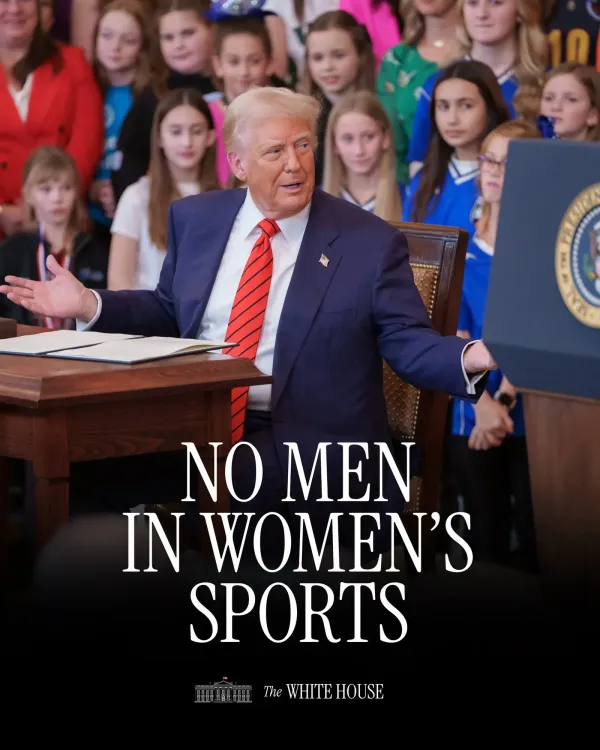
The post, published in all-caps — 'FROM NOW ON, WOMEN'S SPORTS WILL ONLY BE FOR WOMEN' — reflects a formal policy position from the White House, carrying the weight of the Executive Office of the President. The declaration is unambiguous in its scope, applying the restriction going forward across women's athletic competitions under federal jurisdiction or influence.
The statement comes amid a prolonged national debate in the United States over the participation of transgender women in female sports categories, a controversy that has spanned school athletics, collegiate competitions, and elite professional leagues.
Policy Backdrop
The question of transgender athlete eligibility has been a flashpoint in American politics for several years. Various US states had already passed legislation restricting participation in women's sports to individuals assigned female at birth, with legal challenges following in multiple jurisdictions.
At the federal level, earlier executive actions had directed agencies to interpret sex in athletic contexts in biological terms. This latest declaration from the White House appears to consolidate and extend that position as a firm, standing policy — one that could affect federal funding conditions for schools and sporting bodies under Title IX and related statutes.
International sporting bodies, including World Athletics and the International Olympic Committee, have each adopted their own — sometimes divergent — frameworks on transgender and intersex athlete participation, creating a patchwork of rules that this US federal stance now cuts across sharply.
Stakeholders and Impact
The directive is expected to affect a wide range of institutions: K-12 schools, colleges and universities receiving federal funding, and professional sporting organisations operating within US federal frameworks. Compliance with the policy could become a condition tied to federal grants and Title IX protections.
Advocacy groups on both sides of the debate are likely to respond swiftly. Groups championing women's sports fairness have long sought exactly this kind of federal clarity, while LGBTQ+ rights organisations are expected to mount legal challenges arguing the policy discriminates against transgender individuals.
For India, where sports federations often align their eligibility rules with international bodies rather than US federal policy, the direct regulatory impact is limited. However, the declaration carries significant symbolic weight globally, as the United States' position on such matters tends to influence international sporting governance discussions.
What's Next
The White House declaration is likely to be followed by formal regulatory guidance to federal agencies, particularly the Department of Education and the Department of Health and Human Services, on enforcement mechanisms. Legal battles are anticipated, with courts likely to determine the precise scope and constitutionality of the policy.
International sporting federations and the International Olympic Committee will face renewed pressure to align — or explicitly diverge — from the US federal stance ahead of future global competitions. The policy sets a firm baseline that will define the American position in those negotiations for the foreseeable future.
Point of View
All-caps declaration marks a significant hardening of the US federal government's stance on sports eligibility, moving from agency-level guidance to an unambiguous executive-level proclamation. By framing the policy as a clean, forward-looking rule — 'from now on' — the administration signals it intends this to be a settled matter rather than an ongoing regulatory debate. The move is strategically timed to pre-empt legal grey zones before major sporting cycles and to consolidate a political base that has made this issue a culture-war centrepiece. Globally, it places the United States at the assertive end of a spectrum on which international sporting bodies have so far tried to maintain more nuanced, case-by-case frameworks.
NationPress
30 Jun 2026
Frequently Asked Questions
What did the White House say about women's sports?
The White House declared on 1 July 2026 that women's sports will be restricted exclusively to biological women, stating 'FROM NOW ON, WOMEN'S SPORTS WILL ONLY BE FOR WOMEN' in an official post from the Executive Office of the President.
Does the White House women's sports order ban transgender athletes?
The White House declaration effectively excludes transgender women from women's sports categories under US federal policy, though formal regulatory guidance detailing enforcement is expected to follow from agencies such as the Department of Education.
How does this White House policy affect schools and colleges in the US?
Schools and colleges receiving federal funding could face compliance requirements tied to Title IX, potentially making adherence to the women-only eligibility rule a condition for federal grants and protections.
Will this US women's sports policy affect India or Indian athletes?
The direct regulatory impact on India is limited, as Indian sports federations follow international body guidelines rather than US federal law. However, the US stance may influence global sporting governance debates that affect Indian athletes competing internationally.
Can the White House women's sports declaration be challenged in court?
Yes. LGBTQ+ rights organisations are widely expected to file legal challenges arguing the policy discriminates against transgender individuals, and US federal courts will likely determine the policy's precise scope and constitutionality.