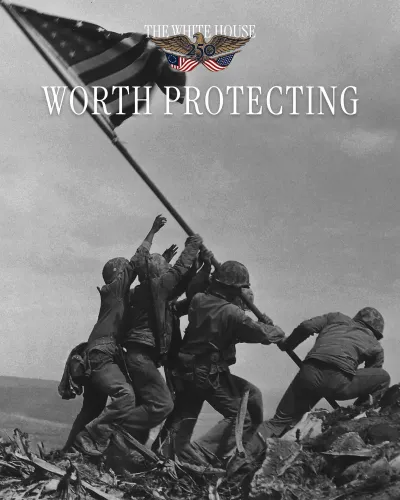
White House Draws Hard Line: Communism vs Patriotism on July 4
Synopsis
On America's Independence Day, 4 July 2026, the White House declared that communism and patriotism are mutually exclusive, reviving a Cold War-era rhetorical framing in a brief but pointed post that is drawing wide political attention across the United States.
Key Takeaways
The White House posted on 4 July 2026 — U.S.
Independence Day — that 'you can be a communist or you can be a patriot, but not both.' The statement draws on a rhetorical tradition dating to the 1947 Truman Doctrine , which framed communism as incompatible with American democratic values.
No specific policy, legislation, or named individual was referenced in the post; it is a standalone ideological declaration.
The post was published on the symbolic occasion of the 250th anniversary of American independence, amplifying its resonance.
Reactions from Congress , political groups, and civil-liberties advocates are expected to follow in the coming days.
The White House, the official communications account of the Executive Office of the President of the United States, posted a stark ideological declaration on 4 July 2026 — American Independence Day — asserting that communism and patriotism are mutually exclusive values.
The post read: 'You can be a communist or you can be a patriot. You cannot be both.' The message, brief and unambiguous, was published at a moment when the United States was observing its 250th Independence Day, a milestone that has prompted wide national reflection on founding principles.
Context
The statement arrives on one of the most symbolically loaded dates in the American calendar. July 4 commemorates the 1776 adoption of the Declaration of Independence, a document that enshrined individual liberty and self-governance as foundational national values. Official White House messaging on this date has historically leaned into constitutional principles as defining markers of American identity.
The framing — patriotism as incompatible with communist ideology — is not new to American political discourse. It draws on a rhetorical tradition that stretches back to the post-World War II era and the early years of the Cold War, when the United States defined itself in explicit opposition to Soviet-style communism.
Policy Backdrop
The intellectual lineage of this kind of declaration runs through decades of American governance. As far back as 1947, the Truman Doctrine framed the global contest between democratic and communist systems as a civilisational choice, one that demanded loyalty from American citizens and allies alike. That framing shaped U.S. foreign and domestic policy for much of the 20th century.
Periodic revivals of this rhetoric in domestic politics have often coincided with elections, national holidays, or moments of ideological polarisation. Statements of this nature from official government channels carry particular weight because they represent the institutional voice of the presidency, not merely a partisan position.
Stakeholders and Impact
The audience for such a declaration is broad. U.S. citizens across the political spectrum will interpret the message through their own ideological lenses — for some, it reaffirms core constitutional values; for others, it raises questions about the boundaries of political expression and the definition of patriotism in a pluralist democracy.
Political groups on both the left and right are likely to respond. Progressive and civil-liberties advocates may flag concerns about the conflation of a political ideology with disloyalty, while conservative voices are expected to amplify the message as a restatement of American exceptionalism. The post's brevity gives it a slogan-like quality that lends itself to wide circulation ahead of any upcoming electoral cycle.
What's Next
Reactions from members of Congress and political commentators are anticipated in the hours and days following the post. Any follow-on statements from the White House or allied officials during the July 4 holiday weekend could sharpen or contextualise the message further.
As the United States moves deeper into a politically charged period, declarations of this nature from the official executive account are likely to set the tone for broader debates about governance, ideology, and national identity in the months ahead.
Point of View
Shareable, and historically resonant. By invoking the patriotism-versus-communism binary, the executive office is deliberately reaching back to Cold War-era framing that has proven durable across administrations. The statement's lack of a specific policy target gives it flexibility: it can serve as a cultural signal, an electoral prompt, or simply a restatement of institutional identity. What it reveals most clearly is that ideological line-drawing remains a live instrument of American political communication, not a relic of the 20th century.
NationPress
4 Jul 2026
Frequently Asked Questions
What did the White House post on July 4 2026?
The White House posted the statement: 'You can be a communist or you can be a patriot. You cannot be both,' on 4 July 2026, American Independence Day.
Why did the White House post about communism on Independence Day?
The White House has not provided an explicit reason, but official messaging on July 4 traditionally emphasises foundational American values. The framing echoes a long-standing U.S. political tradition of contrasting patriotism with communist ideology, particularly visible since the Cold War era.
Is it illegal to be a communist in the United States?
No. Communist Party membership and communist political beliefs are protected under the First Amendment to the U.S. Constitution. The White House post is a political and rhetorical statement, not a legal declaration.
What is the history of anti-communist rhetoric in U.S. politics?
Anti-communist rhetoric became a dominant strand of American political discourse after World War II. The 1947 Truman Doctrine formally framed the global contest as one between democracy and communism, shaping U.S. foreign and domestic policy for decades and influencing presidential communication ever since.
How are Indians and the global community reacting to the White House post?
Formal reactions are still emerging. Political observers globally are watching for responses from U.S. lawmakers, civil-liberties groups, and allied governments, particularly as the statement coincides with a politically sensitive period in American domestic politics.