White House Highlights Business Growth Tied to US Manufacturing Push
Synopsis
The White House on 25 July 2026 amplified a business testimonial crediting federal policies — including the CHIPS Act and Inflation Reduction Act — for driving increased interest and growth in domestic manufacturing, reinforcing the administration's reshoring economic agenda.
Key Takeaways
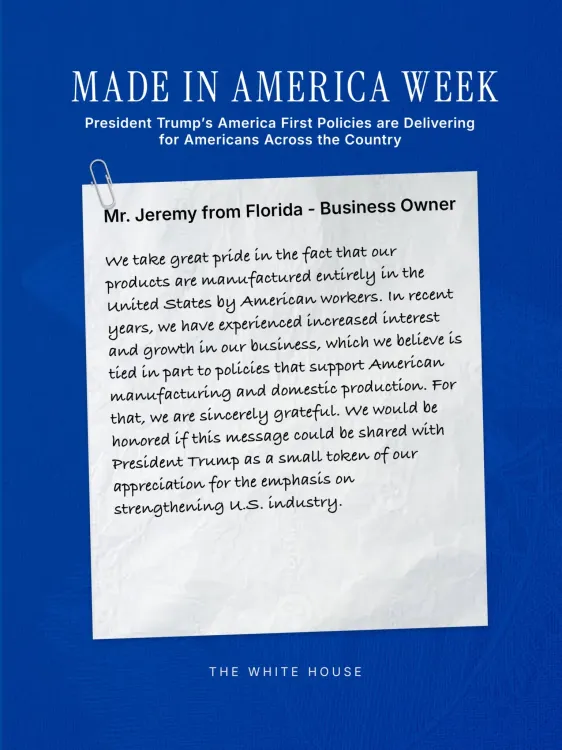
The White House posted a business quote on 25 July 2026 citing growth tied to policies supporting American manufacturing.
The CHIPS and Science Act (2022) provided over $50 billion in subsidies to boost domestic semiconductor production.
The Inflation Reduction Act (2022) offered tax credits and grants for clean energy manufacturing and domestic supply chains.
A 2021 Executive Order directed federal agencies to prioritise domestic sourcing in procurement.
US reshoring efforts accelerated after COVID-19 exposed critical supply-chain vulnerabilities, with strategic competition with China adding urgency.
Upcoming federal data on factory orders and capital expenditure will indicate how broadly manufacturing growth is materialising.
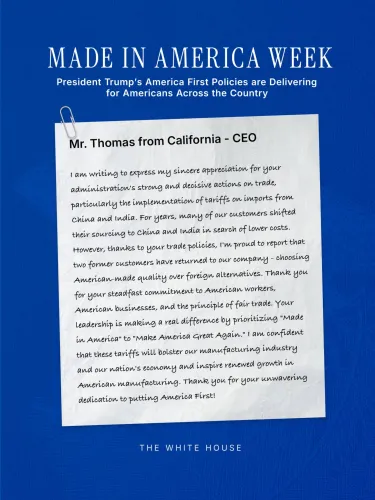
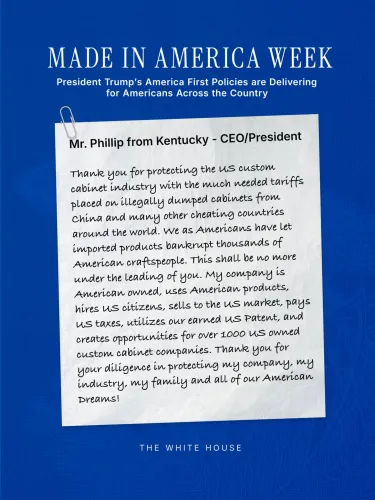
The White House on Saturday, 25 July 2026 shared a business testimonial on X underscoring how federal policies supporting American manufacturing and domestic production have driven measurable commercial growth, amplifying a key pillar of the current administration's economic messaging.
The post quoted an unnamed business stating: 'In recent years, we have experienced increased interest and growth in our business, which we believe is tied in part to policies that support American manufacturing and domestic production.'
Context
The quote reflects a pattern of the White House amplifying private-sector voices to validate its industrial policy agenda. The administration has consistently pointed to business investment announcements as evidence that reshoring efforts are yielding tangible results. The testimonial format is part of a broader communications strategy aimed at building public and legislative support for continued domestic production incentives.
Policy Backdrop
Two landmark laws form the backbone of Washington's manufacturing revival push. The CHIPS and Science Act, signed into law in 2022, allocated over $50 billion in subsidies and incentives to expand domestic semiconductor manufacturing and research. Separately, the Inflation Reduction Act of 2022 offered sweeping tax credits and grants to promote clean energy manufacturing and domestic supply chains.
An Executive Order on Strengthening Buy American Requirements, issued in 2021, further directed federal agencies to prioritise domestic sourcing in procurement decisions. Together, these measures represent a bipartisan consensus — built over successive administrations — that reducing reliance on foreign production is both an economic and a national security imperative. Supply-chain disruptions exposed during the COVID-19 pandemic accelerated this policy shift considerably.
Stakeholders and Impact
US manufacturers across sectors — from semiconductors and electric vehicles to steel and pharmaceuticals — have been the primary intended beneficiaries of these policies. Reported increases in domestic investment announcements, particularly in advanced manufacturing, align with the sentiment expressed in the White House post. The strategic competition with China has added urgency to these efforts, with policymakers framing reshoring as essential to long-term economic resilience.
Small and mid-sized manufacturers, who may lack the lobbying footprint of large corporations, have also cited policy certainty and federal procurement preferences as factors enabling expansion. The White House's choice to highlight a business testimonial — rather than aggregate data — signals an effort to make these macro-level policies feel tangible to everyday Americans and small business owners.
What's Next
Upcoming quarterly reports on US factory orders and capital expenditures from federal statistical agencies will offer a data-driven measure of how broadly manufacturing growth is being felt across the economy. Congressional debates over the continuation and funding of existing incentive programmes will determine whether the current policy architecture holds through the next budget cycle. For global observers, including India, the trajectory of American industrial policy carries implications for trade flows, supply-chain partnerships, and investment competition in sectors such as semiconductors and clean energy.
Point of View
Likely with an eye on sustaining political support for expensive subsidy programmes. The post fits a broader arc in which both parties have embraced economic nationalism, making domestic manufacturing a rare zone of bipartisan consensus. For countries like India, which compete for semiconductor and clean energy investment, Washington's sustained policy commitment is a variable that cannot be ignored.
NationPress
25 Jul 2026
Frequently Asked Questions
What policies is the White House promoting for American manufacturing?
The White House has highlighted the CHIPS and Science Act, the Inflation Reduction Act, and Buy American executive orders as key policies driving domestic manufacturing growth.
What is the CHIPS and Science Act?
The CHIPS and Science Act is a 2022 US law that provided over $50 billion in subsidies and incentives to expand domestic semiconductor manufacturing and research.
How has the Inflation Reduction Act helped US manufacturers?
The Inflation Reduction Act of 2022 offered tax credits and grants specifically aimed at promoting clean energy manufacturing and strengthening domestic supply chains.
Why is the US pushing for more domestic manufacturing?
Supply-chain disruptions during the COVID-19 pandemic and strategic competition with China prompted the US to prioritise reshoring manufacturing to boost economic resilience and national security.
What comes next for US manufacturing policy?
Upcoming federal reports on factory orders and capital expenditure will test the real-world impact of current policies, while congressional debates will decide whether existing incentive programmes are renewed or expanded.