Trump Announces New Push on American Nuclear Innovation
Synopsis
President Trump made a major announcement on American nuclear innovation on 26 July 2026, as the White House signalled fresh federal commitment to advanced reactor technology, small modular reactors, and domestic nuclear supply chains amid intensifying competition from Russia and China.
Key Takeaways
The White House announced on 26 July 2026 that President Trump has made a major announcement on American nuclear innovation.
The announcement aligns with a long-running US push to reclaim civilian nuclear leadership from Russia and China .
During his first term, Trump backed the Nuclear Energy Innovation and Modernization Act (2019) to fast-track advanced reactor licensing.
The Department of Energy leads federal programmes on small modular reactors and advanced fuel cycles central to this policy agenda.
The announcement could affect US nuclear export policy , with implications for countries including India , which has deep civil nuclear ties with Washington.
Congressional appropriations and potential new executive orders on fuel fabrication and export controls are the key follow-on developments to watch.
The White House announced on Saturday, 26 July 2026 that President Donald Trump has made a major announcement concerning American nuclear innovation, signalling fresh federal momentum behind the United States' civilian and strategic nuclear agenda.
Context
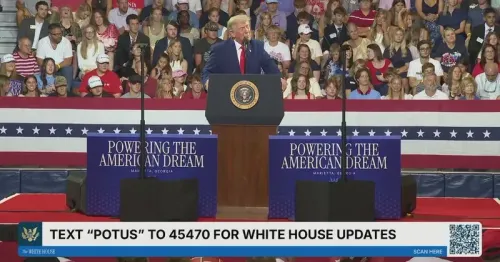
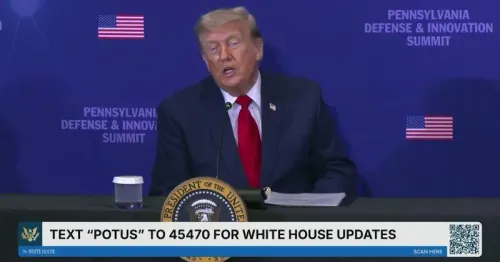
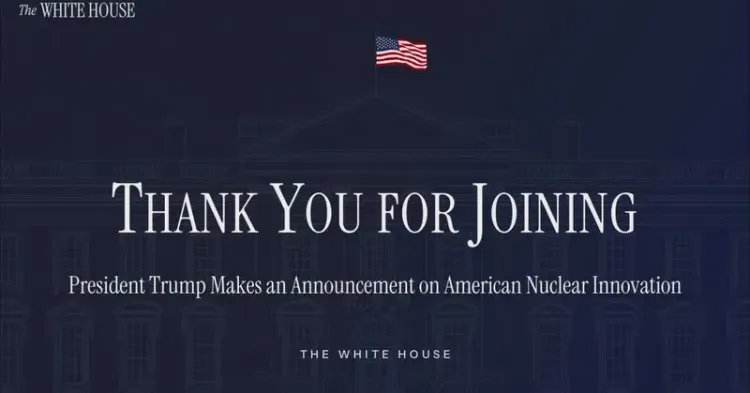
The White House posted that 'President Trump Makes an Announcement on American Nuclear Innovation,' accompanied by a live broadcast link. While the precise details of the announcement are emerging, the move fits a broader pattern of the Trump administration using executive action to reaffirm federal commitment to domestic nuclear technology and supply chains.
The United States has spent recent decades attempting to reclaim its position as the world's leading civilian nuclear power, a status eroded by decades of regulatory delays, plant closures, and aggressive competition from Russia and China, both of which have used state-backed nuclear exports as instruments of geopolitical influence.
Policy Backdrop
During his first term, President Trump backed the Nuclear Energy Innovation and Modernization Act in 2019, which directed the Nuclear Regulatory Commission to develop a faster, more cost-effective licensing framework for advanced reactors. That legislation was widely seen as a turning point in federal nuclear policy after years of inertia.
The Department of Energy has since led programmes on small modular reactors (SMRs), advanced fuel cycles, and next-generation reactor designs. Successive administrations — regardless of party — have identified nuclear energy as essential to meeting both decarbonisation goals and national security requirements, particularly for powering defence installations and data infrastructure.
The July 2026 announcement continues this executive-level signalling, with the White House choosing a live broadcast format to underscore the significance of the moment and reach a broad domestic and international audience.
Stakeholders and Impact
The announcement carries direct implications for the US nuclear industry, which has lobbied aggressively for streamlined permitting, federal loan guarantees, and support for domestic uranium enrichment capacity. Energy firms developing SMR technology and advanced reactor designs stand to benefit most if the announcement includes regulatory relief or new funding commitments.
For India, the announcement is closely watched. New Delhi and Washington DC have deepened civil nuclear cooperation since the landmark Indo-US Civil Nuclear Agreement, and any shift in American nuclear export policy or technology-sharing frameworks could have downstream effects on India's own ambitious nuclear energy expansion programme, which targets significant capacity addition over the coming decades.
Global energy markets will also take note, as a renewed US push in nuclear could reshape competition for reactor contracts across Southeast Asia, the Middle East, and Eastern Europe — regions where Russian and Chinese vendors have dominated recent bids.
What's Next
Analysts will watch for Congressional appropriations for Department of Energy nuclear programmes in the wake of this announcement, as well as any new executive orders on fuel fabrication, uranium enrichment, or nuclear export controls. The administration's ability to translate executive announcements into durable policy will depend on legislative support and regulatory follow-through from the Nuclear Regulatory Commission.
If the announcement includes specific targets, funding figures, or new partnerships, it could mark one of the most consequential federal nuclear policy moments in a generation — reshaping the energy and geopolitical landscape well into the 2030s.
Point of View
The White House is signalling that this is not routine policy but a headline-level commitment intended for both domestic industry and foreign partners. The announcement arrives as American nuclear firms compete fiercely against state-backed Russian and Chinese vendors for contracts across Asia, the Middle East, and Europe. Whether executive intent translates into durable policy will depend on Congressional funding and regulatory action — the perennial gap in US nuclear ambition.
NationPress
25 Jul 2026
Frequently Asked Questions
What did Trump announce about nuclear energy in July 2026?
The White House announced on 26 July 2026 that President Trump made a major announcement on American nuclear innovation, signalling renewed federal support for advanced reactor technology and domestic nuclear supply chains. Specific details of the announcement were broadcast live by the White House.
What is the US policy on small modular reactors?
The Department of Energy has led federal programmes on small modular reactors (SMRs) for several years, aiming to develop faster-to-build, lower-cost nuclear plants. The Nuclear Energy Innovation and Modernization Act of 2019 , backed by Trump in his first term, created a streamlined licensing pathway for these advanced designs.
How does Trump's nuclear announcement affect India?
India and the United States have maintained close civil nuclear ties since the landmark Indo-US Civil Nuclear Agreement . Any shift in American nuclear export policy, technology-sharing frameworks, or fuel supply arrangements stemming from this announcement could have significant implications for India's nuclear energy expansion programme .
Why is the US pushing nuclear energy again?
The United States is seeking to reclaim civilian nuclear leadership lost to Russia and China , both of which use state-backed nuclear exports as geopolitical tools. Nuclear energy is also seen as critical to decarbonisation goals , national security, and powering high-demand infrastructure like data centres.
What should I watch for after Trump's nuclear announcement?
Key follow-on developments include Congressional appropriations for Department of Energy nuclear programmes, potential new executive orders on uranium enrichment or export controls, and any formal agreements with allied nations on nuclear technology cooperation.