White House Backs 'Most Consequential' Budget Bill in US History
Synopsis
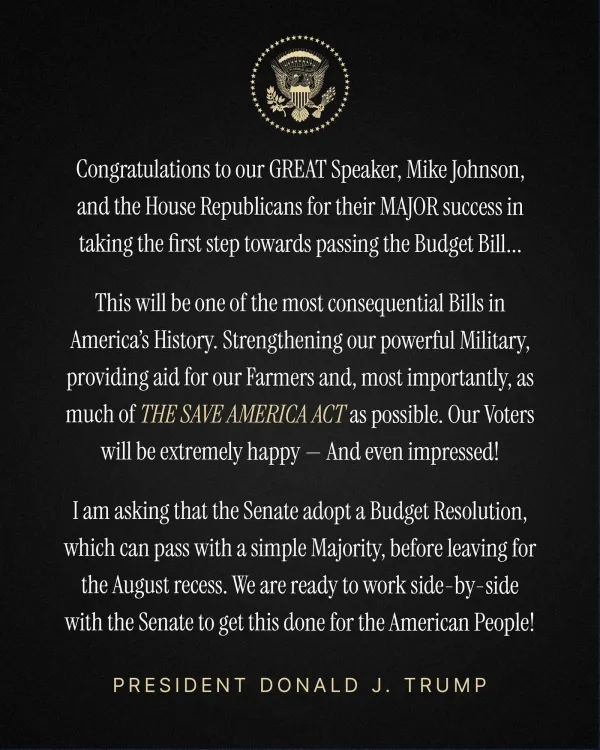
The White House on 24 July 2026 called the proposed Budget Resolution 'one of the most consequential Bills in America's History,' urging Congress to pass it to boost military funding, deliver farm aid, and advance as much of the Save America Act as possible.
Key Takeaways
The White House publicly urged Congress on 24 July 2026 to pass a sweeping Budget Resolution .
The administration called the bill 'one of the most consequential Bills in America's History.' Three stated priorities: strengthening the US military , providing aid to farmers , and advancing the Save America Act .
Budget resolutions set annual federal spending targets under the Congressional Budget and Impoundment Control Act of 1974 .
Bundling defence and agricultural spending is a historic legislative strategy to build congressional majorities.
Floor votes, procedural hurdles, and Senate parliamentarian rulings will determine how much of the agenda survives.
The White House on Friday, 24 July 2026 issued a forceful call for the passage of a sweeping Budget Resolution, describing it as 'one of the most consequential Bills in America's History' and urging Congress to advance legislation combining defence funding, farm aid, and provisions from what it termed the Save America Act.
Context
The official White House post on X called on lawmakers to 'Pass the BUDGET RESOLUTION for strengthening our powerful Military, providing aid for our Farmers and, most importantly, as much of THE SAVE AMERICA ACT as possible.' The statement signals that the executive branch is actively lobbying both chambers of Congress to move quickly on a measure the administration considers historic in scope.
Budget resolutions are the formal mechanism through which Congress sets annual spending targets for all federal programmes. Under the Congressional Budget and Impoundment Control Act of 1974, a budget resolution does not carry the force of law on its own but establishes the framework within which appropriations bills must operate — making its passage a critical first step for any major spending agenda.
Policy Backdrop
Bundling defence increases with agricultural support is a well-established legislative strategy in Washington DC. Lawmakers from farm-heavy states have historically demanded protections for rural constituencies in exchange for backing higher military outlays, producing coalition-building dynamics that often result in large omnibus packages.
The US Armed Forces receive their funding through defence appropriations tied directly to the figures set in budget resolutions. A significant increase in those topline numbers would affect procurement, personnel, and readiness programmes across all service branches. Similarly, agricultural aid provisions carry weight with rural-state senators and House members whose votes are frequently decisive on close procedural tallies.
The White House's explicit mention of the Save America Act as the 'most important' component suggests the administration views the broader resolution primarily as a vehicle for that legislation's provisions, with defence and farm spending serving as the political architecture needed to assemble a majority.
Stakeholders and Impact
The two most directly named constituencies are US defence forces and American farmers. For the military, a budget resolution that raises spending caps could unlock billions in additional procurement and readiness funding. For the agricultural sector, embedded aid provisions could mean expanded subsidies, crop insurance reforms, or emergency relief mechanisms.
Fiscal conservatives within Congress are likely to scrutinise the overall cost of the package, while progressive members may push back on defence-heavy allocations. The procedural path — including filibuster thresholds in the Senate and Freedom Caucus dynamics in the House — will determine how much of the White House's stated agenda survives floor amendments.
What's Next
Floor action in both chambers will be the immediate focus, with procedural votes on the budget resolution expected to test the administration's legislative whip count. Any attempt to incorporate the full text of the Save America Act will face scrutiny from the Senate parliamentarian under reconciliation rules, which restrict what provisions can be bundled into a budget measure.
The White House's public pressure campaign — framing the bill as among the most consequential in national history — is designed to generate constituent pressure on swing-district lawmakers. How Congress responds in the coming days will signal whether the administration has the votes to advance its sweeping legislative agenda before the next recess.
Point of View
A tactic that has precedent in major legislative pushes from both parties. By explicitly naming the Save America Act as the 'most important' element, the administration signals that defence and farm provisions are political sweeteners rather than ends in themselves — a classic inside-outside lobbying strategy. The move also pre-empts opposition by anchoring the bill to patriotism and rural welfare, two themes with broad cross-partisan resonance. Whether this messaging converts into floor votes will reveal the true state of the administration's congressional relationships.
NationPress
23 Oct 2026
Frequently Asked Questions
What is the Budget Resolution the White House is pushing for?
A Budget Resolution is a congressional measure that sets annual federal spending targets. The White House is urging Congress to pass one that covers increased military funding, agricultural aid, and provisions from the Save America Act.
What is the Save America Act?
The White House described the Save America Act as the most important component of the Budget Resolution, but specific details of the Act's provisions have not been publicly verified beyond the administration's statement.
Why is the White House calling this one of the most consequential bills in US history?
The administration's statement frames the bill as historically significant due to its combination of military strengthening, farm support, and the Save America Act, though independent assessments of that claim have not yet been made.
How does a budget resolution become law in the United States?
Under the Congressional Budget and Impoundment Control Act of 1974, a budget resolution sets spending targets but does not carry the force of law on its own. It must pass both the House and Senate and serves as the framework for subsequent appropriations legislation.
What happens next after the White House called for the Budget Resolution vote?
Both chambers of Congress will hold floor votes and procedural tallies. The Senate parliamentarian will also rule on which provisions can be included under reconciliation rules, shaping the final shape of the bill.