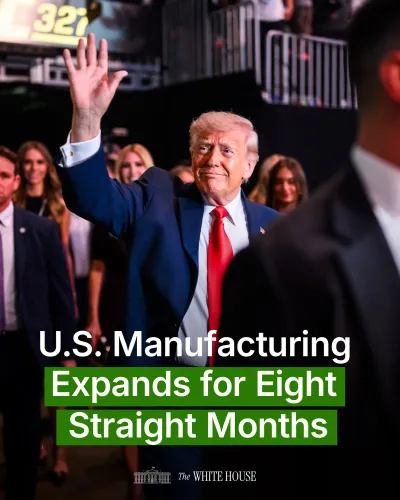
White House Claims US Manufacturing Expands for Fifth Straight Month
Synopsis
The White House declared on June 1, 2026, that US manufacturing has expanded for five consecutive months, pointing to a sustained industrial recovery backed by the CHIPS and Science Act and Inflation Reduction Act. The ISM Manufacturing PMI, where readings above 50 signal growth, is the key benchmark underpinning the claim.
Key Takeaways
The White House announced on June 1, 2026 , that US manufacturing has expanded for five consecutive months .
The ISM Manufacturing PMI is the standard benchmark; a reading above 50 indicates sector expansion.
The CHIPS and Science Act of 2022 authorised more than $50 billion in subsidies to rebuild domestic manufacturing and semiconductor capacity.
The Inflation Reduction Act of 2022 added tax credits and grants targeting clean-energy and advanced manufacturing.
The next ISM PMI report , due in early July 2026 , will confirm whether the expansion streak reaches a sixth month.
The trend carries indirect implications for India , particularly exporters in pharma, auto components, and supply-chain-linked sectors.
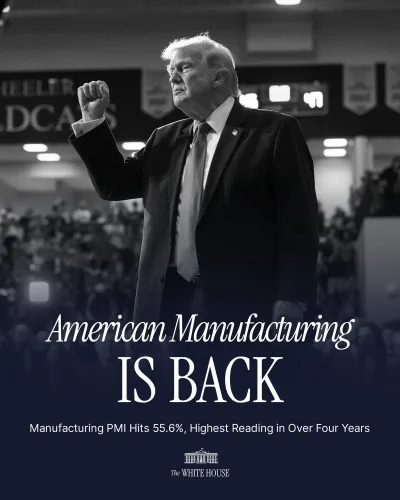
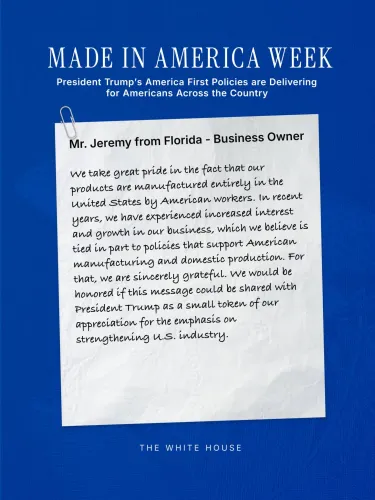
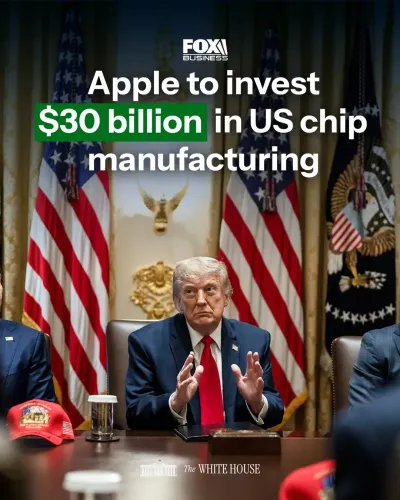
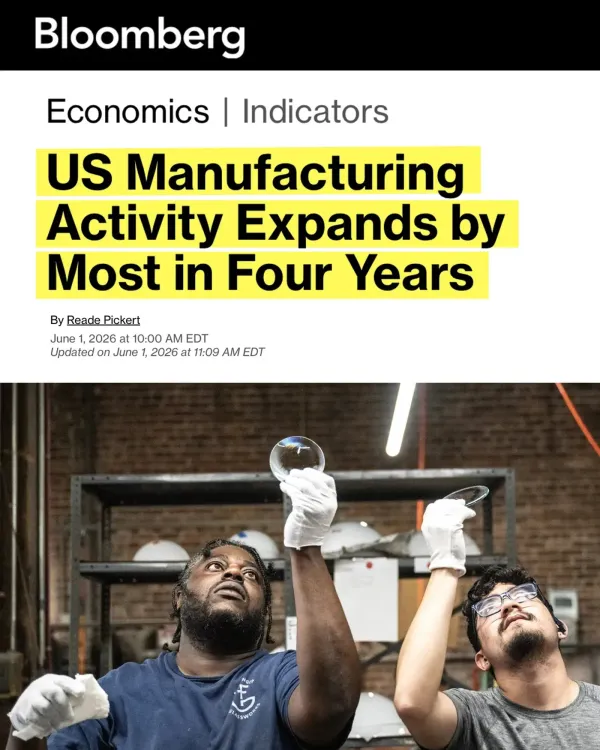
The White House, the official communications account of the Executive Office of the President of the United States, declared on Monday, June 1, 2026, that American manufacturing has expanded for a fifth consecutive month, calling it a sign that 'American Manufacturing is BACK.'
Context
The post, shared on June 1, 2026, coincides with the typical release window for the monthly Manufacturing Purchasing Managers' Index (PMI) published by the Institute for Supply Management (ISM). A PMI reading above 50 signals that the manufacturing sector is expanding; a reading below 50 indicates contraction. Five consecutive readings above that threshold would mark a sustained recovery phase not seen in recent years.
The White House's announcement frames the data as a policy victory, though the specific index figures cited in the linked content have not been independently verified by NationPress.
Policy Backdrop
The claim of a manufacturing resurgence comes against the backdrop of two landmark legislative interventions. The CHIPS and Science Act of 2022 authorised more than $50 billion in federal subsidies and incentives to rebuild domestic semiconductor and advanced manufacturing capacity. Separately, the Inflation Reduction Act of 2022 channelled tax credits and grants toward clean-energy and advanced manufacturing investments across the country.
Both laws were designed to reverse decades of offshoring and reduce American dependence on foreign supply chains — a vulnerability exposed sharply during the 2020-21 pandemic-era supply disruptions. Executive Order 14017, issued in 2021, had earlier directed federal agencies to map and address critical supply-chain gaps, laying the administrative groundwork for these legislative measures.
Monthly PMI data have periodically tracked upward alongside these policy interventions, though economists caution that the relationship between subsidy legislation and near-term output readings is complex and influenced by global demand cycles, interest rates, and trade policy.
Stakeholders and Impact
U.S. factory workers and domestic manufacturing firms stand as the most direct beneficiaries if the expansion trend holds. Sustained PMI growth typically correlates with hiring activity, capital investment, and increased order volumes across sectors ranging from semiconductors to automotive and heavy machinery.
For India, developments in American manufacturing carry indirect but significant implications. A resurgent U.S. industrial base could reshape global supply-chain configurations, affecting Indian exporters in sectors such as pharmaceuticals, auto components, and IT-enabled manufacturing services. It may also influence the trajectory of bilateral trade negotiations between New Delhi and Washington.
Investors tracking emerging-market exposure to the United States economy will watch whether the expansion is broad-based or concentrated in sectors receiving direct federal support under the CHIPS and Inflation Reduction Acts.
What's Next
The next monthly ISM Manufacturing PMI report, expected in early July 2026, will be closely watched to determine whether the streak extends to a sixth month. Regional Federal Reserve manufacturing surveys — including those from Philadelphia, New York, and Dallas — will provide supplementary data points in the weeks ahead.
If the expansion continues, the White House is likely to amplify the narrative ahead of the 2026 midterm election cycle, positioning manufacturing revival as a centrepiece of its economic record. Analysts will also scrutinise whether headline PMI gains are accompanied by meaningful growth in manufacturing employment and capital expenditure, or whether they reflect inventory restocking and order-book volatility.
Point of View
If implicit, line between the CHIPS and Inflation Reduction Acts and on-the-ground factory output, a connection economists treat with caution given the multiple variables at play. For observers in India and other trade-linked economies, the durability of this expansion matters more than the headline: a structurally stronger US manufacturing base could redraw global supply chains and alter the competitive calculus for emerging-market exporters. The real test will come when the ISM data is disaggregated — whether growth is broad-based or sector-specific will determine how much political capital the administration can credibly claim.
NationPress
16 Oct 2026
Frequently Asked Questions
What does it mean that US manufacturing expanded for five months in a row?
It means the ISM Manufacturing PMI has recorded readings above 50 for five consecutive months, signalling that factory output, new orders, and employment in the sector have been growing rather than contracting over that period.
What is the ISM Manufacturing PMI and why does it matter?
The Institute for Supply Management (ISM) publishes a monthly diffusion index called the Manufacturing PMI. A reading above 50 indicates expansion; below 50 signals contraction. It is one of the most closely watched leading indicators of US industrial health.
How does the CHIPS Act relate to US manufacturing growth?
The CHIPS and Science Act of 2022 authorised more than $50 billion in federal subsidies to encourage domestic semiconductor and advanced manufacturing investment, aiming to reduce US reliance on foreign-made components and boost factory activity over the medium term.
How does US manufacturing expansion affect India?
A sustained US manufacturing revival could reshape global supply chains, potentially affecting Indian exporters in sectors such as pharmaceuticals, auto components, and IT-enabled manufacturing. It may also influence the terms of ongoing India-US bilateral trade discussions.
When is the next US manufacturing PMI report released?
The next ISM Manufacturing PMI report is expected in early July 2026 , and will confirm whether the expansion streak extends to a sixth consecutive month.