White House Mourns Senator Lindsey Graham as 'Great Patriot'

Synopsis
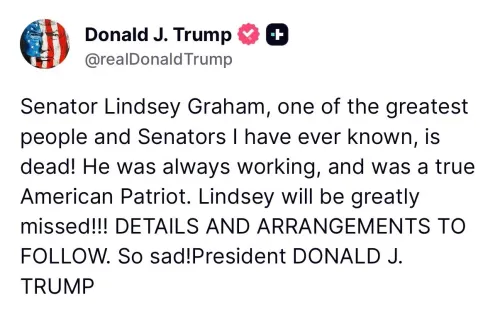
The White House on 13 July 2026 mourned Senator Lindsey Graham, a South Carolina Republican who served in the U.S. Senate since 1997, hailing him as a 'great patriot and true statesman' with a 'colossal impact and remarkable legacy' that would never be forgotten.
Key Takeaways
The White House posted a formal tribute to Senator Lindsey Graham on 13 July 2026 .
Graham is described as a 'great patriot and true statesman' with a 'colossal impact and remarkable legacy.' Graham served as a Republican U.S.
Senator from South Carolina since 1997 , spanning nearly three decades.
He held senior roles on the Senate Armed Services Committee and the Senate Foreign Relations Committee .
A successor appointment process in South Carolina and congressional memorial resolutions are expected to follow.
The White House, the official communications account of the Executive Office of the President of the United States, paid tribute to Senator Lindsey Graham on Monday, 13 July 2026, calling him a 'great patriot and true statesman' whose legacy would never be forgotten.
Context
The White House post stated: 'Lindsey Graham was a great patriot and true statesman. His colossal impact and remarkable legacy will never be forgotten.' The tribute marks the passing of one of the most prominent figures in recent United States Senate history, a lawmaker whose career spanned nearly three decades on Capitol Hill.
Graham had served as a Republican U.S. Senator from South Carolina since 1997, when he was first appointed to fill a vacancy. He went on to win multiple re-elections, cementing his position as a senior voice on national security and foreign affairs.
Policy Backdrop
Over the course of his Senate career, Graham held influential positions on the Senate Armed Services Committee and the Senate Foreign Relations Committee, including leadership roles. His legislative footprint extended across defence authorisation bills, military aid packages, and international treaty debates.
White House tributes to deceased senators follow a long-standing institutional practice of recognising extended public service, often cutting across partisan lines. Such statements are designed to honour the office as much as the individual, underscoring continuity of democratic norms.
Stakeholders and Impact
Graham's passing leaves a significant vacancy in the Republican caucus, particularly within the foreign policy and defence communities where he was regarded as a hawkish but bipartisan voice. His decades of committee leadership shaped legislation that affected U.S. military posture across multiple theatres globally.
The tribute from the White House signals the breadth of Graham's reach — extending beyond his home state of South Carolina to the highest levels of the executive branch. Colleagues from both parties had long acknowledged his role as a consistent advocate for a robust American presence on the world stage.
What's Next
Attention now turns to South Carolina, where state law and party processes will govern the appointment or election of a successor to fill Graham's seat. Congressional resolutions honouring his service are expected, and arrangements for official memorial proceedings may follow in the coming days.
Graham's departure reshapes the composition of key Senate committees and could influence the balance of voices on U.S. foreign and defence policy at a consequential moment in global affairs. His legacy, built over nearly thirty years of Senate service, will remain a reference point in debates over American statecraft for years to come.
Point of View
Signalling institutional continuity. Graham's near-thirty-year tenure on defence and foreign policy committees made him an outsized force in shaping U.S. military and diplomatic posture, and his absence will be felt acutely in Senate deliberations on global security. The tribute's language — 'colossal impact' and 'remarkable legacy' — is notably strong, reflecting Graham's cross-aisle stature even in a polarised era. His passing opens a consequential succession question in South Carolina that could, depending on the appointment, shift the ideological balance on key Senate committees.
NationPress
14 Jul 2026
Frequently Asked Questions
Who was Lindsey Graham?
Lindsey Graham was a Republican U.S. Senator from South Carolina who served in the Senate since 1997, known for his influential roles on the Senate Armed Services and Foreign Relations committees.
What did the White House say about Lindsey Graham?
The White House called Graham a 'great patriot and true statesman,' adding that his 'colossal impact and remarkable legacy will never be forgotten,' in a post on 13 July 2026.
How long did Lindsey Graham serve in the U.S. Senate?
Graham served in the U.S. Senate from 1997, giving him a tenure of nearly three decades during which he became a senior figure on defence and foreign policy legislation.
What happens to Lindsey Graham's Senate seat?
South Carolina state law and party processes will govern the appointment or election of a successor; congressional memorial resolutions and possible official funeral arrangements are also expected.
Why is Lindsey Graham significant for U.S. foreign policy?
Graham chaired and served on the Senate Armed Services and Foreign Relations committees, making him a key architect of U.S. defence authorisations, military aid decisions, and international treaty debates over nearly thirty years.