White House Declares Certain Groups Will Never Receive US Taxpayer Funds
Synopsis
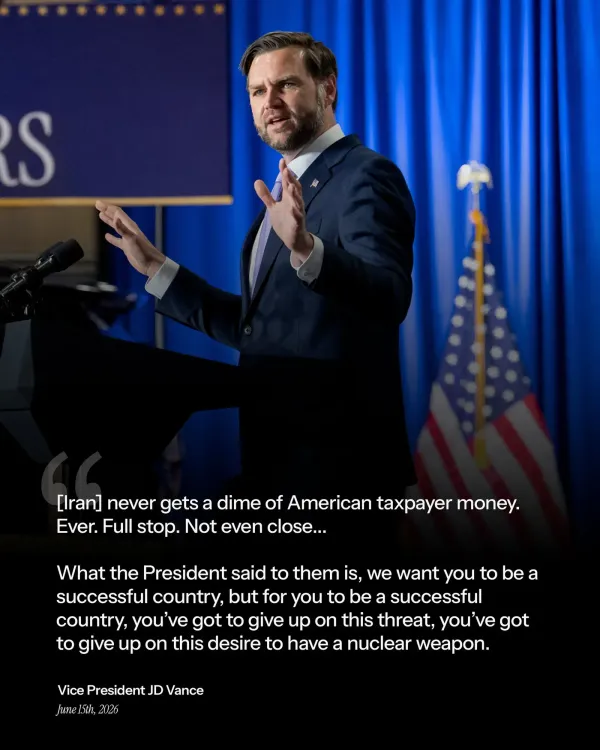
The White House issued a forceful statement on June 16, 2026, declaring that an unnamed group will never receive American taxpayer money, tagging the Vice President. The emphatic post — 'Ever. Full stop. Not even close.' — signals a deliberate executive-branch stance amid broader US spending debates, though the specific referent remains unidentified.
Key Takeaways
The White House posted on June 16, 2026 that an unspecified group will 'never get a dime of American taxpayer money.' The post tagged the Vice President , indicating the message carries administration-wide endorsement.
No specific group, programme, or legislative context was named in the post.
Such declarations typically respond to public controversy or misinformation about federal fund disbursement rather than announcing new policy.
The next signal to watch is congressional budget debates and agency guidance on fund eligibility in the coming fiscal cycle.
The White House, the official communications account of the Executive Office of the President of the United States, issued a blunt fiscal declaration on Tuesday, June 16, 2026, stating that an unspecified group will never receive American taxpayer money, tagging Vice President in the post.
The post read: 'They never get a dime of American taxpayer money. Ever. Full stop. Not even close.' The message, directed at or shared with the Vice President's account, offered no further identification of the group in question, making it a pointed but contextually sparse statement from the executive branch.
Context
Public declarations from the White House denying federal funding to particular entities are not unusual. US administrations have historically issued such clarifications in response to public controversy, political pressure, or misinformation circulating about how taxpayer resources are allocated.
The emphatic language — 'Ever. Full stop. Not even close.' — signals a deliberate effort to close down debate on the question, suggesting the statement responds to persistent claims or political opposition rather than a new policy development.
Policy Backdrop
Federal funding eligibility is governed by a layered framework of congressional appropriations, executive orders, and agency-level guidance. The executive branch can issue public clarifications on existing restrictions, but cannot unilaterally create or eliminate funding streams without legislative action.
Debates over which domestic or foreign entities qualify for US federal dollars have intensified in recent years, spanning areas from foreign aid to domestic social programmes. Statements of this nature typically accompany broader budget or spending controversies playing out in Congress or in the public arena.
Stakeholders and Impact
The primary stakeholders in any such declaration are US taxpayers, who have a direct interest in how federal funds are disbursed, and the unnamed recipient group, whose identity would determine the political and policy significance of the statement.
The involvement of the Vice President's account suggests the message carries weight at the highest levels of the executive branch, and is likely intended to reinforce a shared administration position rather than represent a solo communication.
What's Next
The absence of specifics in the post means the full significance will depend on context that emerges through subsequent official statements, congressional responses, or agency guidance. Observers will watch upcoming congressional budget debates and any agency-level communications on fund disbursement for clarity on which group or programme the White House is referencing.
Until the referent of 'they' is publicly identified through official channels, the declaration functions as a strong political signal whose policy implications remain to be fully defined.
Point of View
Absolute language — 'Ever. Full stop. Not even close.' — is a deliberate rhetorical device designed to foreclose debate rather than open policy dialogue. By tagging the Vice President, the administration signals unified executive-branch ownership of the position. The ambiguity around 'they' is itself politically functional: it allows the statement to resonate with multiple audiences who may each project their own preferred referent onto it. This pattern of emphatic but contextually sparse executive communication is consistent with a broader trend of using social media as a primary arena for fiscal and political signalling.
NationPress
19 Sept 2026
Frequently Asked Questions
What did the White House say about taxpayer money on June 16 2026?
The White House posted that an unnamed group will 'never get a dime of American taxpayer money,' using emphatic language — 'Ever. Full stop. Not even close.' — and tagging the Vice President.
Who is the White House referring to in the taxpayer money post?
The post did not identify the group. The referent of 'they' was not specified in the White House statement, making it a pointed but contextually ambiguous declaration.
Can the White House unilaterally deny federal funding to a group?
The executive branch can clarify existing funding restrictions, but creating or eliminating funding streams generally requires congressional action through the appropriations process.
Why was the Vice President tagged in the White House taxpayer money post?
Tagging the Vice President suggests the statement represents a shared administration position, not just a standalone communication from the White House account.
What happens next after the White House taxpayer money declaration?
Observers will monitor congressional budget debates and agency-level guidance on fund disbursement for further clarity on which group or programme the White House intended to reference.