White House Warns Governors: Fix Unemployment Fraud or Lose Funding
Synopsis
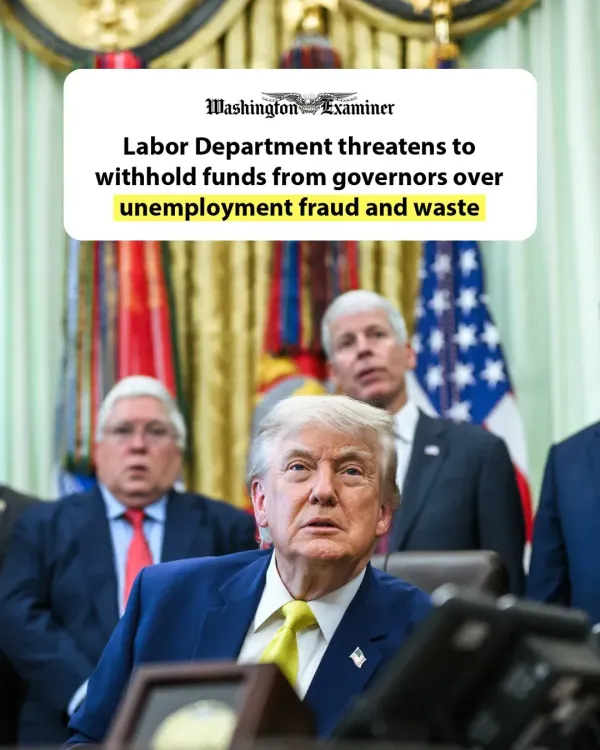
The White House warned state governors on 18 June 2026 that Acting Labor Secretary Keith Sonderling is putting them on notice to crack down on unemployment insurance fraud or face federal funding cuts, citing over $100 billion in pandemic-era improper payments.
Key Takeaways
The White House issued a public warning on 18 June 2026 threatening to withhold federal funding from states that fail to curb unemployment insurance fraud.
Department of Labor Secretary Keith Sonderling is leading the enforcement push directed at state governors.
The Department of Labor and state agencies estimated over $100 billion in improper or fraudulent UI payments during the 2020-2021 pandemic expansion.
The federal government funds the joint federal-state UI system, giving it significant leverage to enforce compliance through funding conditions.
The administration framed the crackdown as protection of taxpayer dollars, consistent with its broader fiscal accountability agenda.
State labor departments, unemployed workers, and taxpayers are all key stakeholders in the outcome of this enforcement drive.
The White House issued a sharp warning to state governors on Wednesday, 18 June 2026, declaring that the administration will no longer tolerate fraudulent claims and wasteful spending in the federal-state unemployment insurance system. Acting Secretary of the U.S. Department of Labor (DOL), Keith Sonderling, has been tasked with putting governors 'on notice' to crack down on unemployment fraud or risk losing federal funding.
Context
The White House post stated plainly: 'Fraud and waste have no place in America, especially not under this administration.' The message singled out Acting Labor Secretary Keith Sonderling as the official driving this enforcement push, framing it as a direct warning to state-level leadership. The administration characterised continued inaction as an abuse of taxpayer dollars.
The Unemployment Insurance (UI) program is a joint federal-state system that provides temporary income support to eligible workers who lose jobs through no fault of their own. Federal funding flows to states to administer the program, giving Washington significant leverage over state compliance.
Policy Backdrop
The current crackdown has deep roots in the COVID-19 pandemic era of 2020-2021, when an unprecedented expansion of unemployment benefits triggered a wave of identity theft, fictitious employer schemes, and improper payments. The Department of Labor and state agencies reported over $100 billion in estimated improper or fraudulent unemployment payments linked to that period.
Multiple administrations since then have required states to implement enhanced identity verification and cross-checks with IRS and prison databases to reduce UI improper payments. However, the current administration is now signalling a harder line, explicitly linking federal funding to compliance rather than treating it as a routine administrative matter.
The use of funding-withholding threats is not without precedent. Federal agencies have historically deployed this mechanism to enforce state compliance with program integrity rules across a range of entitlement programs, from Medicaid to food assistance.
Stakeholders and Impact
State governments face the most immediate pressure, as their labor departments would bear the consequences of any federal funding reductions. States that have lagged on upgrading identity verification systems or clearing fraud backlogs are most at risk.
Unemployed workers who rely on legitimate UI benefits could also be affected if states, under pressure to reduce improper payments, tighten eligibility checks in ways that slow or complicate valid claims. Advocacy groups have previously raised concerns about overly aggressive fraud-prevention measures ensnaring genuine claimants.
For American taxpayers, the administration is framing the initiative as a protection of public funds. The broader political context is one where fiscal accountability in entitlement programs has become a central theme of the current administration's domestic agenda.
What's Next
Observers will be watching for formal compliance directives from the Department of Labor to state agencies, as well as any updated data on UI improper-payment rates. Congressional oversight committees are likely to scrutinise both the administration's enforcement mechanisms and state-level responses.
The administration's willingness to follow through on funding threats will be the defining test of this initiative. If even one state faces a tangible funding consequence, it could sharply accelerate compliance efforts nationwide — reshaping how the $100-billion-plus fraud problem left over from the pandemic era is ultimately addressed.
Point of View
And this move signals the administration intends to use it as a sustained political and policy wedge. The real test will be whether any state actually loses funding, which would transform the warning from rhetoric into a structural shift in federal-state relations on welfare administration.
NationPress
21 Sept 2026
Frequently Asked Questions
Why is the White House threatening to cut unemployment funding to states?
The White House says states that fail to crack down on unemployment insurance fraud risk losing federal funding, with Acting Labor Secretary Keith Sonderling delivering the warning to governors directly.
How much unemployment fraud occurred during COVID-19 in the US?
The U.S. Department of Labor and state agencies estimated over $100 billion in improper or fraudulent unemployment payments linked to the 2020-2021 pandemic-era expansion of benefits.
Who is Keith Sonderling?
Keith Sonderling is the Acting Secretary of the U.S. Department of Labor, appointed to lead the department on an acting basis and now tasked by the White House with enforcing unemployment fraud compliance among states.
Can the federal government actually cut state unemployment funding?
Yes. The unemployment insurance system is jointly funded by federal and state payroll taxes, and the federal government provides administrative funding to states, giving it leverage to impose conditions including funding cuts for non-compliance.
How does unemployment insurance fraud happen?
Common methods include identity theft, fictitious employer schemes, and claims filed on behalf of people who are incarcerated or still employed — problems that surged dramatically during the 2020-2021 pandemic benefit expansions.