Smriti Irani hails 10,107 girls qualifying for IITs via JEE Advanced 2026
Synopsis
For the first time in India's history, over 10,000 girls — specifically 10,107 — have qualified for IIT admission through JEE Advanced 2026. BJP leader Smriti Irani linked the milestone to STEM access schemes including UDAAN, Pragati and SWAYAM that her HRD Ministry introduced between 2014 and 2016.
Key Takeaways
10,107 girls have qualified for IIT admission through JEE Advanced 2026 — the first time in India's history the figure has crossed 10,000 .
BJP leader Smriti Irani attributed the milestone to policy interventions she led as HRD Minister (2014–2016) , including the UDAAN mentoring scheme and the Pragati Scholarship Scheme .
Other cited initiatives include SWAYAM , GIAN , IMPRINT , the Digital Gender Atlas , Ishan Uday and Ishan Vikas .
Irani described the reforms as creating a 'domino effect,' with each intervention reinforcing the next across preparation, access and confidence-building.
The IIT network spans 23 institutions ; admission is determined exclusively by JEE Advanced , one of India's most competitive examinations.
Gender-disaggregated enrolment data post the 2026 admission cycle will be a key indicator of whether qualification numbers translate into actual IIT seats for women.
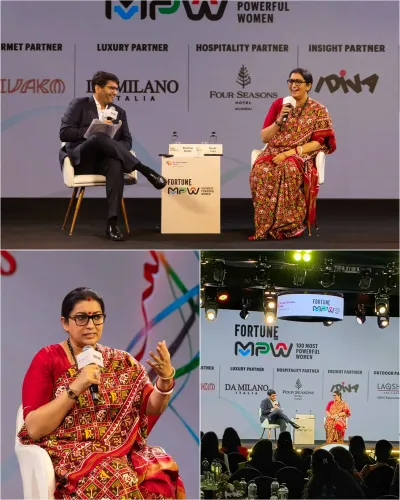
BJP leader and former Union Minister Smriti Irani on Friday, June 5, 2026, celebrated a landmark moment in Indian higher education — more than 10,000 girls qualifying for admission to the Indian Institutes of Technology (IITs) through JEE Advanced 2026 for the first time in the country's history, crediting a chain of policy interventions she championed during her tenure as HRD Minister.
Context
Irani announced that 10,107 girls have earned qualification for IIT admission through JEE Advanced 2026, describing the milestone as 'not merely a story about an examination, but about aspirations nurtured, barriers lowered and possibilities expanded.' She called the achievement the outcome of a 'larger journey' rooted in reforms initiated years before the results became visible.
In her post, Irani extended 'heartfelt congratulations to every student, parent, teacher and mentor' who contributed to this outcome, framing the moment as a generational dividend rather than a single-year event.
Policy Backdrop
Irani served as Minister of Human Resource Development from 2014 to 2016, during which her ministry launched or scaled several targeted programmes aimed at widening female participation in STEM. She specifically cited UDAAN, a free online coaching and mentoring scheme for girl students from Class XI preparing for engineering entrance exams, and the Pragati Scholarship Scheme, an AICTE-administered financial support programme for meritorious girls in technical education.
She also referenced SWAYAM, the government's Massive Open Online Course platform offering free courseware from Class IX to postgraduate level; GIAN, which brought international faculty into institutions including the IITs from 2015; IMPRINT, a high-impact engineering research funding initiative; and the Digital Gender Atlas, a data tool designed to map and address gender-based educational gaps across geographies. Regional access schemes Ishan Uday and Ishan Vikas targeted students from the North East, further addressing geographic barriers.
Irani described these as creating a 'domino effect — with one reform reinforcing another, one opportunity creating the next, and one aspiration inspiring many more,' arguing that the challenge was never a lack of talent but a deficit in access, preparation and confidence-building at an early stage.
Stakeholders and Impact
The IIT network comprises 23 premier public engineering institutions whose undergraduate admissions are determined exclusively by JEE Advanced, one of the most competitive examinations in the world. A sustained rise in the number of girl qualifiers signals a structural shift in who is able to compete at the top tier of technical education in India.
The layered approach — combining targeted scholarships, online learning infrastructure and school-level mentoring — was designed to address preparation gaps as well as financial and geographic barriers simultaneously. Stakeholders including girl students from rural and semi-urban areas, first-generation learners and educators in underserved regions stand to benefit most from the compounding effects of such policies over time.
What's Next
Attention will now turn to gender-disaggregated enrolment data after the 2026 admission cycle to determine how many of the 10,107 qualifiers ultimately secure and accept IIT seats. Policymakers and education researchers will also watch for any updates on scaling similar interventions under the National Education Policy 2020, which has placed renewed emphasis on gender equity in higher and technical education. The milestone is likely to renew debate on whether supply-side reforms — scholarships, coaching access, digital platforms — are sufficient on their own, or whether demand-side barriers at the family and community level require separate, sustained attention.
Point of View
000-girl threshold in JEE Advanced qualifications is a statistically significant inflection point in India's long struggle to diversify the IIT pipeline, and Smriti Irani's claim of policy lineage is grounded in a real set of interventions from the 2014–2016 period. Whether those schemes are the primary driver — or whether broader socioeconomic shifts, private coaching industry growth, and state-level efforts share equal credit — is a question the data alone will eventually settle. What the milestone does confirm is that layered, multi-year education policy, when it targets preparation gaps before the exam rather than reservations after it, can produce visible systemic change. For the BJP, the figure also offers a counter-narrative on women's empowerment in the technical education domain ahead of future electoral cycles.
NationPress
21 Oct 2026
Frequently Asked Questions
How many girls qualified for IIT through JEE Advanced 2026?
According to a post by BJP leader Smriti Irani, 10,107 girls qualified for IIT admission through JEE Advanced 2026 , which she described as the first time the figure has crossed 10,000 in India's history.
What is the UDAAN scheme for girls in engineering?
UDAAN is a government scheme launched in 2014 that provides free online coaching, study material and mentoring to girl students from Class XI to help them prepare for engineering entrance examinations such as JEE.
What did Smriti Irani do as HRD Minister for women in STEM?
As HRD Minister from 2014 to 2016 , Smriti Irani oversaw the launch or scaling of several programmes including UDAAN , the Pragati Scholarship Scheme , the Digital Gender Atlas , SWAYAM , GIAN and IMPRINT , all aimed at improving female access to and participation in technical higher education.
What is the Pragati Scholarship Scheme?
The Pragati Scholarship Scheme is an AICTE -administered programme that provides financial support to meritorious girl students pursuing technical education, intended to reduce economic barriers to higher STEM enrolment.
What is JEE Advanced and who conducts it?
JEE Advanced is an annual national examination that serves as the sole gateway for undergraduate admission to India's 23 Indian Institutes of Technology (IITs) . It is considered one of the most competitive entrance tests in the country.