Chhattisgarh CMO Spotlights Bailey Bridges Driving Bastar Connectivity

Synopsis
The Chief Minister's Office of Chhattisgarh said 21 Bailey bridges have been built in Bijapur district, easing access to remote Bastar villages and supporting education, health, employment and trade under the state's Sushasan governance framework.
Key Takeaways
Chhattisgarh CMO highlighted Bailey bridges as connectivity drivers in Bastar division.
21 Bailey bridges have so far been built in Bijapur district, per the post.
Bridges aim to link remote tribal villages with block and district centres.
State frames the rollout under its Sushasan governance agenda.
Improved access is pitched as boosting education, health, jobs and trade.
Bastar has long faced connectivity gaps due to terrain and left-wing extremism.
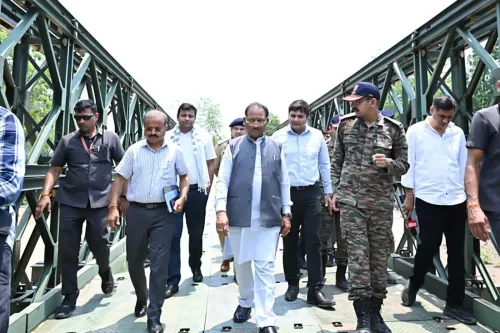
The Chief Minister's Office of Chhattisgarh on 3 June 2026 highlighted the construction of Bailey bridges across the Bastar division as a centrepiece of the state's push to extend road and infrastructure access to remote tribal areas. In a post on X, the office said 21 Bailey bridges have so far been built in Bijapur district, easing movement to far-flung villages and opening fresh avenues in education, health, employment and trade.
Describing the structures as a 'bridge of development' for Bastar, the CMO wrote that 'along with the expansion of roads, bridges and other basic facilities in Bastar, Bailey bridges are being constructed to connect inaccessible areas with better connectivity'. It added that under the Sushasan (good governance) framework, expanded connectivity is 'opening new doors of education, health, employment and trade' and improving everyday life for ordinary citizens.
Context
Bastar, the southern division of Chhattisgarh, is a heavily forested region with a large tribal population and a long history of left-wing extremism. Road and bridge construction in the division has frequently been slowed by difficult terrain, monsoon-fed rivers and security considerations, leaving several interior hamlets cut off for parts of the year.
Bailey bridges — prefabricated, modular steel structures — are favoured in such terrain because they can be assembled rapidly and span streams and ravines without the heavy civil works required for permanent bridges. Their deployment in Bijapur, one of the more remote districts of Bastar, is aimed at shortening travel times between interior villages and block or district headquarters.
Policy backdrop
Connectivity in Bastar has been pursued through a mix of state-funded works and central programmes, including components of the Pradhan Mantri Gram Sadak Yojana, which has been rolling out rural roads in left-wing extremism-affected districts since the 2000s. Bridge-building has typically accompanied these road projects to ensure all-weather access.
The state government has framed the latest push as part of its broader Sushasan agenda, linking physical infrastructure to service delivery outcomes. The argument advanced by the CMO is that motorable links allow ambulances, school transport, ration supplies and agricultural produce to move more reliably between villages and market towns.
Stakeholders and impact
The most direct beneficiaries, as identified in the post, are residents of remote villages in Bijapur and the wider Bastar division, many of whom belong to tribal communities. Better road links are typically associated with improved access to primary health centres, schools and weekly markets — factors that have long been flagged as gaps in interior Bastar.
Security forces and civilian administration also stand to benefit, since faster, more dependable connectivity supports the movement of personnel, supplies and development teams. Local contractors and labour engaged in bridge assembly and road works form another stakeholder group, though the CMO's post does not detail employment generated by the projects.
What's next
Attention will turn to whether similar Bailey bridge deployments are scaled up in the remaining Bastar districts — including Sukma, Dantewada, Narayanpur, Kondagaon, Kanker and Bastar district itself — and how quickly the temporary structures are followed by permanent bridges where required. Performance indicators to watch include changes in travel time to block headquarters, attendance at schools and health facilities, and the volume of farm produce reaching mandis from interior villages.
For the state administration, the political signal is equally important: presenting Bastar not primarily as a security theatre but as a region where development outcomes can be measured in kilometres of road and the number of streams now bridged.
Point of View
And showcasing district-level numbers helps the state demonstrate tangible delivery in left-wing extremism-affected areas. The political subtext is the marriage of counter-insurgency gains with visible civilian infrastructure. The real test will be whether these temporary spans are upgraded and whether service-delivery indicators in interior Bastar move in step.
NationPress
21 Oct 2026
Frequently Asked Questions
What are Bailey bridges and why are they used in Bastar?
Bailey bridges are prefabricated, modular steel structures that can be assembled quickly in difficult terrain. They are used in Bastar to span streams and ravines and connect remote tribal villages where building permanent bridges takes much longer.
How many Bailey bridges have been built in Bijapur district?
According to the Chhattisgarh CMO, 21 Bailey bridges have so far been built in Bijapur district to improve access to remote villages in the Bastar region.
Which region of Chhattisgarh is Bastar and why is connectivity an issue?
Bastar is the southern division of Chhattisgarh, comprising districts such as Bijapur, Sukma, Dantewada, Narayanpur, Kondagaon, Kanker and Bastar. Its dense forests, hilly terrain and history of left-wing extremism have long made road and bridge construction difficult.
What is the Sushasan framework referred to by the Chhattisgarh government?
Sushasan, meaning good governance, is the umbrella label used by the Chhattisgarh government for its administrative and development agenda, including infrastructure expansion and service delivery in regions like Bastar.
How do Bailey bridges affect daily life in remote Bastar villages?
By providing reliable crossings over streams and gullies, Bailey bridges shorten travel times to schools, health centres and markets, and allow ambulances, supplies and farm produce to move more easily between interior villages and town centres.