Is Acharya Prashant's Theatrical Performance on Mahashivratri a Unique Confluence of Dharma and Art?
Synopsis
On Mahashivratri, Acharya Prashant mesmerized audiences with a theatrical performance that unveiled profound themes of Dharma and spirituality. The event, attended by thousands both in-person and via the Gita App, showcased his exceptional acting talent while exploring the struggle between worldly attachments and spiritual awakening. Experience this unforgettable journey of emotion and insight.
Key Takeaways
Acharya Prashant's theatrical performance captivated audiences with its emotional depth.
The event highlighted the struggle between worldly life and spiritual awakening.
Over 200,000 people participated via the Gita App, showcasing widespread interest.
The teachings centered on recognizing personal agency in addressing suffering.
The significance of Mahashivratri as a festival of creative destruction was emphasized.
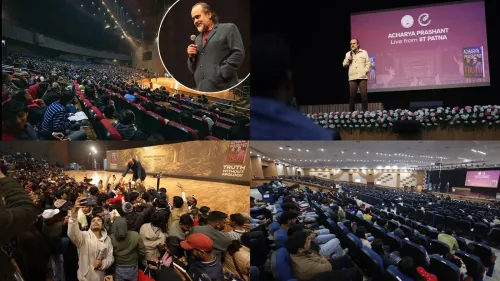
Greater Noida, Feb 16 (NationPress) — On the eve of Mahashivratri, the grand auditorium of Gautam Buddha University was filled to the brim. With chairs running out, many attendees opted to sit on the floor. A diverse crowd, including thousands from across India and beyond, gathered to witness a remarkable side of Acharya Prashant — his prowess as an accomplished actor.
Following the theatrical presentation, emotions ran high among the audience, with tears in their eyes and resounding applause echoing through the hall. Coincidentally, Mahashivratri also marks Acharya Prashant's birthday, and he chose to present a solo theatrical performance as a gift to his audience. An incredible 200,000 people participated in the event via the Gita App.
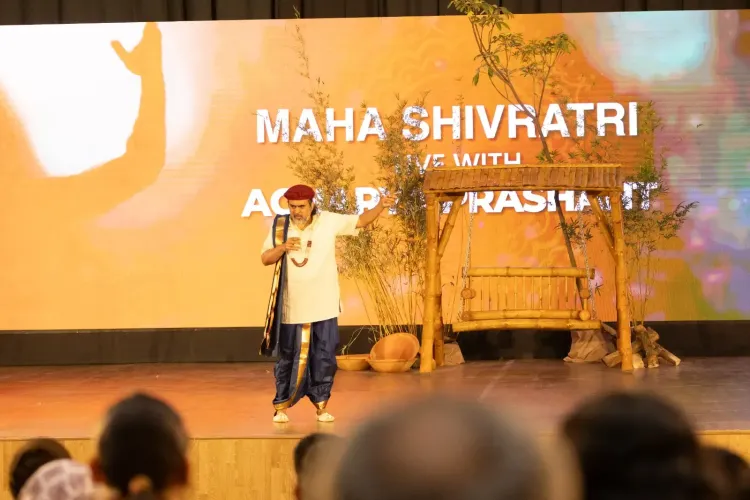
The performance, organized by the PrashantAdvait Foundation, opened with a stunning reveal. The curtain rose to unveil Acharya Prashant portraying the central character from Mohan Rakesh's celebrated Hindi play ‘Lehron Ke Rajhans.’
This play narrates the tale of Nand, a wealthy man deeply devoted to his wife, yet who also has a profound respect for the Buddha. When the Buddha tries to guide him, a tumultuous storm brews within Nand that lacks a straightforward resolution. He struggles to maintain a balance between worldly life and renunciation. As articulated in the play, ‘I am this, and I am that too... I am that naked man standing at the crossroads, whom all directions seek to devour.’ Acharya Prashant embodied this internal conflict on stage, immersing the audience in an unforgettable emotional and spiritual journey.
Regarding the play's essence, Acharya Prashant remarked, ‘This challenge resonated from the stage — must you truly live as a weakling? What do you gain by labeling yourself helpless?’ He emphasized that individuals often cling to the notion of compulsion to justify their lives of bondage. The play's message is clear: wherever suffering, exploitation, or injustice exists, it thrives not out of necessity but by our own acceptance and consent.
One audience member shared their impression: ‘I am still under the spell of that experience. Typically, Acharya Ji engages us in teachings and discussions, but today he portrayed a play that highlights the conflict between the ordinary human experience and Buddhahood. I saw my own struggles reflected in this narrative.’
This performance was far from spontaneous. Acharya Prashant's acting capabilities have deep roots. During his tenure at IIM Ahmedabad, he was actively involved in theater, not only acting in productions like ‘Rhinoceros,’ ‘Pagla Ghoda,’ and ‘Night of January 16th,’ but also directing them. Today, he seamlessly integrates this theatrical tradition into his teaching methodology.
On the significance of Mahashivratri, Acharya Prashant described Shiva's Tandav as a profound inner signal. He stated, ‘Shiva's destruction is not an external phenomenon. It is the dismantling of all the illusions, deceits, and egos that you have clung to within yourself; that is the true essence of Shivatva (the essence of Shiva).’ He further added that Dharma and spirituality are not merely about seeking Truth but are about liberation from falsehood, asserting that Mahashivratri symbolizes that creative destruction.
After the theatrical performance, a Q&A session centered around the play took place with the audience. Following this, Acharya Prashant led a special discussion on verses from the Avadhut Gita. He underlined the Gita's significance, stating, ‘The Gita is not an ordinary discourse. It is the voice of Dharma that emerged on the battlefield of life. What unfolded at Kurukshetra continues to resonate today.’ The event concluded with an extensive book-signing session.
Another attendee noted, ‘Acharya Prashant's gathering is no mere event; it represents a significant revolution that is reshaping society.’ One participant recounted her initial encounter with Acharya Prashant through a brief YouTube video. ‘In that fleeting moment, I felt an essence of fearlessness and truth in his words. Since then, I've dedicated an entire week to listening to him and have consistently attended live sessions of the Gita,’ she shared.
Participants for in-person attendance were meticulously selected from thousands of applicants, with criteria emphasizing seriousness towards the Gita sessions and dedication to personal study.
A grand exhibition at the venue also captivated attendees, showcasing Acharya Prashant's travels over several months, spanning from Goa to Hyderabad, Kolkata to Chennai. His sessions at 16 major educational institutions, participation in four literary festivals, and gatherings with thousands of listeners were all encapsulated in stunning photographs.
This event is part of Acharya Prashant's nationwide campaign over the past six months, during which he traversed numerous cities and engaged with over a dozen prestigious institutions, including 13 IITs, IISc, and IIMs. He addressed a wide array of topics, from love and jealousy to artificial intelligence and global affairs, fielding more than 1,700 questions and signing over 10,000 books during his journey. His appearances at literary festivals in Pune, Bhubaneswar, Goa, and Delhi attracted enormous crowds.
Numerous prominent media outlets covered the event and engaged in discussions with Acharya Prashant.
Point of View
I observe that Acharya Prashant's recent theatrical performance not only showcases his artistic talents but also serves as a profound exploration of deeper philosophical themes. The blend of spirituality and performance art resonates with audiences, making it a significant cultural event worth noting.
NationPress
19 Sept 2026
Frequently Asked Questions
What was the theme of Acharya Prashant's performance?
The performance explored the internal conflict between worldly attachments and spiritual awakening, as portrayed through the play 'Lehron Ke Rajhans.'
How many people attended the event?
The event was attended by thousands in person, with over 200,000 joining live via the Gita App.
What message did Acharya Prashant convey during the event?
He emphasized the importance of recognizing personal agency in overcoming suffering and injustice, rather than succumbing to the idea of helplessness.
What is the significance of Mahashivratri in this context?
Mahashivratri symbolizes creative destruction, allowing individuals to dismantle internal illusions and egos, as highlighted in Acharya Prashant's teachings.
What other activities took place during the event?
The event included a Q&A session about the play, discussions on the Avadhut Gita, and a book-signing session with Acharya Prashant.