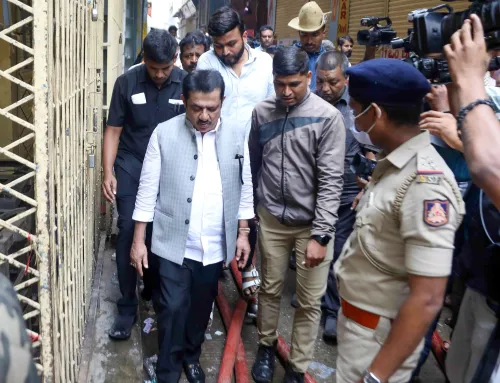
Is Kerala MLA Antony Raju Guilty in the ‘Underwear Evidence Tampering’ Case?
Click to start listening

Synopsis
In a significant legal development, Kerala MLA Antony Raju has been convicted in the notorious underwear evidence tampering case, concluding a 36-year-old saga. This verdict not only affects Raju's political career but also raises questions about the integrity of evidence in the justice system. Stay tuned for more updates.
Key Takeaways
- Antony Raju has been convicted in a case that highlights the importance of evidence integrity.
- The conviction concludes a legal saga that has spanned over 36 years.
- The case raises questions about the role of political influence in legal proceedings.
- Potential penalties could significantly impact Raju's future.
- The Supreme Court's involvement underscores the complexities of judicial decisions.
Thiruvananthapuram, Jan 3 (NationPress) In a surprising development, a local court situated in the suburbs of Thiruvananthapuram has found Kerala’s Left Front MLA and former Transport Minister Antony Raju guilty in the notorious "underwear evidence tampering" case. This verdict signals the conclusion of a legal battle that has persisted for over 36 years.
The proven charges against Raju carry sentences ranging from a decade of imprisonment to life behind bars. The prosecution has asked for the Chief Judicial Magistrate's court to oversee the sentencing process. Should this request be granted, Raju and his co-accused will be transferred to prison.
Despite the verdict coming nearly two decades after the charge sheet was filed, the events that led to this case unfolded 36 years ago. The primary accused is court clerk Jose, while Raju is identified as the second accused. This ruling emerges almost a year after the Supreme Court annulled a previous Kerala High Court decision that had dismissed criminal proceedings against Raju.
The case traces back to 1990, when Australian citizen Andrew Salvatore Cervelli was detained at Thiruvananthapuram airport for allegedly trying to smuggle 61.5 grams of illegal substances hidden in his underwear. Raju, then an aspiring politician and lawyer, acted as Cervelli's legal representative.
The trial court convicted Cervelli, sentencing him to ten years in prison. However, in a surprising twist, the Kerala High Court overturned this conviction, citing that the underwear presented as evidence was too small for Cervelli, thereby casting significant doubt on the prosecution's narrative.
Cervelli later returned to Australia. Years afterward, based on information from the Australian National Central Bureau, an investigation into possible evidence tampering was initiated.
This led to the filing of a criminal case against Raju and the court clerk in 1994. Following a lengthy investigation lasting 12 years, a charge sheet was submitted to the Additional Chief Judicial Magistrate Court, Thiruvananthapuram, in 2006, accusing Raju of conspiracy, cheating, and obstructing justice.
Raju contested the proceedings, asserting that the disputed underwear was under trial court custody at the relevant time, and only the court could have acted under the provisions of Section 195(1)(b) of the CrPC. He argued that the police lacked the jurisdiction to investigate or file charges, deeming the proceedings legally invalid.
While the High Court sided with Raju, the Supreme Court disagreed, reinstating the prosecution and paving the way for a verdict that could bring significant repercussions for Raju.
Point of View
It is essential to approach this case with an unbiased lens, focusing on the implications of the verdict for justice and political integrity. The conviction of Antony Raju not only highlights the complexities of legal proceedings but also emphasizes the importance of maintaining trust in our judicial system.
NationPress
08/01/2026
Frequently Asked Questions
What is the underwear evidence tampering case?
The underwear evidence tampering case involves allegations of evidence manipulation related to the arrest of Andrew Cervelli, who was accused of smuggling drugs hidden in his underwear.
What are the potential penalties for Antony Raju?
Antony Raju faces penalties that could range from ten years to life imprisonment, depending on the sentencing by the Chief Judicial Magistrate.
How long has this legal battle been ongoing?
This case has been ongoing for over 36 years, with the initial incident occurring in 1990.
What role did the Supreme Court play in this case?
The Supreme Court reinstated the prosecution against Raju after the Kerala High Court had previously quashed the criminal proceedings.
Why was the evidence considered tampered?
The evidence was deemed tampered as it was argued that the underwear presented as evidence was too small for the accused, raising doubts about the integrity of the prosecution's case.