Agri Minister Chouhan: Cabinet clears ₹1,141 cr postal scheme
Synopsis
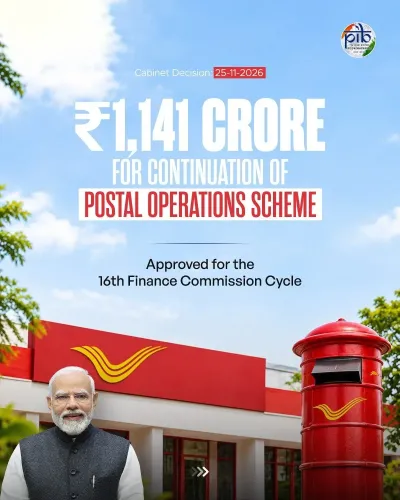
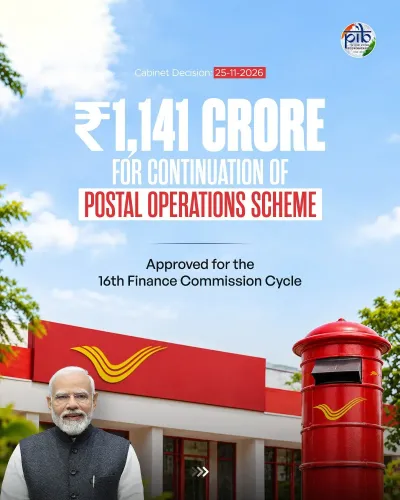
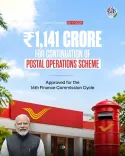
Union Agriculture Minister Shivraj Singh Chouhan said the Union Cabinet, led by PM Narendra Modi, has approved continuation of the Postal Operations Scheme with a ₹1,141 crore outlay to modernise India Post, deepen rural access and back e-commerce, logistics and financial inclusion under Digital India.
Key Takeaways
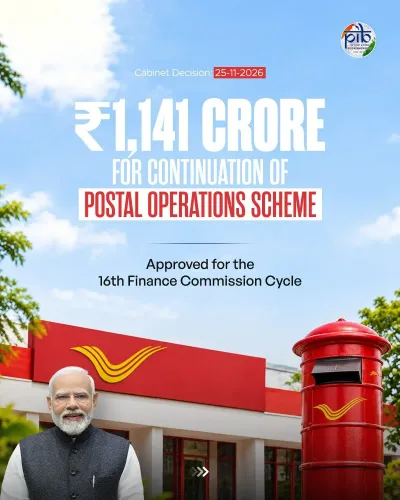
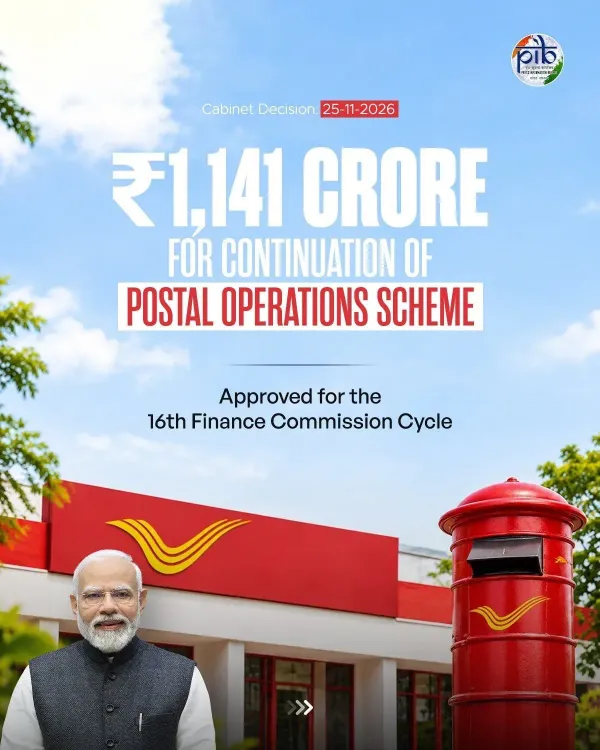
The Union Cabinet on 25 November 2026 approved continuation of the Postal Operations Scheme with an outlay of ₹1,141 crore.
Union Agriculture Minister Shivraj Singh Chouhan announced the decision, crediting Prime Minister Narendra Modi's leadership.
The scheme is intended to modernise the postal network, strengthen mail and parcel operations, and improve rural access.
E-commerce, logistics, financial inclusion and international postal services are also listed as beneficiaries.
Chouhan said the move aligns with the broader objectives of Digital India, launched in July 2015.
Implementation now rests with the Department of Posts, including guidelines and fund disbursement.
The Union Cabinet has put ₹1,141 crore behind India's oldest last-mile machine. Union Agriculture Minister Shivraj Singh Chouhan said on 25 November 2026 that the government, under Prime Minister Narendra Modi, has approved continuation of the Postal Operations Scheme — a New Delhi decision aimed at modernising India Post and widening rural reach.
Posting on X, Chouhan said the scheme would help modernise the postal network, strengthen mail and parcel operations, and improve access to postal services in rural areas. He added that e-commerce, logistics, financial inclusion and international postal services would also be strengthened, and that the step is aligned with the broader objectives of Digital India.
In his words, the decision under Modi's leadership would help डाक नेटवर्क को आधुनिक बनाने (modernise the postal network), tighten mail and parcel operations, and improve rural access. 'This initiative is in line with the broader objectives of Digital India,' he wrote, tagging it as a Cabinet decision.
₹1,141 crore for a modern postal backbone
The number is the story: a financial outlay of ₹1,141 crore to keep the Postal Operations Scheme running. Chouhan framed the money as a tool to upgrade the network itself — not only counters, but mail and parcel operations that now compete with private logistics on speed and volume.
India Post remains the state's densest physical grid. That is why a Cabinet nod on postal operations is also a nod on rural delivery, where private fleets thin out and a post office is still the public square.
Rural reach, e-commerce and the Digital India thread
Digital India, launched in July 2015, set out to deliver government services digitally and widen financial access, especially beyond cities. The postal network has sat inside that project for a decade: a counter that can take a letter, a parcel, a bank deposit or an insurance premium.
Successive Union Cabinets have approved phased funding for postal modernisation to back e-commerce growth and last-mile delivery in rural India. Those efforts run alongside financial inclusion drives that already use post offices for banking and insurance. Chouhan's list — e-commerce, logistics, financial inclusion, international postal services — sits on that same arc. Rural households and the e-commerce sector are the two constituencies that feel a stronger postal spine first.
Department of Posts must now convert cash into capacity
The political announcement is done. The operational file now moves to the Department of Posts: detailed implementation guidelines and a fund disbursement schedule. Parliament's winter session is the window where questions on outcomes typically land — whether the outlay shows up as stronger sorting, denser rural service and faster parcels.
₹1,141 crore keeps the scheme on the books. The test is whether a village post office can now move a parcel as reliably as it once moved a letter.
Point of View
A physical arm of Digital India rather than a legacy letter service. Chouhan amplifying a Posts decision from the Agriculture and Rural Development brief underlines how the government wants rural reach narrated as a whole-of-cabinet project. The Department of Posts' guidelines will decide whether ₹1,141 crore becomes sorting capacity and rural routes or stays a headline figure.
NationPress
25 Nov 2026
Frequently Asked Questions
What did the Union Cabinet approve regarding the Postal Operations Scheme?
The Union Cabinet approved continuation of the Postal Operations Scheme with a financial outlay of ₹1,141 crore. Union Agriculture Minister Shivraj Singh Chouhan announced the decision on 25 November 2026, saying it would modernise the postal network and strengthen mail and parcel operations.
How will the Postal Operations Scheme help rural India?
The scheme is meant to improve access to postal services in rural areas and modernise the wider postal network. Chouhan said it would also support financial inclusion, which already uses post offices as last-mile points for banking and related services.
How is the postal Cabinet decision linked to Digital India?
Chouhan said the initiative is in line with the broader objectives of Digital India, the programme launched in July 2015 to deliver government services digitally and expand access. A stronger postal grid is treated as physical infrastructure for digital and financial services in the hinterland.
Who announced the ₹1,141 crore postal scheme approval?
Union Agriculture Minister Shivraj Singh Chouhan announced it on X on 25 November 2026. He attributed the Cabinet decision to the leadership of Prime Minister Narendra Modi.
Which sectors does the Postal Operations Scheme aim to strengthen?
Besides core mail and parcel operations, Chouhan listed e-commerce, logistics, financial inclusion and international postal services. Rural users and the e-commerce sector are the principal constituencies of a denser, faster postal network.