Akhilesh Yadav Questions Legitimacy of UP Police Encounters
Synopsis
Samajwadi Party president Akhilesh Yadav posted a Hindi couplet on 26 May 2026 declaring that any police encounter carried out 'at will' should be considered fake, renewing his party's long-running challenge to the Yogi Adityanath government's encounter record in Uttar Pradesh.
Key Takeaways
Akhilesh Yadav posted a Hindi couplet on 26 May 2026 calling politically motivated police encounters 'fake'.
The Yogi Adityanath government has overseen a large number of police encounter operations in Uttar Pradesh since 2017 .
The Samajwadi Party has consistently questioned the legitimacy of these encounters since the BJP came to power in the state.
The NHRC has had mandatory encounter-death guidelines in place since 1997 , and the Supreme Court has also laid down independent-inquiry norms.
The encounter debate is expected to resurface in upcoming UP assembly and parliamentary sessions.
Samajwadi Party president Akhilesh Yadav on Tuesday, 26 May 2026, posted a pointed couplet on X questioning the credibility of police encounters in Uttar Pradesh, reigniting the long-running political debate over extrajudicial killings in the state.
In the post, Yadav wrote: 'जिस एनकाउंटर के पीछे चले मर्ज़ी, समझो वो है फ़र्ज़ी' — which translates as, 'Any encounter carried out at will, understand that it is fake.' The couplet, though brief, carries a direct political charge aimed at the Yogi Adityanath-led Bharatiya Janata Party government in Lucknow.
Context
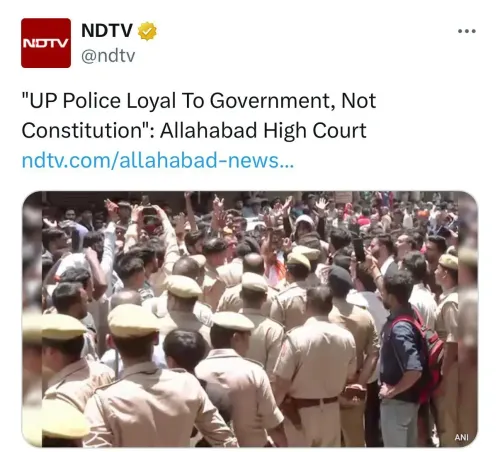
Since 2017, the Uttar Pradesh Police has conducted a large number of encounter operations, which the state government has consistently defended as targeted action against organised crime and gangsters. The Adityanath administration has presented these operations as a cornerstone of its law-and-order record ahead of successive elections.
The Samajwadi Party, as the principal opposition in Uttar Pradesh, has repeatedly challenged the authenticity of these encounters, alleging that some may be staged or politically motivated. Yadav's post continues that pattern of opposition, framing the encounters as acts of arbitrary state power rather than legitimate policing.
Policy Backdrop
The National Human Rights Commission (NHRC) issued detailed procedural guidelines as far back as 1997 requiring mandatory reporting, magisterial inquiry, and next-of-kin compensation in all cases of death in police encounters. Critics argue these norms are inconsistently followed across states, including in Uttar Pradesh.
The broader legal and constitutional framework requires that every encounter death be treated as a potential custodial death until independently investigated. Supreme Court of India guidelines, reaffirmed in the PUCL v. State of Maharashtra judgment, mandate independent probes in all such cases. Opposition parties have cited these benchmarks when questioning the UP government's encounter record.
Stakeholders and Impact
The debate directly affects families of encounter victims, civil liberties groups, and serving police personnel, whose professional conduct is implicated in every such allegation. For the Yogi Adityanath government, encounters have been a political asset — presented as proof of a tough stance on crime — making any challenge to their legitimacy a direct attack on its governance narrative.
For the Samajwadi Party, keeping the encounter issue alive serves a dual purpose: mobilising communities that feel disproportionately targeted by police action, and framing the BJP's law-and-order model as one built on impunity rather than due process. Yadav, as a Lok Sabha MP from Kannauj, also has a national platform from which to amplify these concerns beyond state politics.
What's Next
Political observers will watch whether the post prompts a formal response from the Uttar Pradesh government or the BJP, or whether human rights bodies such as the NHRC take note of renewed public attention on encounter practices. The exchange is also likely to surface in upcoming sessions of the Uttar Pradesh Legislative Assembly and in Parliament.
With assembly elections in Uttar Pradesh forming a perennial backdrop to every political statement from both sides, Yadav's couplet signals that police accountability will remain a live fault line between the ruling party and the opposition well into the electoral cycle ahead.
Point of View
Sharp enough to reopen a governance wound the BJP would prefer to keep closed. By framing encounters as acts of 'will' rather than law, he shifts the debate from crime statistics to constitutional due process, a terrain where the opposition is on firmer legal ground. The post fits a broader arc in which the Samajwadi Party has sought to consolidate communities that feel over-policed, positioning rule-of-law concerns as a vote-mobilisation issue ahead of the next electoral cycle. Whether the ruling party responds or stays silent, the post forces a renewed public reckoning with NHRC and Supreme Court norms that the state government has rarely engaged with directly.
NationPress
9 Oct 2026
Frequently Asked Questions
What did Akhilesh Yadav say about UP police encounters?
Akhilesh Yadav posted a Hindi couplet on 26 May 2026 stating that any encounter carried out 'at will' should be understood as fake, directly targeting the Yogi Adityanath government's encounter policy.
How many encounters has UP Police conducted since 2017?
The Uttar Pradesh Police has conducted a large number of encounter operations since the Yogi Adityanath government took office in 2017; precise verified figures for 2026 are not available from current data.
What are the legal rules for police encounters in India?
The National Human Rights Commission issued mandatory procedural guidelines in 1997 requiring magisterial inquiry and next-of-kin compensation in all encounter deaths; the Supreme Court has also mandated independent investigations in such cases.
Has the Samajwadi Party raised the encounter issue before?
Yes, the Samajwadi Party has consistently questioned the legitimacy of UP police encounters since 2017, and similar exchanges have followed almost every high-profile encounter during the BJP government's tenure.
Can the NHRC take action on UP encounter deaths?
The NHRC can issue notices, call for reports, and recommend compensation in cases of encounter deaths; it has done so in past cases where its 1997 guidelines were allegedly not followed by state police forces.