Akhilesh flags Jal Jeevan Mission gaps as women protest at BJP MLA's home

Synopsis
Samajwadi Party president Akhilesh Yadav posted a video on 26 May 2026 showing a women's group staging a sit-in outside a BJP MLA's home in Uttar Pradesh, demanding water access — framing it as an ironic 'achievement' of the Jal Jeevan Mission.
Key Takeaways
Akhilesh Yadav shared a video on 26 May 2026 highlighting a women's protest outside a BJP MLA's residence in Uttar Pradesh .
The protesting group, described as a Nari Samuh (women's group), was demanding Neer Arakshan — assured access to drinking water.
Yadav framed the protest as an ironic indicator of the Jal Jeevan Mission's on-ground delivery record.
The Jal Jeevan Mission was launched in 2019 with a target to provide tap water to every rural household by 2024 .
Uttar Pradesh is a BJP-governed state and a key implementation ground for the central water supply scheme.
Opposition parties have repeatedly used local protests over basic services to question the scheme's actual coverage in rural UP.
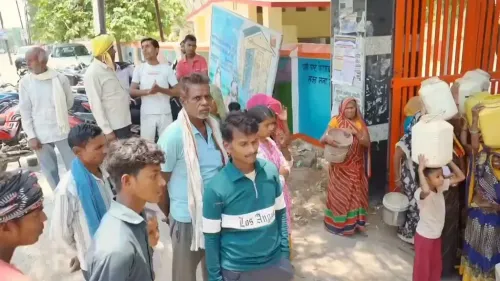
Samajwadi Party president Akhilesh Yadav on Tuesday, 26 May 2026, took to X to highlight what he described as a stark commentary on the Jal Jeevan Mission's ground-level delivery — pointing to a protest by a women's group outside a BJP MLA's residence, demanding what the post terms 'Neer Arakshan' (water reservation or water access rights).
Context
Yadav's post, written in Hindi, reads: 'Jal Jeevan Mission ki uplabdhi: Neer Arakshan ke liye Nari Samuh ka BJP vidhayak ke ghar dharna-pradarshan' — translated as: 'Achievement of the Jal Jeevan Mission: Women's group stages sit-in protest outside BJP MLA's house demanding water access.' The framing is sharply ironic, presenting the demonstration as a measure of how far the scheme has actually delivered on its promises in Uttar Pradesh.
The post is accompanied by a video, which Yadav has shared without further textual elaboration, letting the visuals speak to the claim. The 'Nari Samuh' (women's group) staging the protest is described as demanding 'Neer Arakshan' — a phrase that broadly conveys the demand for assured, equitable access to drinking water.
Policy Backdrop
The Jal Jeevan Mission was launched by the Government of India in 2019 with an ambitious target: provide a functional household tap connection to every rural home across the country by 2024. The scheme is among the largest rural infrastructure programmes in India's history, with allocations running into lakh crore rupees across its implementation period.
Uttar Pradesh, as India's most populous state, has been a central focus of the mission's rollout. The state is governed by the Bharatiya Janata Party, which is also the ruling party at the Centre and the primary custodian of the scheme's implementation. Opposition parties, including the Samajwadi Party, have consistently questioned whether coverage figures translate into reliable, functional water supply at the household level in rural areas.
Stakeholders and Impact
Rural women are among the most directly affected stakeholders in any drinking water access dispute. Across Uttar Pradesh, women in villages have historically borne the burden of water collection, often walking long distances when piped supply is absent or irregular. A women's group staging a sit-in protest at an elected representative's home underscores the personal and daily nature of the grievance.
The BJP MLA at whose residence the protest reportedly took place is an immediate point of accountability in the eyes of the demonstrators — elected representatives are often the first port of call when residents seek redress for undelivered civic infrastructure. The broader political implication is that gaps in scheme delivery are becoming visible at the constituency level, drawing local protests that opposition leaders are quick to amplify.
What's Next
The episode adds to a growing pattern of scrutiny around Jal Jeevan Mission implementation audits in Uttar Pradesh. State government responses to coverage verification exercises and forthcoming rural water supply budget reviews in the state assembly are likely to be watched closely by both the opposition and civil society groups tracking scheme outcomes. Whether the specific grievance raised by the protesting women's group leads to administrative action or a political response from the ruling party remains to be seen.
Point of View
Falsifiable claim. By labelling the demonstration an 'achievement' of the Jal Jeevan Mission, he deploys irony rather than assertion — a format that is harder to rebut and travels well on social media. The targeting of a BJP MLA's residence by the protesters also allows him to connect individual constituency-level accountability with the broader narrative of scheme under-delivery in Uttar Pradesh. As the 2027 Uttar Pradesh assembly elections draw closer, such episodes are likely to become more frequent ammunition in the SP's campaign against the BJP's governance record on rural infrastructure.
NationPress
10 Oct 2026
Frequently Asked Questions
What is the Jal Jeevan Mission?
The Jal Jeevan Mission is a Government of India scheme launched in 2019 to provide functional household tap connections to all rural households across the country, with an original target of achieving full coverage by 2024.
Why did women protest outside a BJP MLA's house over water?
According to the video shared by Akhilesh Yadav, a women's group staged a sit-in outside a BJP MLA's residence in Uttar Pradesh demanding 'Neer Arakshan' — assured access to drinking water — suggesting that piped water supply under the Jal Jeevan Mission had not reached them adequately.
What does 'Neer Arakshan' mean?
'Neer Arakshan' is a Hindi phrase that broadly translates to 'water reservation' or 'water rights,' used in this context to mean the demand for guaranteed, equitable access to drinking water for rural households.
What is Akhilesh Yadav's criticism of the Jal Jeevan Mission?
Akhilesh Yadav has framed local protests over drinking water as evidence that the Jal Jeevan Mission has not delivered on its promises in Uttar Pradesh, using the ironic phrase 'achievement of the Jal Jeevan Mission' to highlight the gap between the scheme's stated goals and ground reality.
Which party governs Uttar Pradesh and is responsible for Jal Jeevan Mission implementation?
The Bharatiya Janata Party governs Uttar Pradesh and is also the ruling party at the Centre, making it responsible for the implementation of the Jal Jeevan Mission in the state.