Akhilesh Yadav Hails Lucknow as 'Markaz-e-Suba' in Poetic Tribute

Synopsis
Samajwadi Party president Akhilesh Yadav invoked the phrase 'Sham-e-Awadh' in a poetic Urdu post on 9 August 2026, saluting Lucknow as 'Markaz-e-Suba' and linking the city's Nawabi cultural legacy to the SP government's urban development record.
Key Takeaways
On 9 August 2026 , Akhilesh Yadav posted in Urdu hailing Lucknow as 'Markaz-e-Suba' (centre of the province) and the new-age 'Sham-e-Awadh' . 'Sham-e-Awadh' is a classical Urdu phrase evoking the Nawabi-era cultural refinement of Awadh , centred on Lucknow.
Yadav served as Chief Minister of Uttar Pradesh from 2012 to 2017 , during which the SP government undertook metro, expressway, and heritage beautification projects in Lucknow.
The Samajwadi Party has consistently used Awadh's cultural legacy as a political reference point, often contrasting it with subsequent administrations' approach to the city.
The post carried a video and no formal policy announcement, signalling a deliberate cultural-identity message ahead of any forthcoming assembly session.
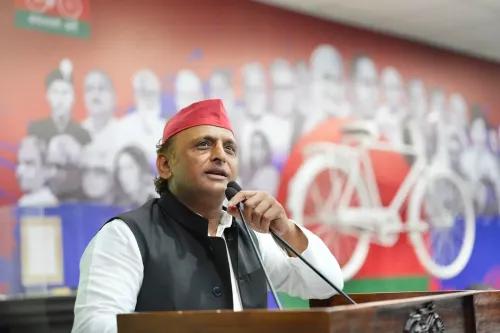
A city dreamed, shaped, and now celebrated — Samajwadi Party president Akhilesh Yadav turned to Urdu verse on Sunday, 9 August 2026 to salute Lucknow, invoking the city's storied Nawabi soul and framing it as a modern realisation of an old ambition.
In his post, Yadav wrote: 'जिसे एक ख़्वाब की तरह बारीक़ी से तराशा था हमने, ये उन कोशिशों से सजी नये ज़माने की शाम-ए-अवध है। ये अपना मरकज़-ए-सूबा लखनऊ है!' — which translates as: 'What we had carved with the precision of a dream, this is the new-age 'Sham-e-Awadh' adorned by those efforts. This is our own 'Markaz-e-Suba' — Lucknow!'
'Sham-e-Awadh' — literally 'the evening of Awadh' — is among the most resonant phrases in Urdu literary tradition, conjuring the candlelit salons, courtly refinement, and syncretic grace of the Nawabi era centred on Lucknow. To invoke it is to plant a flag in a very particular cultural soil.
The Awadh Metaphor as Political Signature
This is not the first time Yadav has reached for the language of Awadh. Throughout his tenure as Chief Minister of Uttar Pradesh from 2012 to 2017, the Samajwadi Party government pursued a string of urban projects in Lucknow — metro rail, expressway connectivity, and heritage beautification drives — that the party has consistently framed as a renaissance of the city's historic identity. The phrase 'Markaz-e-Suba' — 'the centre of the province' — layers a governance claim onto the cultural one. Lucknow is not merely a beautiful city in this framing; it is the rightful, purposeful heart of Uttar Pradesh, shaped by deliberate effort. Samajwadi Party leaders have long used the Awadh legacy as a rhetorical foil — contrasting it, implicitly, with what they characterise as the neglect or dilution of Lucknow's composite cultural character under subsequent administrations. Sunday's post continues that pattern, tying poetic sentiment to a record of governance.Why Lucknow's Cultural Identity Remains a Live Political Argument
Lucknow occupies a unique place in Indian political imagination. As the capital of Uttar Pradesh — India's most populous state and the single largest determinant of Lok Sabha outcomes — its development trajectory is never merely local news. The city's Nawabi-era architecture, its Urdu literary heritage, and its reputation for tehzeeb (refinement) have all become contested terrain between parties with sharply different visions for the state. For the Samajwadi Party, anchoring Lucknow's identity in Awadh's pluralist, Urdu-inflected past is both a cultural statement and an electoral signal — particularly to constituencies that feel that heritage is under pressure. Yadav's choice of a video post — without press release, without policy announcement — suggests the message is intentionally atmospheric. Sometimes the most pointed political communication arrives dressed as poetry. The next Uttar Pradesh assembly session will be a natural moment to watch for whether this cultural framing translates into concrete legislative or urban-policy positions from the Samajwadi Party.Point of View
Urdu-inflected cultural heritage. By framing Lucknow's development as a dream 'carved with precision,' Yadav implicitly reasserts the SP's ownership of the city's modern transformation — a claim that carries electoral weight in Uttar Pradesh's urban constituencies. The absence of any specific policy hook suggests this is mood-setting: cultural messaging that warms the ground for harder political arguments to follow. Watch for whether the Awadh framing intensifies as the next assembly session approaches.
NationPress
24 Sept 2026
Frequently Asked Questions
What did Akhilesh Yadav post about Lucknow on 9 August 2026?
Akhilesh Yadav posted in Urdu calling Lucknow the new-age 'Sham-e-Awadh' and 'Markaz-e-Suba,' crediting past SP government efforts for shaping the city's modern identity.
What does 'Sham-e-Awadh' mean?
'Sham-e-Awadh' literally means 'the evening of Awadh' and is a classical Urdu phrase evoking the cultural refinement, courtly elegance, and syncretic traditions of Lucknow's Nawabi era.
What does 'Markaz-e-Suba' mean?
'Markaz-e-Suba' translates to 'centre of the province,' a phrase Akhilesh Yadav used to describe Lucknow's status as the rightful heart of Uttar Pradesh.
What urban projects did the SP government complete in Lucknow?
During Akhilesh Yadav's tenure as Chief Minister from 2012 to 2017, the SP government undertook Lucknow Metro rail, expressway development, and heritage beautification initiatives in the city.
Why does the Samajwadi Party frequently reference Awadh's cultural legacy?
The SP uses Awadh's Nawabi and Urdu-literary heritage as a political identity marker, particularly to appeal to constituencies that value Lucknow's composite cultural character and to contrast its governance record with that of subsequent administrations.