Akhilesh Yadav vows to develop Ayodhya as spiritual 'Siyaram-Dham'

Synopsis
Samajwadi Party president Akhilesh Yadav on 27 June 2026 pledged to develop Ayodhya as a 'Siyaram-Dham' — a spiritually authentic religious city — if the party forms the next Uttar Pradesh government, and promised to restore traditional rights of Ayodhya's residents.
Key Takeaways
Akhilesh Yadav on 27 June 2026 pledged to develop Ayodhya into an 'unparalleled religious city' if the Samajwadi Party forms the next Uttar Pradesh government.
He committed to establishing Ayodhya as a 'Siyaram-Dham' rooted in Sanatan values, faith, and genuine devotion, distinct from the current infrastructure-led model.
The pledge specifically promises to restore the traditional pride and rights of Ayodhya's residents , signalling focus on local communities affected by post-2024 development projects.
The Ram Temple at Ayodhya was consecrated in January 2024 and has since been accompanied by large-scale state government infrastructure investment under the BJP.
The statement is widely seen as an early electoral pitch ahead of the 2027 Uttar Pradesh Assembly Elections , intensifying the contest over Ayodhya's political and religious identity.
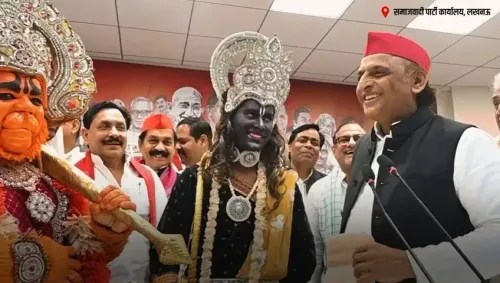
Samajwadi Party president Akhilesh Yadav on Saturday, 27 June 2026 pledged to transform Ayodhya into an unparalleled religious city if the Samajwadi Party forms the next government in Uttar Pradesh, promising to restore the city's traditional spiritual character and the rights of its residents.
Context
In his post, Akhilesh Yadav declared: 'हम धर्मनिष्ठता और सत्यनिष्ठता के साथ ये संकल्प लेते हैं' ('We take this pledge with devotion and integrity') that a new government formed by the party will develop Ayodhya as a 'unique and exemplary religious city' where pilgrims from across the world will experience 'unparalleled true spirituality.' He further committed to re-establishing and nurturing Ayodhya's 'Sanatan dignity' as a 'Siyaram-Dham' — a sacred abode of Sita and Rama — grounded in faith, unwavering belief, and genuine devotion. The post also specifically promised to 're-establish the traditional pride and rights of Ayodhya's residents.'
The statement is notable for its invocation of Sanatan Dharma and the phrase 'Siyaram-Dham', framing Samajwadi Party's vision as one of spiritual authenticity rather than infrastructure-led development. This marks a deliberate rhetorical positioning ahead of the 2027 Uttar Pradesh Assembly Elections.
Policy Backdrop
The Supreme Court of India delivered its landmark verdict in November 2019, directing that the disputed site in Ayodhya be allotted for construction of a Ram Temple, while providing an alternative plot for a mosque. The Ram Temple was consecrated in January 2024 by Prime Minister Narendra Modi in a nationally televised ceremony, after which the Uttar Pradesh government undertook extensive infrastructure, beautification, and religious tourism projects in the city.
The BJP-led state government has positioned Ayodhya as a centrepiece of its governance record, investing heavily in road widening, airport development, hotel infrastructure, and ghats along the Saryu river. Akhilesh Yadav's pledge implicitly critiques this model, suggesting that large-scale state-driven development has come at the cost of the city's organic spiritual character and the livelihoods and customary rights of long-time residents.
Stakeholders and Impact
Ayodhya's residents — including priests, small traders, traditional custodians of temples, and families displaced or affected by infrastructure projects — are the primary constituency invoked in the pledge. The Samajwadi Party has historically drawn support from Other Backward Classes (OBCs) and minority communities in Uttar Pradesh, and this statement signals an effort to also appeal to devout Hindu pilgrims and local stakeholders in the temple city.
Hindu pilgrims visiting Ayodhya from across India and abroad stand to be impacted by any policy shift in how the city is governed and developed. The framing of Ayodhya as 'Siyaram-Dham' is also directed at voters who may feel the city's traditional religious atmosphere has been overshadowed by commercialisation accompanying the post-consecration development drive.
What's Next
The pledge is likely to intensify the political contest over Ayodhya's identity and development model as the 2027 Uttar Pradesh Assembly Elections approach. The BJP government in Lucknow is expected to respond by highlighting its own record of temple construction and infrastructure investment in the city. Observers will watch whether the Samajwadi Party translates this statement into a detailed policy manifesto on Ayodhya's governance, heritage conservation, and the specific rights it promises to restore for local residents.
The broader contest over Ayodhya's future will serve as a key indicator of how competing visions of religious heritage, urban development, and community rights shape the electoral narrative in Uttar Pradesh over the next year.
Point of View
The SP attempts to peel away voters who feel commercialisation has diluted the city's sacred character. This mirrors a broader national trend of opposition parties seeking to engage with Hindu religious sentiment on their own terms rather than ceding that space entirely to the ruling party. The pledge's vagueness on specifics, however, means its electoral impact will depend heavily on whether the party can articulate a concrete and credible alternative development vision before 2027.
NationPress
26 Sept 2026
Frequently Asked Questions
What did Akhilesh Yadav say about Ayodhya?
Akhilesh Yadav pledged on 27 June 2026 that if the Samajwadi Party forms the next Uttar Pradesh government, it will develop Ayodhya as a 'Siyaram-Dham' — an unparalleled religious city offering authentic spiritual experience to pilgrims worldwide — and will restore the traditional rights and pride of Ayodhya's residents.
What is 'Siyaram-Dham' that Akhilesh Yadav mentioned?
'Siyaram-Dham' refers to a sacred abode of Sita (Siya) and Rama, invoking the divine couple central to Sanatan Hindu tradition. Akhilesh Yadav used the term to describe his vision of Ayodhya as a city defined by genuine faith and devotion rather than state-driven infrastructure development.
Why is Ayodhya politically significant in Uttar Pradesh?
Ayodhya is the site of the Ram Temple consecrated in January 2024 following the Supreme Court's November 2019 verdict on the Ram Janmabhoomi dispute. The city has since become a focal point of religious tourism and electoral politics in Uttar Pradesh, with both the BJP and opposition parties advancing competing visions for its development ahead of the 2027 state assembly elections.
What is the Samajwadi Party's stance on the Ram Temple?
The Samajwadi Party has accepted the Supreme Court's 2019 verdict on the Ram Temple. Akhilesh Yadav's June 2026 post does not challenge the temple's existence but instead contests the BJP's model of development around it, arguing that Ayodhya's true spiritual character and the rights of its residents must be restored.
When are the next Uttar Pradesh Assembly Elections?
The next Uttar Pradesh Assembly Elections are scheduled for 2027. Akhilesh Yadav's Ayodhya pledge is widely seen as an early campaign statement positioning the Samajwadi Party's governance vision against the incumbent BJP government's record in the state.