Owaisi Questions 'B Team' Label in Indian Politics
Synopsis
AIMIM president Asaduddin Owaisi challenged the 'B Team' label on 11 August 2026, questioning whether the charge is applied selectively in Indian politics and whether it belongs only to what he called the 'LAILA' of Indian politics.
Key Takeaways
Asaduddin Owaisi posted a pointed rhetorical question on 11 August 2026 challenging the 'B Team' label in Indian politics.
The term 'B Team' is commonly used in Indian political discourse to allege that a party acts as a proxy or vote-splitter for a rival.
Owaisi referenced an entity he called 'LAILA,' implying the label is applied selectively rather than consistently.
AIMIM has itself been repeatedly accused of being a 'B Team' in multi-cornered electoral contests, particularly in Uttar Pradesh and Maharashtra .
The post named no party or individual directly, relying on implication to make its argument.
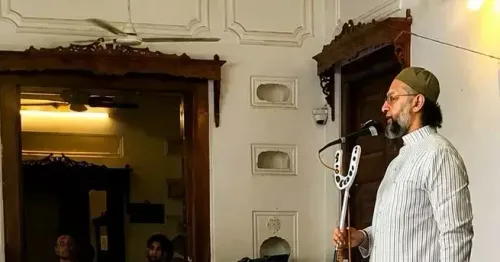
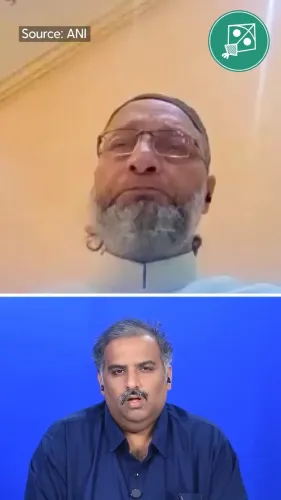
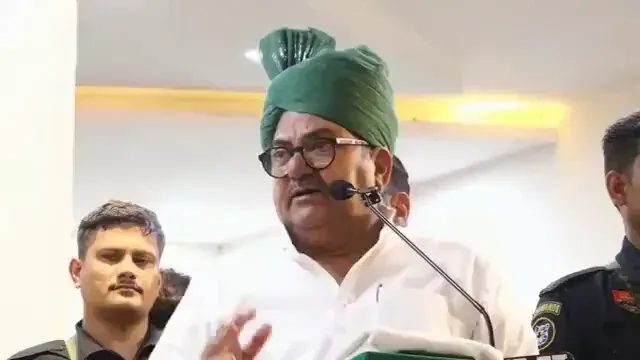
A four-word question landed on Indian political timelines on Tuesday, 11 August 2026, and it carried the sharpest kind of sting — the rhetorical kind. AIMIM president Asaduddin Owaisi, Lok Sabha MP from Hyderabad, turned a well-worn political insult back on itself, asking who exactly qualifies as the 'B Team' in Indian politics — and whether that label belongs exclusively to what he called the 'LAILA' of Indian politics.
The 'B Team' Charge and Who It Usually Hits
The term 'B Team' has circulated in Indian political discourse for years, used by rival parties to allege that a smaller or regional outfit is secretly propping up a larger opponent — doing its dirty work without owning the agenda. The accusation has been levelled across the political spectrum: against regional parties, against independents, and — repeatedly — against AIMIM itself, whose candidates in tight multi-cornered contests have drawn charges of splitting the anti-BJP vote.
Owaisi has never accepted that framing. His post flips the script: if 'B Team' is a meaningful charge, he is asking, who is the original 'A Team' — and who is the real subordinate player? The reference to 'LAILA' appears to invoke a colloquial political nickname, though the specific target of the allusion was not spelled out in the post itself.
Why the Jab Lands the Way It Does
The power of the post is its economy. No names, no party abbreviations, no manifesto language — just a question that forces the reader to fill in the blank. That is a deliberate rhetorical move: by leaving 'LAILA' undefined, Owaisi invites multiple interpretations while keeping himself insulated from a direct accusation. It is political commentary as a koan.
The broader pattern matters here. Indian opposition politics has been marked by persistent arguments over who is genuinely independent and who is a convenient foil. For a party like AIMIM, which contests seats in Hyderabad, Maharashtra, and parts of Uttar Pradesh, the 'B Team' charge is not abstract — it is an electoral weapon used to delegitimise the party's presence on the ballot.
Owaisi's counter-question does not answer the charge so much as contest the premise: if the label can be applied selectively, it stops being analysis and starts being a political convenience.
Whether the jab lands a response from the unnamed 'LAILA' of Indian politics — or simply hangs in the air as a provocation — is now the only question left on the table.
Point of View
He exposes the term's selective deployment as a rhetorical weapon rather than a neutral analytical category. The reference to 'LAILA' suggests a specific target within opposition dynamics, though the deliberate ambiguity gives him room to deny a direct accusation. This fits a broader pattern in which smaller parties push back against the binary framing imposed by larger blocs. The exchange, if it generates responses, could sharpen the debate over political independence versus strategic alignment ahead of future electoral cycles.
NationPress
11 Aug 2026
Frequently Asked Questions
What does 'B Team' mean in Indian politics?
'B Team' is a charge used to allege that a political party secretly helps a rival by splitting votes or diverting opposition support, effectively acting as the rival's proxy without admitting it.
Why is AIMIM called a 'B Team' by some parties?
Critics allege that AIMIM candidates in close multi-cornered contests draw votes away from larger opposition parties, indirectly benefiting the BJP . Owaisi has consistently denied this framing.
Who is 'LAILA' in Owaisi's tweet?
Owaisi did not name anyone explicitly. The reference to 'LAILA' appears to be a colloquial political nickname, but the specific target was not verified from available information.
What did Asaduddin Owaisi post on 11 August 2026?
Owaisi posted a rhetorical question asking who qualifies as the 'B Team' in Indian politics and whether the label is applied only to the 'LAILA' of Indian politics, attaching a video to the post.
Is Asaduddin Owaisi in the opposition?
Asaduddin Owaisi is president of AIMIM and Lok Sabha MP from Hyderabad . AIMIM operates independently and is not formally part of any national opposition alliance.