Akhilesh Yadav: 'What is Sanatan is Socialism'
Synopsis
Samajwadi Party president Akhilesh Yadav posted 'Jo Sanatan hai, vahi Samajwad hai!' on 9 July 2026, equating eternal civilisational values with socialism — a sharp ideological move to reclaim cultural vocabulary from the BJP ahead of the 2027 Uttar Pradesh assembly elections.
Key Takeaways
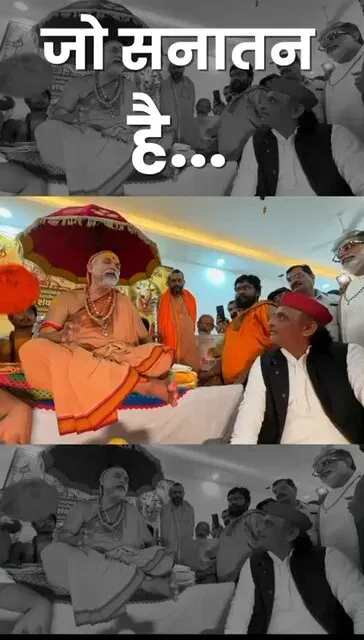
Akhilesh Yadav posted ' Jo Sanatan hai, vahi Samajwad hai! ' ('What is eternal is Socialism!') on X on 9 July 2026 .
The post was accompanied by a video , suggesting the line originated in a public speech or address.
The formulation draws on the Lohiaite tradition of grounding socialism in Indian civilisational identity rather than Western political theory.
The Samajwadi Party was founded in 1992 by Mulayam Singh Yadav on principles of democratic socialism, secularism and anti-caste politics.
The statement targets OBC, Muslim and swing voters in Uttar Pradesh ahead of the 2027 state assembly elections .
The move reflects a broader pattern of opposition parties contesting the BJP's ownership of cultural and Sanatan vocabulary in Indian politics.
Samajwadi Party president Akhilesh Yadav on Thursday, 9 July 2026, posted a pointed ideological assertion on X, declaring 'Jo Sanatan hai, vahi Samajwad hai!' — 'What is eternal (Sanatan) is Socialism' — in a move that blends cultural idiom with the party's foundational socialist creed.
Context
The six-word post — 'Jo Sanatan hai, vahi Samajwad hai!' ('What is eternal is Socialism!') — is a rhetorical equation that plants the Samajwadi Party's socialist identity squarely within the language of Indian civilisational continuity. By invoking the word Sanatan, long associated with Hindu tradition and used prominently by the ruling BJP and its ideological ecosystem, Akhilesh Yadav appears to contest the ownership of that vocabulary rather than cede it to opponents.
The post was accompanied by a video, the contents of which are consistent with a speech or public address format, suggesting the line may have originated in a live address before being amplified on social media.
Policy Backdrop
The Samajwadi Party was founded in 1992 by Mulayam Singh Yadav on the twin pillars of democratic socialism and Lohiaite anti-caste politics — a tradition rooted in the thought of Ram Manohar Lohia, who argued that social justice and Indian cultural identity were inseparable. That lineage provides the intellectual scaffolding for Akhilesh Yadav's formulation: socialism, in this reading, is not a Western import but a value as old and enduring as civilisation itself.
During his tenure as Chief Minister of Uttar Pradesh from 2012 to 2017, Akhilesh Yadav positioned the party as a champion of welfare for OBC communities, farmers and youth while projecting a secular image. Since the BJP's consolidation of the Hindutva narrative in Uttar Pradesh after 2014, opposition parties — including the Samajwadi Party — have grappled with how to engage voters on questions of culture and identity without abandoning their secular foundations.
Stakeholders and Impact
The statement is directed at multiple audiences simultaneously. For the party's core OBC and Muslim voter base in Uttar Pradesh, it reaffirms that socialism — and by extension social justice — is a timeless, non-negotiable value. For swing voters drawn to cultural messaging, it signals that the Samajwadi Party does not regard Sanatan as the exclusive property of any single political formation.
Indian regional socialist parties have periodically sought to reinterpret cultural or religious idioms to broaden their appeal, and this post fits that pattern. The framing is notably compact and slogan-ready, suggesting it is designed for wide circulation ahead of what will be an intensely contested electoral cycle in Uttar Pradesh.
What's Next
All eyes will be on how the BJP and allied voices respond to Akhilesh Yadav's appropriation of Sanatan vocabulary, and whether the Samajwadi Party develops this formulation into a sustained campaign theme. With the 2027 Uttar Pradesh assembly elections on the horizon, ideological positioning on culture, identity and social justice is expected to intensify across party lines. Any parliamentary interventions or public addresses by Akhilesh Yadav that expand on this equation will be closely watched by political observers and rival parties alike.
Point of View
He attempts to deny the BJP exclusive claim over civilisational language without abandoning the SP's secular and social-justice identity. The move fits a recurring pattern in Indian opposition politics — reclaiming rather than retreating from the cultural terrain that has defined electoral battles in Uttar Pradesh since 2014. Rooted in Ram Manohar Lohia's argument that caste annihilation and Indian cultural pride were complementary, not contradictory, the formulation has intellectual precedent even if its political potency remains to be tested. With the 2027 UP assembly elections approaching, this kind of slogan-ready ideological reframing signals that the Samajwadi Party intends to fight on cultural ground, not merely concede it.
NationPress
7 Oct 2026
Frequently Asked Questions
What did Akhilesh Yadav say about Sanatan and Socialism?
On 9 July 2026 , Akhilesh Yadav posted ' Jo Sanatan hai, vahi Samajwad hai! ' on X, which translates as 'What is eternal (Sanatan) is Socialism!' — equating the concept of civilisational continuity with the Samajwadi Party's founding socialist ideology.
Why did Akhilesh Yadav use the word Sanatan?
The word Sanatan , meaning 'eternal' or 'timeless,' has been prominently associated with Hindu tradition and the BJP's cultural narrative. By using it, Akhilesh Yadav appears to contest that ownership and argue that socialism — rooted in social justice — is itself an eternal Indian value.
What is the Samajwadi Party's ideological foundation?
The Samajwadi Party was founded in 1992 by Mulayam Singh Yadav on democratic socialism, secularism and Lohiaite anti-caste politics, drawing on the thought of socialist thinker Ram Manohar Lohia .
How does this statement relate to the 2027 UP elections?
With the 2027 Uttar Pradesh assembly elections on the horizon, the post is widely seen as part of the Samajwadi Party's effort to broaden its cultural appeal and challenge the BJP's dominance of identity-based messaging in India's most populous state.
What is Lohiaite socialism?
Lohiaite socialism refers to the political philosophy of Ram Manohar Lohia , which combined democratic socialism with a strong emphasis on caste annihilation, Indian cultural identity and opposition to both Western capitalism and Soviet-style communism — the tradition on which the Samajwadi Party was built.