Akhilesh Yadav accuses BJP of betraying faith at Ram Temple Trust
Synopsis
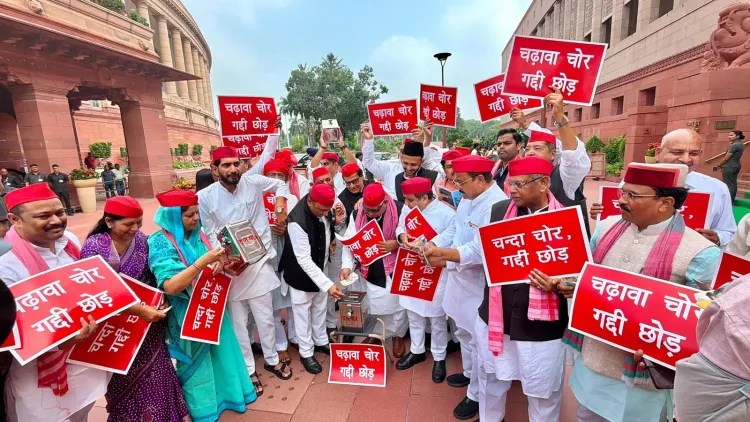
Samajwadi Party president Akhilesh Yadav has accused the BJP and its allies of a sweeping series of financial and procedural violations at the Shri Ram Janmabhoomi Teerth Kshetra Trust, calling it a betrayal of devotees' faith and vowing to raise the issue in Parliament.
Key Takeaways
Akhilesh Yadav posted a 12-point charge sheet on 30 July 2026 accusing BJP-linked individuals of corruption within the Shri Ram Janmabhoomi Teerth Kshetra Trust .
Allegations include theft from donation boxes, forged donation receipts, and anonymous-donation irregularities at the Ayodhya temple.
Yadav claims BJP allies bought Ayodhya land cheaply and resold it to the trust at twenty times the price , looting crores from the trust's religious fund.
The post alleges destruction of CCTV footage, removal of honest officials, and self-investigation by those under scrutiny.
Yadav frames raising the issue in Parliament as a 'religiously sanctioned civic duty' and calls BJP allies 'destroyers of Ram.' The Ram Janmabhoomi Trust was formed by the central government in February 2020 following the Supreme Court's 2019 Ayodhya verdict; the BJP and trust have not yet publicly responded to these specific charges.
Faith weaponised, then allegedly looted — that is the charge Samajwadi Party president Akhilesh Yadav has levelled at the Bharatiya Janata Party in a blistering post on Thursday, 30 July 2026, targeting the financial management of the Shri Ram Janmabhoomi Teerth Kshetra Trust in Ayodhya.
Yadav's post, written in Hindi, frames the allegations as nothing short of a sacred betrayal — 'आस्था के साथ विश्वासघात का महापाप' ('the mortal sin of betraying faith') — and lists more than a dozen specific charges against the BJP and its allies in the trust's administration.
A twelve-point charge sheet against the Trust
The Samajwadi Party chief's accusations span financial, procedural, and evidentiary domains. He alleges that BJP-linked individuals stole from donation boxes (daan-paatra), conducted large-scale irregularities in anonymous donations, and either withheld official receipts or issued forged ones in their place.
On land, Yadav's charge is pointed: that BJP-affiliated persons bought Ayodhya land at throwaway prices and then sold it to the temple trust at prices twenty times higher, siphoning crores from the trust's religious fund (dharm-khaata). He further alleges that profits from these land deals were distributed among insiders.
The post also accuses the trust's administration of removing honest officials who raised objections, planting loyalists in key positions, failing to log recovered stolen amounts, and misleading investigators by claiming nothing 'noteworthy' was found. Most seriously, Yadav alleges that CCTV recordings and other evidence were destroyed, that those under investigation were allowed to conduct the investigation themselves, and that senior trust officials received clean chits without any accountability being fixed. He ends with the claim that temple funds and precious metals were packed into sacks and moved elsewhere.
Why Yadav calls it a duty to raise this in Parliament
Yadav's framing is deliberate: he does not present the allegations merely as political criticism but as a moral and civic obligation — 'लोक-संसद तक पहुँचाना हम सब का धर्म सम्मत कर्तव्य है' ('it is the religiously sanctioned duty of all of us to bring the issue of looting public money to Parliament'). The closing line is a direct political dart: 'जो भाजपा का साथी, वो रामघाती-महापापी' — 'Whoever is BJP's ally is a destroyer of Ram and a great sinner.'
The Ayodhya Trust and the opposition's running audit
The Shri Ram Janmabhoomi Teerth Kshetra Trust was constituted by the central government in February 2020, following the Supreme Court of India's landmark 2019 verdict resolving the decades-long Ayodhya title dispute. The trust oversees construction and management of the Ram temple, which was consecrated in 2024 in a ceremony that drew national attention.
Since the trust's formation, opposition parties — led prominently by the Samajwadi Party in Uttar Pradesh — have repeatedly raised questions about land transactions and financial oversight. The BJP and the trust have not yet issued a formal response to this specific post. Any parliamentary escalation would likely surface during the next session of Lok Sabha, where Yadav sits as an MP.
The allegations in the post — including specifics on CCTV evidence and ongoing probes — have not been independently corroborated from public records, and the trust and BJP have not confirmed or denied them.
If even a fraction of these charges finds traction in Parliament, the Ram temple trust's governance could become the defining accountability flashpoint of the monsoon session.
Point of View
He attempts to shift the Ayodhya narrative from BJP's electoral asset to a liability. This mirrors a broader opposition strategy of using trust-governance questions to erode the BJP's claim to being the sole custodian of Hindu faith. The absence of a formal BJP or trust rebuttal so far leaves the charges politically unanswered, which could amplify their traction heading into the next parliamentary session.
NationPress
30 Jul 2026
Frequently Asked Questions
What are Akhilesh Yadav's allegations against the Ram Temple Trust?
Akhilesh Yadav has accused BJP-linked individuals of stealing from donation boxes, issuing forged receipts, orchestrating land deals that overcharged the temple trust by up to twenty times the purchase price, destroying CCTV evidence, removing honest officials, and moving temple funds and precious metals to unknown locations.
What is the Shri Ram Janmabhoomi Teerth Kshetra Trust?
The Shri Ram Janmabhoomi Teerth Kshetra Trust is a body constituted by the Indian central government in February 2020 to oversee the construction and management of the Ram temple in Ayodhya, following the Supreme Court's 2019 verdict on the Ayodhya title dispute.
Has the BJP or the Ram Temple Trust responded to Akhilesh Yadav's allegations?
As of the time of this report, neither the BJP nor the Shri Ram Janmabhoomi Teerth Kshetra Trust has issued a formal public response to the specific allegations made in Yadav's 30 July 2026 post.
What does Akhilesh Yadav mean by raising the issue in 'lok-sansad'?
Yadav uses 'lok-sansad' to refer to Parliament, specifically the Lok Sabha where he serves as an MP. He is signalling his intent to formally raise these corruption allegations on the parliamentary floor, framing it as a civic and moral duty.
Why is Ayodhya temple trust governance a political issue?
The Ram temple in Ayodhya is one of India's most politically significant religious sites. Since the trust's formation in 2020, opposition parties — particularly the Samajwadi Party in Uttar Pradesh — have questioned its land transactions and financial transparency, making trust governance a recurring flashpoint between the BJP and opposition.