Akhilesh Yadav: Only PDA Govt Can End Caste Inequality

Synopsis
Samajwadi Party president Akhilesh Yadav declared on 19 October 2026 that caste-based 'pain, humiliation, and suffering' persists even in prisons, and argued that only a PDA government can deliver true social justice — a message aimed squarely at OBC, Dalit, and minority voters in Uttar Pradesh.
Key Takeaways
Akhilesh Yadav posted on 19 October 2026 asserting that caste discrimination now draws eyewitness accounts even from foreign observers.
He argued that members of PDA society — OBCs, Dalits, and minorities — face 'pain, suffering, and humiliation' based on caste whether inside prison or outside.
Yadav declared that a PDA government is the 'only option' to eliminate caste-based inequality at its root.
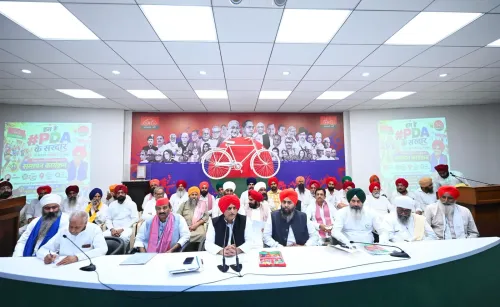
The Samajwadi Party 's PDA alliance has been its primary electoral consolidation strategy across multiple Uttar Pradesh election cycles.
The post echoes a policy lineage dating to the Mandal Commission recommendations of 1990 , which first institutionalised OBC reservations.
The specific reference to caste discrimination inside jails signals an attempt to link institutional failures to the broader social-justice argument.
Caste discrimination does not end at India's borders — and now, Samajwadi Party president Akhilesh Yadav says even foreign observers are saying so out loud. On Monday, 19 October 2026, Yadav took to X with a pointed political message, arguing that the suffering born of caste identity follows people everywhere — inside prison walls and outside them — and that only a PDA (Pichhda-Dalit-Alpsankhyak) government can uproot it.
In his post, Yadav wrote: 'Ye bahut durbhagyapurn hai ki ab toh videshi bhi jaati ke bhed se janam lenewale bhedbhav ka aankhon dekha haal bata rahe hain' — 'It is very unfortunate that even foreigners are now giving eyewitness accounts of discrimination rooted in caste of birth.' The remark, while unspecific about which foreign voices he is referencing, frames caste bias as a reality that has crossed beyond domestic debate into international visibility.
Pain, Humiliation, and the PDA Framing
Yadav did not soften the language. He stated that no member of PDA society — whether inside jail or free — is spared 'pain, suffering, and humiliation' on account of caste. The Hindi phrase he used, 'peeda, dukh aur apman,' carries deliberate rhetorical weight: it collapses the distinction between legal incarceration and social life, arguing that caste functions as its own permanent sentence.
This framing is central to the Samajwadi Party's political architecture. The PDA alliance — comprising Other Backward Classes (OBCs), Dalits, and religious minorities — has been the party's primary consolidation strategy across recent election cycles in Uttar Pradesh, India's most populous state. Yadav closed his post with a campaign-ready declaration: 'PDA sarkar aayegi, samajik nyay ka raaj layegi' — 'The PDA government will come and bring the reign of social justice.'
From Mandal to PDA: A Long Policy Lineage
The political ground Yadav is planting his flag on has been tilled for decades. The Mandal Commission recommendations, implemented in 1990, first codified OBC reservations as a state remedy for caste inequality. The Samajwadi Party, founded on socialist principles, built successive governments in Uttar Pradesh — in 1993–95, 2003–07, and 2012–17 — that introduced targeted welfare for backward classes and minorities.
Each cycle has sharpened the messaging. The current PDA formulation is arguably the most explicit attempt yet to name and unify the coalition: backward castes, Scheduled Castes, and minorities as a single political bloc with a single grievance — the persistence of caste-based hierarchy in public life and institutions.
Why the 'Jail' Reference Matters
The specific mention of people 'inside jail' is not incidental. Caste discrimination within Indian prisons — from work assignments to cell allotments — has been a documented point of civil-society advocacy for years. By invoking it, Yadav connects an institutional failure to the broader social argument, suggesting that state apparatus itself has not been neutral. It is a pointed rhetorical move aimed at voters who know the difference between law on paper and life as lived.
With Uttar Pradesh politics perpetually in motion and caste-census demands growing louder at the national level, Yadav's post is less a one-off comment and more a marker: the PDA social-justice frame is being refreshed and amplified ahead of the next political contest. Whether it translates into votes will depend on organisation, but the argument itself is sharp — and it is getting an international footnote.
Point of View
Terrain where the PDA coalition's grievances are most visceral. Against the backdrop of growing national demand for a caste census, this messaging positions the Samajwadi Party as the vanguard of a structural reckoning — not merely a beneficiary of caste arithmetic. The risk is that the argument remains aspirational rhetoric without a concrete policy ladder to climb.
NationPress
19 Oct 2026
Frequently Asked Questions
What is the PDA alliance that Akhilesh Yadav keeps talking about?
PDA stands for Pichhda-Dalit-Alpsankhyak — a coalition of Other Backward Classes, Dalits (Scheduled Castes), and religious minorities. The Samajwadi Party uses it as a unifying political identity to consolidate non-upper-caste voters, particularly in Uttar Pradesh.
What did Akhilesh Yadav say about caste discrimination on 19 October 2026?
Yadav said it is 'very unfortunate' that even foreign observers are now giving eyewitness accounts of caste-based discrimination. He argued that PDA communities face 'pain, suffering, and humiliation' due to caste — inside prisons and outside — and that only a PDA government can eliminate this inequality.
Why did Akhilesh Yadav mention caste discrimination inside jails?
Yadav used the prison reference to argue that caste hierarchy operates even within state institutions, not just in social spaces. It is a rhetorical device to show that the problem is structural and institutional, not merely cultural.
What is the Samajwadi Party's history on OBC and Dalit rights?
The Samajwadi Party has governed Uttar Pradesh across multiple terms — 1993–95, 2003–07, and 2012–17 — and introduced targeted welfare measures for backward classes and minorities in each. The party was also formed in the wake of the 1990 Mandal Commission OBC reservation movement.
What is the caste census demand and how does it connect to this post?
The caste census demand calls for an enumeration of OBC and other caste populations to better calibrate reservations and welfare. Yadav's post aligns with this demand's spirit by asserting that caste inequality is deep, documented, and requires structural government intervention — not just policy tweaks.